2026-07-19

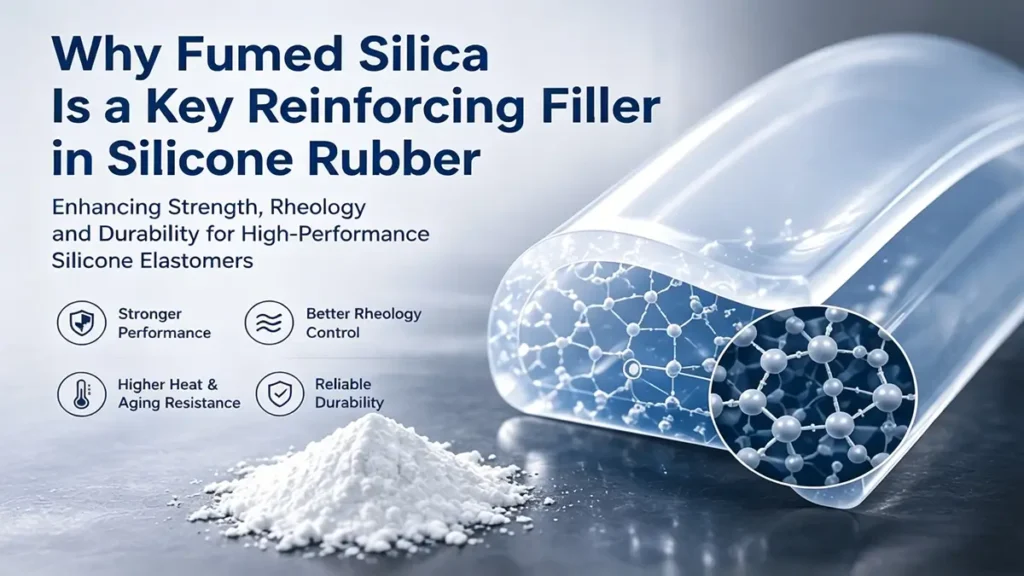
As the demand for high-performance silicone materials continues to grow in industries such as automotive, electronics, medical devices, construction sealants, and energy storage, manufacturers are increasingly relying on fumed silica to improve silicone rubber performance.
Pure silicone rubber offers excellent flexibility, thermal stability, and weather resistance, but its mechanical strength is relatively low. To overcome these limitations, fumed silica for silicone rubber has become the industry-standard reinforcing filler due to its nano-scale particle structure, high surface area, and outstanding compatibility with silicone polymers.
Today, both hydrophilic and hydrophobic fumed silica are widely used in RTV silicone sealants, HTV silicone rubber, liquid silicone rubber (LSR), and specialty silicone elastomers requiring high tensile strength, anti-sag performance, and rheology control.
As a professional silicone materials brand, Silico® continues to focus on high-quality silicone additive solutions for advanced industrial applications.
Fumed silica, also known as pyrogenic silica, is an ultra-fine amorphous silicon dioxide produced through flame hydrolysis technology. It features:
Because silicone rubber contains a similar Si–O–Si backbone structure, fumed silica demonstrates exceptional compatibility with silicone polymers. This makes it one of the most effective reinforcing fillers for silicone elastomers.
Compared with conventional fillers, high surface area fumed silica provides superior reinforcement, rheology control, and anti-settling performance in silicone formulations.
Unfilled silicone rubber is naturally soft and lacks sufficient mechanical strength for demanding industrial applications.
Without reinforcement, silicone elastomers may suffer from:To improve these properties, manufacturers commonly use fumed silica reinforcing fillers in silicone compounds. The addition of nano-scale silica significantly enhances the durability and structural performance of silicone rubber products.
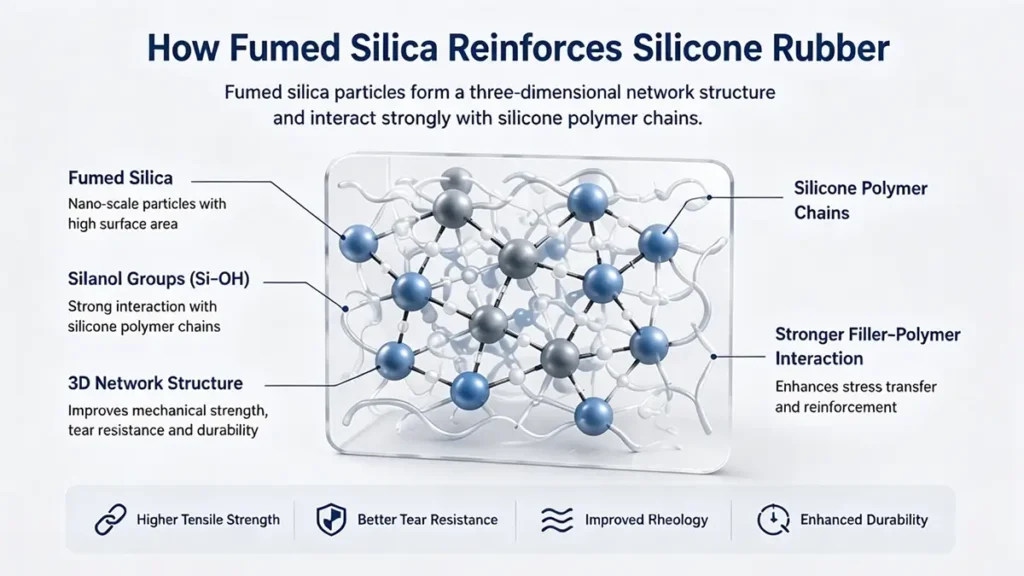
The surface of fumed silica contains abundant silanol groups (Si–OH), which strongly interact with silicone polymer chains. These interactions form a three-dimensional filler network throughout the silicone matrix.
This network improves:Because of its ultra-fine particle structure, fumed silica for RTV silicone sealants also provides excellent thixotropy and anti-sag behavior.
Another important reinforcement mechanism is the formation of bound rubber.
Part of the silicone polymer becomes attached to the silica surface, creating a stable interfacial layer that improves stress transfer between filler particles and the silicone matrix.
This effect greatly enhances the mechanical performance of silicone elastomers used in automotive, electronics, and industrial sealing applications.
Compared with conventional mineral fillers, nano-scale fumed silica offers a much larger surface contact area with silicone polymer chains.
As a result, it delivers:
Many manufacturers now prefer hydrophobic fumed silica for silicone rubber because it provides better dispersion and lower moisture sensitivity.
At present, Silico® is also focusing on advanced silicone additive technologies designed to improve filler dispersion and processing efficiency in modern silicone elastomer systems.
This is why it is widely considered the best reinforcing filler for high-performance silicone rubber applications.
Unlike many conventional fillers, fumed silica can maintain excellent optical clarity.
This makes it ideal for:One of the biggest advantages of fumed silica rheology modifiers is their ability to provide controlled flow behavior.
In RTV sealants and adhesives, fumed silica helps:Fumed silica also improves the long-term stability of silicone rubber under harsh environments.
Enhanced properties include:These characteristics are especially important in automotive, aerospace, and electronic insulation applications.
These grades are commonly used in HTV silicone rubber and general-purpose RTV formulations.
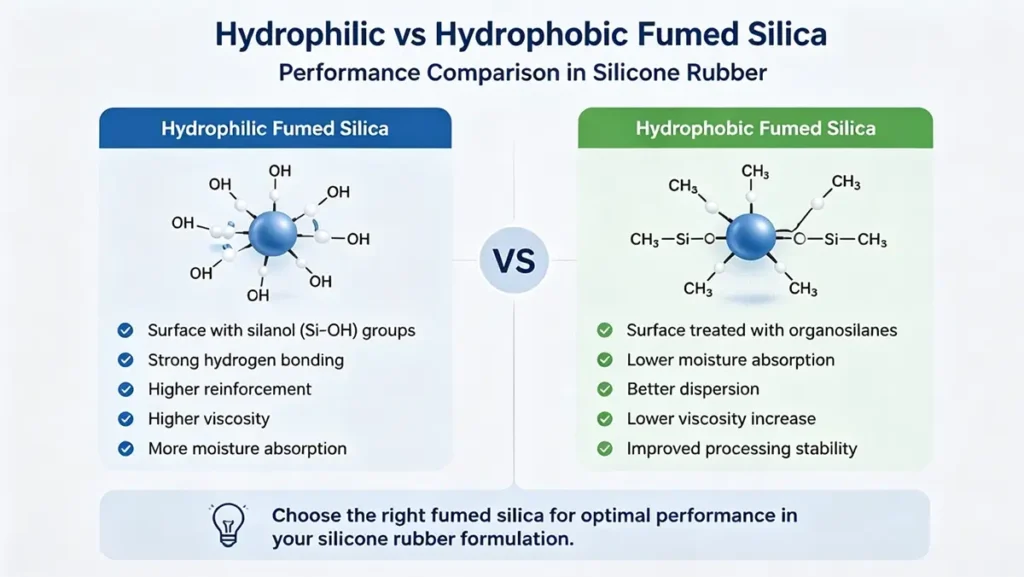
Hydrophobic grades are surface-treated with organosilanes or siloxanes.
Key advantages include: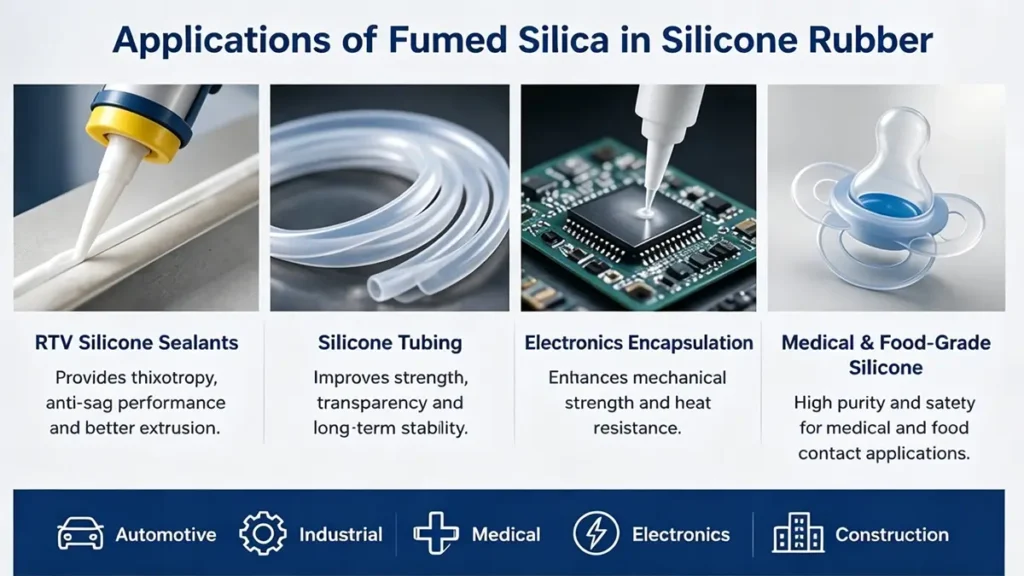
This makes it essential in construction and industrial silicone sealants.
Due to its high purity, fumed silica is widely used in:
As global demand for premium silicone materials continues to increase, Silico® remains committed to supplying reliable silicone additive solutions for industrial and specialty silicone applications.
Typical fumed silica loading levels include:
| Silicone System | Typical Loading |
|---|---|
| RTV Silicone Sealants | 3–30 wt% |
| HTV Silicone Rubber | 5–35 wt% |
| Liquid Silicone Rubber | 5–30 wt% |
Because fumed silica particles tend to agglomerate, achieving uniform dispersion can be difficult.
Common solutions include:High surface area silica can significantly increase compound viscosity.
Hydrophobic surface treatment technologies are often used to improve processing stability while maintaining reinforcement performance.
| Property | Fumed Silica | Precipitated Silica |
|---|---|---|
| Particle Size | Nano-scale | Larger particles |
| Reinforcement | Excellent | Moderate |
| Transparency | High | Lower |
| Rheology Control | Superior | Moderate |
| Mechanical Strength | Higher | Lower |
| Processing Difficulty | Higher | Easier |
With the rapid development of electric vehicles, electronics, renewable energy, and medical technology, the demand for advanced silicone materials continues to rise.
Future trends include:
These developments are expected to further improve silicone rubber performance, processing efficiency, and long-term durability.
Fumed silica remains the most important reinforcing filler in silicone rubber because of its ability to significantly improve mechanical strength, rheology control, thermal stability, transparency, and anti-sag performance.
Its nano-scale structure and strong interaction with silicone polymer chains make it essential in RTV silicone sealants, HTV silicone rubber, liquid silicone rubber, and advanced industrial silicone elastomers.
As demand for high-performance silicone materials continues to grow, the role of fumed silica in silicone rubber applications will become even more important across automotive, electronics, medical, and construction industries.
Fumed silica is mainly used as a reinforcing filler in silicone rubber to improve tensile strength, tear resistance, rheology control, and anti-sag performance in RTV, HTV, and LSR systems.
Fumed silica offers higher reinforcement efficiency, better transparency, stronger mechanical properties, and improved rheology control compared with precipitated silica.
Hydrophilic fumed silica provides stronger thickening and reinforcement, while hydrophobic fumed silica offers better moisture resistance, dispersion, and processing stability in silicone formulations.
Typical loading levels range from 3–35 wt%, depending on the silicone system and required performance properties such as reinforcement, viscosity control, and thixotropy.
Yes. Fumed silica helps improve thermal stability, aging resistance, compression set resistance, and long-term durability in high-performance silicone rubber applications.