2026-07-19

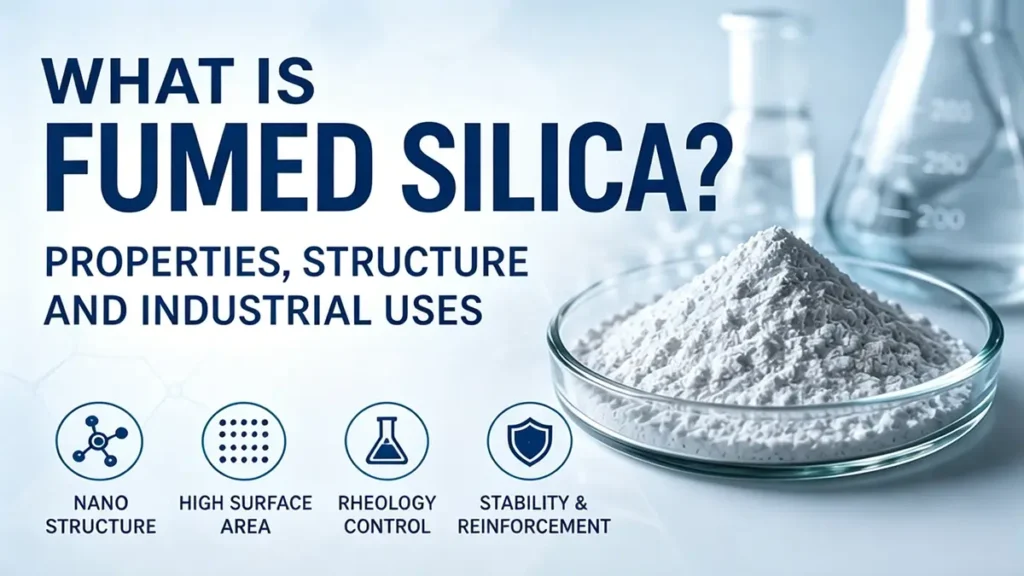
Fumed silica (pyrogenic silica) is a high-performance nano-scale silicon dioxide (SiO₂) widely used as a rheology modifier, thickening agent, anti-settling additive, and reinforcing filler in advanced industrial formulations. Owing to its ultrafine particle size, extremely high specific surface area, and reactive surface chemistry, it plays a critical role in silicone rubber systems (LSR, HTV, RTV), adhesives and sealants, coatings, cosmetics, and pharmaceutical applications.
With growing demand for hydrophobic surface-treated silica, high BET surface area grades, and fumed silica for silicone rubber and RTV sealants, this material has become indispensable in modern material engineering.
👉 For consistent quality and tailored formulations, industrial suppliers such as Silico® provide customized fumed silica solutions for global applications.
Fumed silica is a synthetic, amorphous nano silica powder produced under high-temperature conditions. It is characterized by:
Compared with other silica forms, such as precipitated silica, fumed silica offers superior thickening efficiency, stronger reinforcement capability, and more effective rheological control, making it particularly suitable for high-performance systems.
Its CAS numbers, commonly referenced in procurement and regulatory contexts, include 112945-52-5 and 7631-86-9.
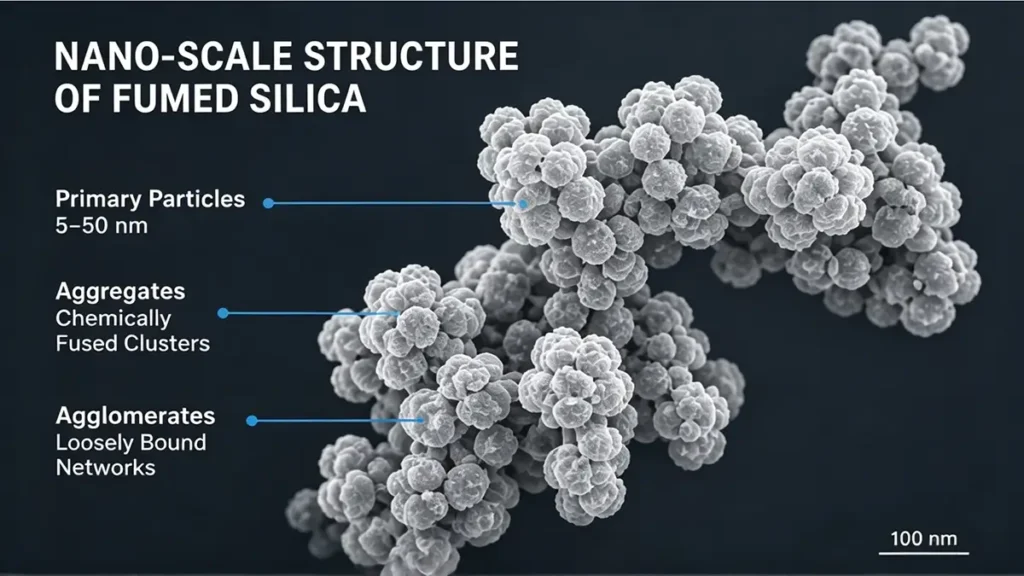
This method yields:
The resulting morphology is fundamental to its performance as a rheology control additive and thixotropic agent.
Fumed silica exhibits a hierarchical structure that directly determines its functional behavior.
The surface is rich in silanol groups (Si–OH), which enable:
This structure is responsible for its ability to impart thixotropy, viscosity control, and anti-settling performance in formulations such as coatings, sealants, and adhesives.
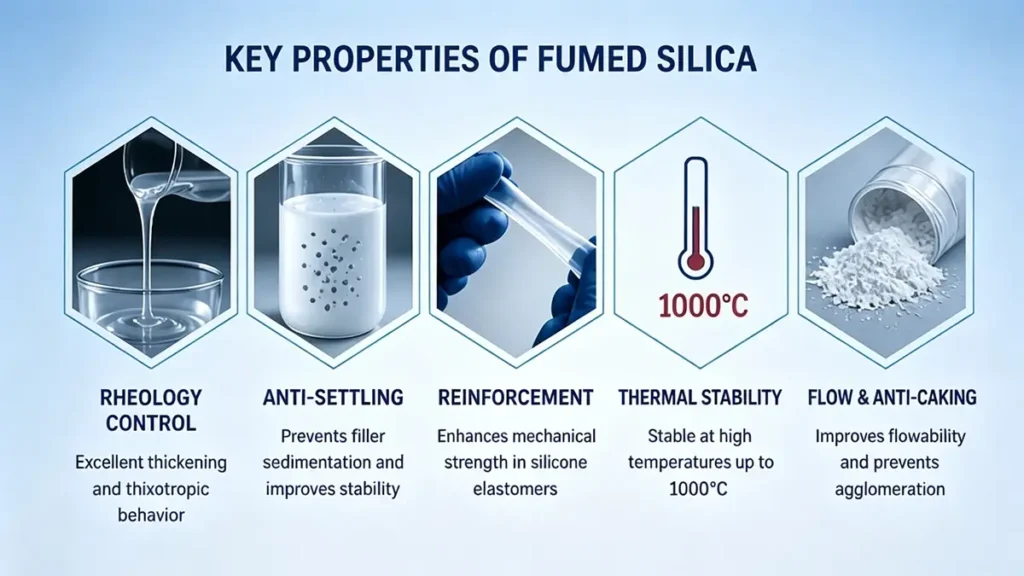
Fumed silica is valued for its multifunctional performance across a wide range of systems:
It acts as a highly efficient viscosity modifier, forming a network structure that provides shear-thinning (thixotropic) behavior, essential in preventing sagging and improving application properties.
By creating a structural network within formulations, it effectively prevents sedimentation of fillers and pigments, enhancing storage stability.
In silicone elastomers, especially LSR, HTV, and RTV systems, fumed silica serves as a reinforcing filler, significantly improving mechanical strength, elasticity, and durability.
Fumed silica remains stable at temperatures approaching 1000°C and exhibits strong resistance to chemical degradation, making it suitable for demanding environments.
In powder systems, it improves flowability and prevents agglomeration, which is particularly valuable in pharmaceuticals and food processing.
Hydrophilic grades retain surface silanol groups, making them highly compatible with polar systems.
They are commonly used in:
Hydrophobic grades are produced through surface treatment with silanes or silicone compounds, replacing hydroxyl groups with non-polar functionalities.
This modification results in:
Such grades are widely used in adhesives, sealants, and silicone rubber applications, where moisture sensitivity and process stability are critical.
👉 Manufacturers like Silico® provide a range of surface-treated options tailored to specific industrial requirements.
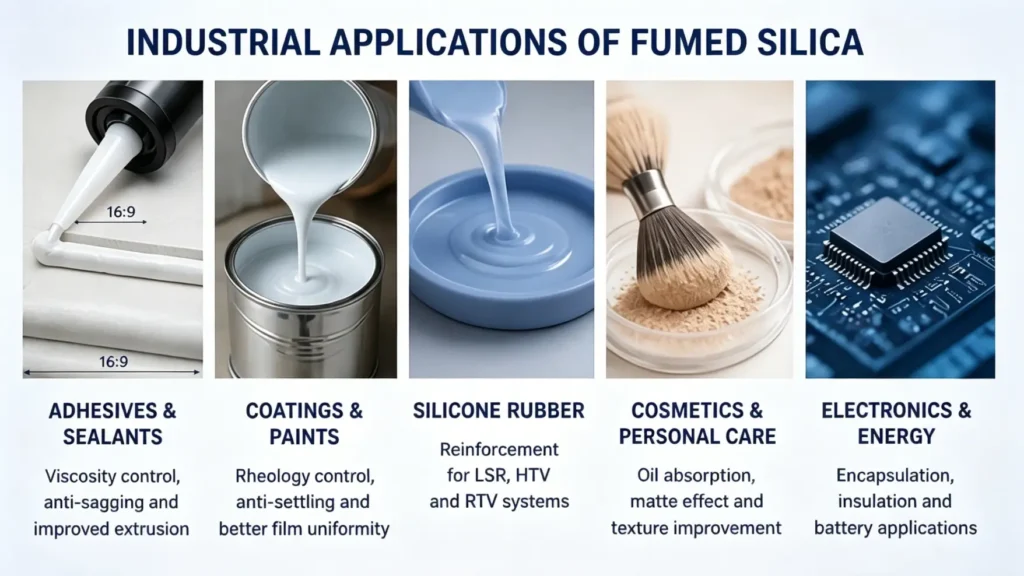
Fumed silica is a versatile functional additive used across multiple industries:
It functions as a reinforcing agent, significantly enhancing mechanical strength and elasticity, making it indispensable in high-performance silicone formulations.
It provides viscosity control, anti-sagging properties, and improved extrusion performance, ensuring consistent application behavior.
Used as a rheology modifier, it prevents pigment settling, improves film uniformity, and enhances coating stability.
It contributes to oil absorption, texture improvement, and matte effects, widely used in powders and skincare formulations.
Acts as an anti-caking and flow-enhancing agent, improving processing efficiency and product consistency.
Applied in encapsulation materials and battery systems, where stability, insulation, and dispersion are essential.
Choosing the appropriate grade of fumed silica is critical for achieving optimal performance:
Higher surface area increases thickening efficiency but may require more advanced dispersion techniques.
Hydrophilic grades suit polar systems, while hydrophobic grades perform better in non-polar or moisture-sensitive environments.
Reinforcement, rheology control, or flow improvement needs should guide grade selection.
Mixing equipment, shear conditions, and dispersion methods must be considered to ensure effective incorporation.
Fumed silica is a core material in modern formulation science, offering unmatched performance in rheology control, reinforcement, and stability enhancement. Its nano-scale structure, high surface area, and adaptable surface chemistry enable its use across a wide range of demanding industrial applications.
As industries continue to require higher-performance materials and more precise formulation control, the role of fumed silica will remain critical. Reliable suppliers such as Silico® support this demand by providing consistent quality, customizable grades, and technical expertise for global markets.
Fumed silica is a high-performance additive used for rheology control, thickening, anti-settling, and reinforcement. It is widely applied in silicone rubber (LSR, HTV, RTV), adhesives, sealants, coatings, cosmetics, and pharmaceuticals.
Fumed silica is produced by flame hydrolysis, resulting in nano-sized particles with high surface area and strong rheological performance. Precipitated silica has larger, porous particles and offers lower thickening and reinforcement efficiency.
Hydrophilic fumed silica contains silanol groups and is suitable for polar systems. Hydrophobic fumed silica is surface-treated for use in non-polar systems, offering improved moisture resistance and dispersion.
Fumed silica acts as a reinforcing filler in silicone rubber, improving mechanical strength, elasticity, and processing performance in LSR, HTV, and RTV systems.
Selection depends on surface area, surface treatment, and application needs. High BET grades provide stronger thickening, while hydrophobic grades are ideal for silicone and moisture-sensitive systems. Suppliers like Silico offer customized solutions for specific formulations.