2026-07-19

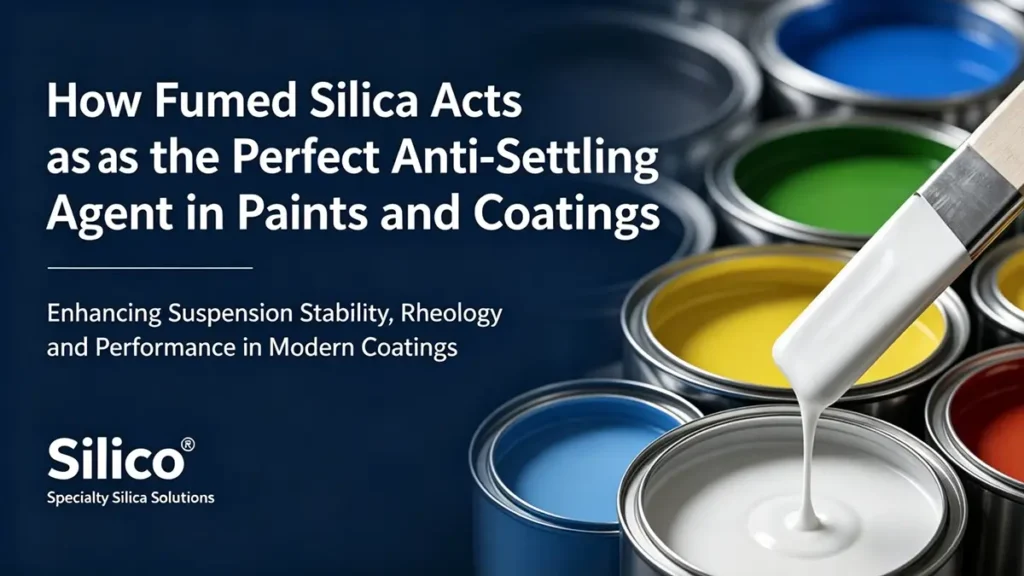
Fumed silica is a high-performance anti-settling and rheology modifier widely used in paints and coatings to enhance suspension stability, prevent pigment sedimentation, and improve anti-sag performance. By forming a three-dimensional network structure, it delivers excellent thixotropy, viscosity control, and long-term storage stability across industrial, epoxy, UV, marine, and waterborne coating systems. Silico® fumed silica provides reliable rheology optimization for advanced coating formulations, supporting improved application performance, durability, and consistency in modern high-solid and low-VOC coatings.
In modern paints and coatings, achieving excellent suspension stability and long-term storage performance is essential. Heavy pigments and fillers naturally settle over time, leading to hard sedimentation, inconsistent color, poor leveling, and reduced coating performance.
To solve these issues, manufacturers widely use fumed silica as a high-performance anti-settling agent and rheology modifier. Thanks to its ultra-fine particle structure and excellent thixotropic properties, fumed silica helps coatings maintain stable viscosity, prevent pigment settling, and improve anti-sag performance.
Today, fumed silica is commonly used in: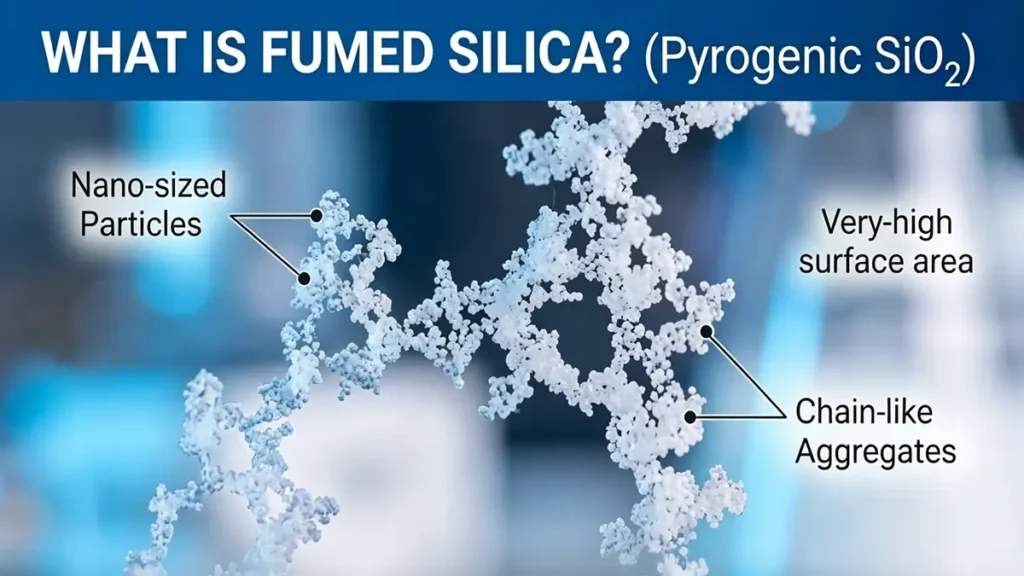
Pigment settling occurs when dense solid particles gradually sink to the bottom of a paint container during storage.
Common causes include:Fumed silica, also known as pyrogenic silica, is a nano-sized amorphous silicon dioxide (SiO₂) produced through flame hydrolysis technology.
Its extremely high surface area and chain-like particle structure provide outstanding: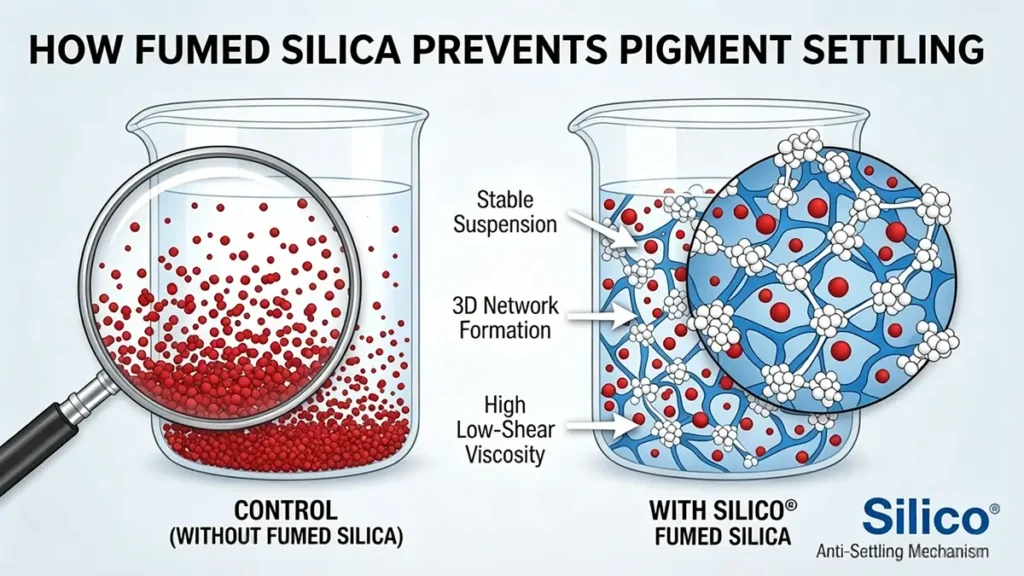
Fumed silica forms a three-dimensional network inside the coating system. This microscopic structure helps suspend pigments and fillers evenly throughout the formulation.
The anti-settling mechanism includes:
Silica particles interact through hydrogen bonding and particle entanglement, creating a stable internal structure.
At rest, the silica network increases low-shear viscosity and slows pigment movement, preventing sedimentation.
During brushing or spraying, the structure temporarily breaks down for smooth application. After application, viscosity rapidly recovers to reduce sagging and dripping.
This rheological behavior is known as thixotropy.
η↓ under shear,η↑ at rest
In high-performance coating systems, Silico® fumed silica grades are often selected to optimize suspension stability and application performance simultaneously.Helps prevent hard sediment formation and improves long-term storage stability.
Improves vertical holdout and reduces dripping during application.
Provides balanced viscosity control and smooth application behavior.
Can enhance scratch resistance, film strength, and mechanical performance.
Fumed silica is widely used in:
Improves suspension stability and anti-sag performance.
Enhances viscosity control and reduces filler settling.
Improves sprayability and coating uniformity.
Provides excellent rheology stability under harsh conditions.
Improves powder flow and storage behavior.
Maintains pigment dispersion consistency.
Many coating manufacturers choose Silico® specialty silica products for advanced rheology control in demanding industrial applications.| Coating System | Typical Dosage |
|---|---|
| Architectural Paints | 0.5–2.0% |
| Industrial Coatings | 1.0–3.0% |
| Zinc-Rich Primers | 1.0–3.0% |
| UV Coatings | 2.0–5.0% |
The performance of a coating formulation strongly depends on the quality and consistency of the fumed silica used.
High-quality fumed silica offers: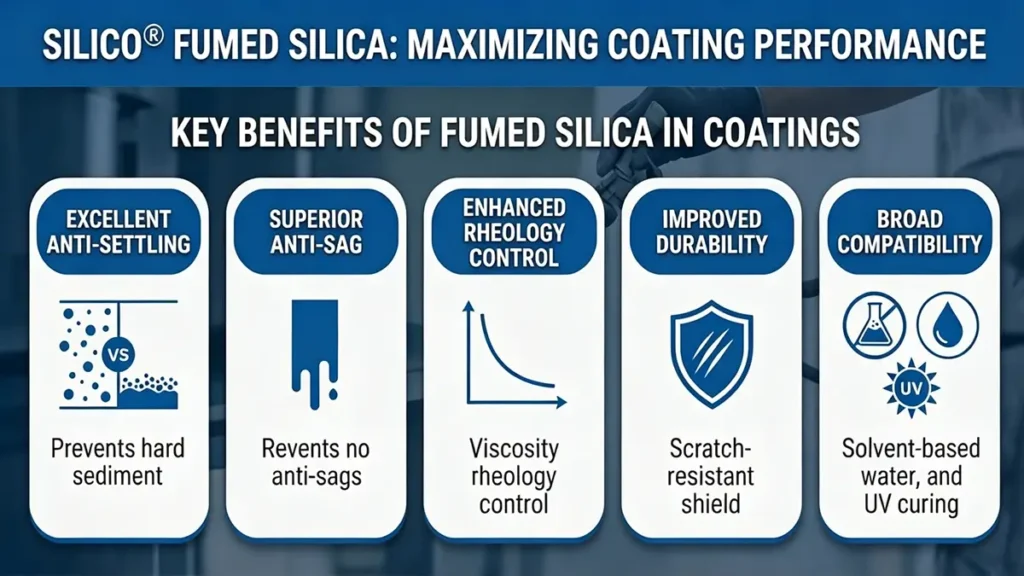
Fumed silica remains one of the most effective anti-settling agents and rheology modifiers in modern paints and coatings.
Its ability to provide:makes it an essential additive for high-performance coating formulations.
From industrial coatings to UV systems and waterborne paints, fumed silica continues to play a key role in improving coating stability, storage life, and application quality.As demand grows for advanced low-VOC and high-solid coatings, high-performance silica additives such as Silico® fumed silica will continue to support the development of next-generation coating technologies.
Fumed silica mainly acts as an anti-settling agent and rheology modifier to improve suspension stability and prevent pigment sedimentation.
It improves viscosity control, anti-sag performance, and long-term storage stability.
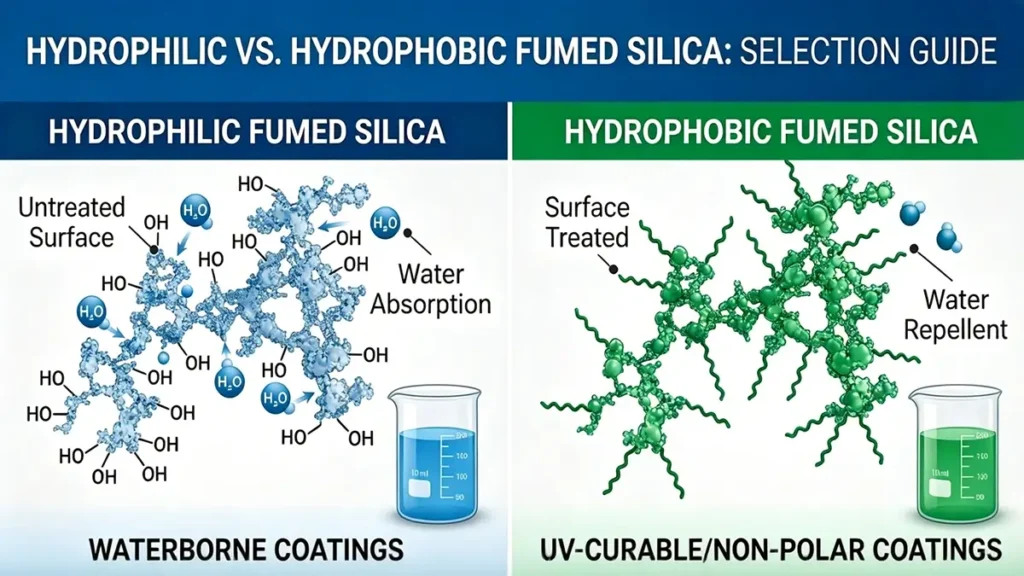
Hydrophilic grades work best in polar systems, while hydrophobic grades are preferred for UV coatings and non-polar formulations.
Yes. It can improve scratch resistance, mechanical strength, and film stability in many coating systems.
Typical dosage ranges from 0.5% to 5.0%, depending on the formulation and rheology requirements.