2026-07-19


Selecting the right industrial silicone fluid is critical for maximizing equipment performance, extending service life, and improving manufacturing efficiency. Whether your application involves lubrication, heat transfer, electrical insulation, textile finishing, or mold release, choosing the correct silicone fluid can significantly reduce maintenance costs and enhance product quality.
As the demand for high-performance materials continues to grow, manufacturers are increasingly seeking reliable suppliers that provide consistent quality, technical expertise, and customized formulations. Silico® is one example of a manufacturer offering a broad portfolio of industrial silicone fluid solutions for diverse application requirements, alongside many other established suppliers in the global market.
This comprehensive guide explains how engineers, purchasing managers, and product designers can select the most suitable silicone fluid based on performance characteristics, operating conditions, and industry-specific requirements.
Silicone fluid is a synthetic polymer primarily based on polydimethylsiloxane (PDMS) or modified silicone polymers. Unlike conventional mineral oils, silicone fluids maintain stable physical and chemical properties across extremely wide temperature ranges.
Typical characteristics include:These properties make silicone fluids ideal for demanding industrial environments where conventional lubricants or oils cannot perform reliably.
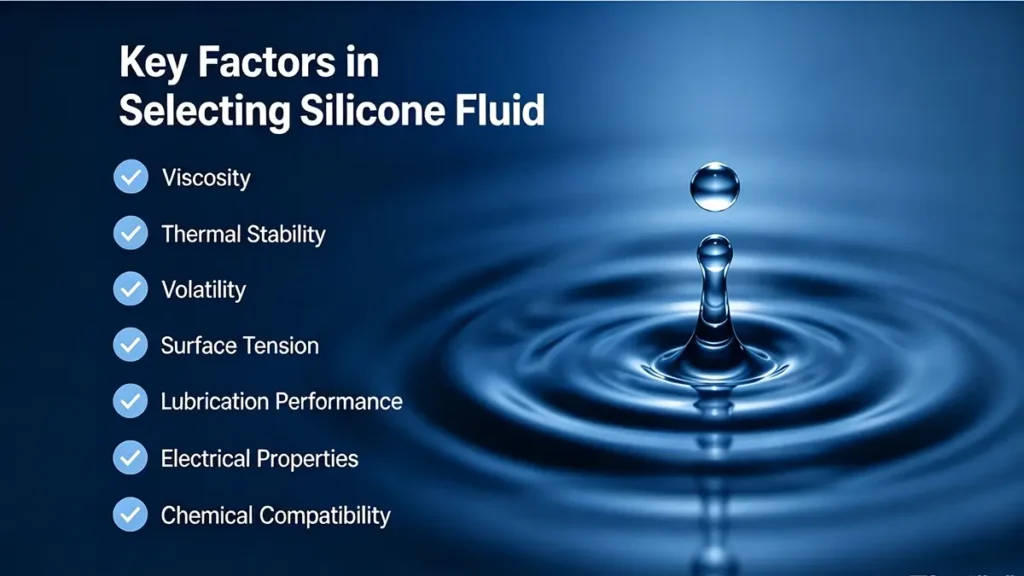
Industrial silicone fluids are widely used because they combine exceptional thermal stability, chemical inertness, low surface tension, and excellent lubrication performance in a single material.
However, selecting the wrong product may lead to:Choosing the appropriate industrial silicone fluid helps optimize productivity, improve process reliability, and reduce the total cost of ownership.
Viscosity is usually the first specification engineers evaluate when selecting a silicone oil for industrial use. It determines how the fluid flows, lubricates moving parts, transfers heat, and wets surfaces under different operating conditions.
| Viscosity Range | Typical Applications |
|---|---|
| 0.65–10 cSt | Release agents, coatings, anti-foam formulations |
| 20–100 cSt | Textile finishing, personal care formulations |
| 100–350 cSt | Lubrication and mold release |
| 500–1,000 cSt | Hydraulic damping, mechanical lubrication |
| 5,000–100,000+ cSt | Shock absorbers, damping systems, specialty applications |
Besides viscosity, engineers should also consider startup temperatures, pumpability, shear stability, and the expected service life to ensure long-term performance.
For high-temperature manufacturing environments, thermal stability becomes one of the most important selection criteria.
A premium high temperature silicone fluid should provide:These characteristics are particularly important in automotive manufacturing, electronics assembly, aerospace components, industrial ovens, and heat transfer systems.
Silicone fluids possess exceptionally low surface tension, enabling excellent wetting and spreading.
Benefits include:Silicone fluids provide excellent lubrication where conventional oils struggle.
Important considerations include:Silicone fluids are outstanding dielectric materials.
Key advantages include:Although silicone fluids are chemically inert, compatibility testing is recommended before large-scale production.
PDMS silicone fluid remains the industry’s most widely used material due to its excellent balance of thermal stability, lubrication, dielectric strength, water repellency, and oxidation resistance.
It is commonly selected for:
Modified silicone fluids are engineered for enhanced functionality.
Examples include:
| Industry | Recommended Silicone Fluid Characteristics |
|---|---|
| Automotive | High thermal stability, lubrication, oxidation resistance |
| Electronics | Low volatility, dielectric insulation, purity |
| Textile | Amino modified silicone, softness, durability |
| Cosmetics | Low viscosity, skin compatibility, smooth feel |
| Construction | Water repellency, weather resistance |
| Industrial Manufacturing | Lubrication, release performance, long service life |
| Medical Devices | High purity, biocompatibility, stability |
| Renewable Energy | UV resistance, thermal stability, durability |
Different industries prioritize different performance characteristics. Rather than selecting products solely based on viscosity, manufacturers should evaluate the complete operating environment, including temperature, mechanical load, chemical exposure, and regulatory requirements.
At this stage, working with an experienced silicone fluid manufacturer can greatly simplify product selection. Companies such as Silico® provide technical consultation, customized viscosity grades, and application-specific recommendations to help customers identify the most suitable solution while maintaining consistent product quality.
Many purchasing decisions focus exclusively on price or viscosity. In reality, long-term operating costs are often determined by overall fluid performance.
Avoid these common mistakes:A professional supplier should be able to recommend the most suitable product rather than simply offering the lowest-priced option.
Choosing the right industrial silicone fluid requires a comprehensive evaluation of viscosity, thermal stability, volatility, dielectric performance, chemical compatibility, and application-specific operating conditions. Focusing solely on one parameter may compromise equipment reliability and increase long-term operating costs.
By partnering with an experienced silicone fluid manufacturer and selecting products that match your technical requirements, manufacturers can improve productivity, reduce maintenance, and extend equipment life. Suppliers such as Silico® provide a wide range of silicone fluid solutions, technical support, and customized formulations that can help optimize performance across diverse industrial applications while complementing the broader range of products available in the global market.
Silico® specializes in high-performance organosilicon materials, providing silicone fluids, modified silicone products, and customized silicone solutions for global industrial applications.
With a focus on consistent quality, technical innovation, and customer support, Silico® helps customers worldwide develop reliable solutions for coatings, lubrication, electronics, personal care, and advanced manufacturing industries.
The ideal viscosity depends on your application. Low-viscosity fluids are suitable for coatings and release agents, while high-viscosity grades are commonly used for lubrication, damping, and shock absorption.
Silicone fluids are widely used in the automotive, electronics, textile, cosmetics, construction, medical, energy, aerospace, and industrial manufacturing sectors.
Yes. Most industrial silicone fluids provide excellent thermal stability, with continuous operating temperatures typically ranging from −50°C to 200°C, and some specialty grades capable of performing at even higher temperatures.
Standard PDMS silicone fluids provide general-purpose lubrication, insulation, and thermal stability, while modified silicone fluids (such as amino, polyether, phenyl, or hydrogen-modified types) are designed for specialized applications requiring enhanced softness, wetting, high-temperature resistance, or water repellency.
Review the technical data sheet, verify chemical compatibility with substrates such as plastics, rubbers, metals, and coatings, and conduct application-specific testing before full-scale production to ensure optimal performance.