2026-07-19

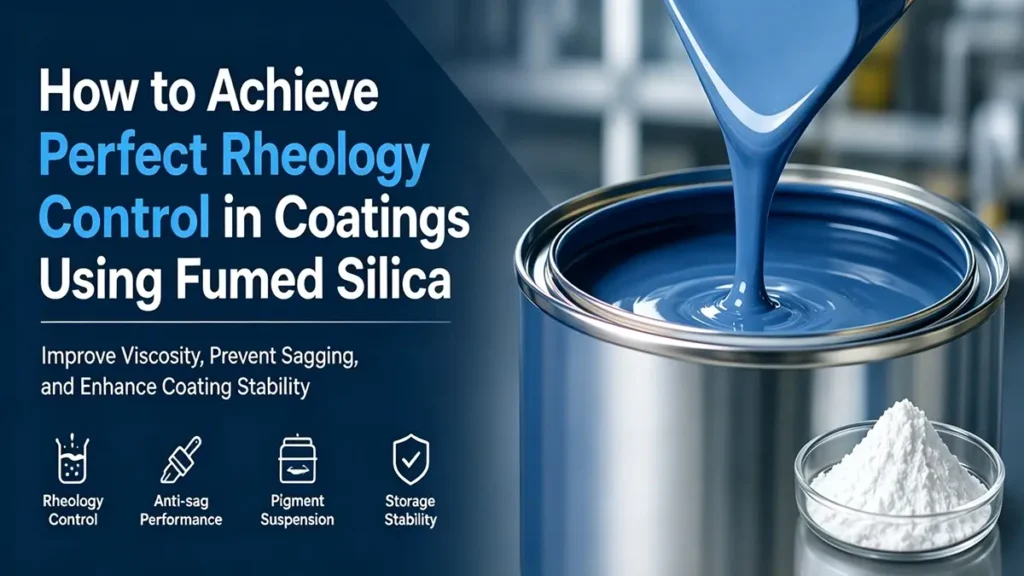
In modern paint and coating formulations, achieving stable viscosity, excellent anti-sag performance, and long-term pigment suspension is essential for product quality. Whether in industrial coatings, epoxy coatings, UV coatings, automotive paints, or water-based coatings, rheology control directly affects application performance, leveling, storage stability, and final film appearance.
Among various rheology modifiers for coatings, fumed silica is widely recognized as one of the most efficient additives for controlling coating viscosity and thixotropy. Due to its ultra-high surface area and strong particle interaction capability, fumed silica can significantly improve anti-settling performance, prevent sagging, and enhance coating stability in both solvent-based and waterborne systems.
As a professional silicone and specialty materials supplier, Silico® also provides high-performance silicone-related materials used in coatings, inks, adhesives, and industrial formulations worldwide.
This guide explains how to optimize rheology control in coatings using fumed silica, including grade selection, dispersion techniques, dosage recommendations, and common formulation solutions.
Fumed silica is a synthetic amorphous silicon dioxide produced through flame hydrolysis technology. Its nano-scale particle structure provides excellent thickening efficiency and thixotropic control.
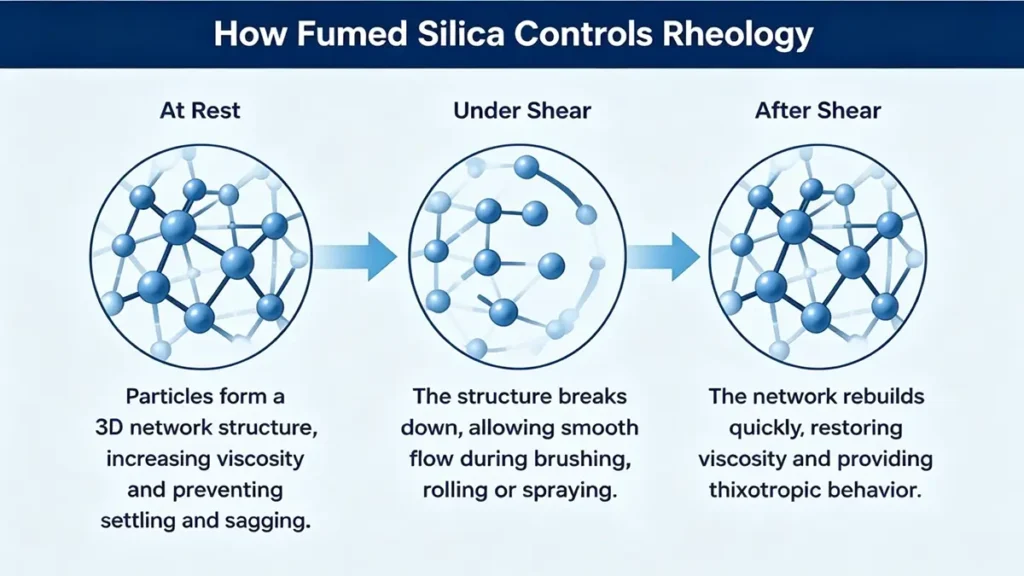
In coating formulations, fumed silica is commonly used as:The rheology mechanism of fumed silica is based on the formation of a three-dimensional particle network inside the coating system.
At rest, silica particles interact through hydrogen bonding and increase low-shear viscosity. This helps:
During brushing, rolling, or spraying, the structure temporarily breaks down under shear force, allowing smooth application.
After application, the network rebuilds quickly, restoring viscosity and preventing dripping or sagging.
This thixotropic behavior is why fumed silica rheology control is highly valued in advanced coating systems.Fumed silica keeps pigments and fillers uniformly suspended during storage, reducing hard sediment formation.
It helps coatings maintain thickness on vertical surfaces without running or dripping.
The thixotropic structure improves long-term formulation stability in industrial paints and coatings.
Properly dispersed fumed silica improves sprayability, brushability, and roller application.
Choosing the correct type of fumed silica is essential for optimal coating performance.
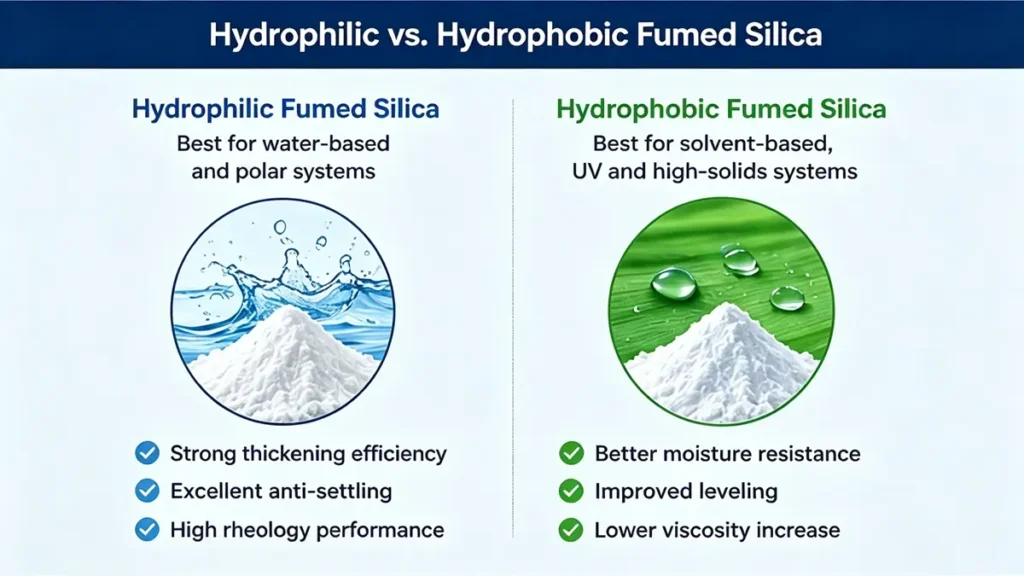
Selecting the correct fumed silica for paint formulations depends on several factors.
However, high-surface-area grades may require stronger dispersion equipment.
| Coating System | Recommended Type |
|---|---|
| Waterborne coatings | Hydrophilic |
| Solvent-based coatings | Hydrophobic |
| UV coatings | Hydrophobic |
| Epoxy coatings | Hydrophobic |
| Target Property | Recommended Grade |
|---|---|
| Maximum anti-settling | High surface area |
| Better leveling | Moderate surface area |
| High transparency | Easy-dispersing grades |
At present, many coating manufacturers also cooperate with suppliers such as Silico® to optimize additive compatibility in specialty coating systems and silicone-modified formulations.
Typical dosage levels of fumed silica in coatings include:
| Application | Recommended Dosage |
|---|---|
| General industrial coatings | 0.5–2.0% |
| Anti-settling systems | 1.0–3.0% |
| High-solids coatings | 1.0–4.0% |
| UV coatings | 2.0–3.0% |
| Printing inks | 1.0–10% |
Most formulators start with low loading levels and optimize based on viscosity and sag resistance targets.
Proper dispersion is critical for achieving maximum thickening efficiency.
Poorly dispersed silica can cause:Cowles dissolvers and rotor-stator mixers are commonly used for efficient silica activation.
Gradual addition helps prevent powder clumping and improves wetting efficiency.
Insufficient dispersion reduces performance, while excessive shear may damage the rheological structure.
| Problem | Possible Cause | Solution |
|---|---|---|
| Pigment settling | Low silica dosage | Increase loading |
| Sagging | Weak thixotropic structure | Use higher surface area grade |
| Poor leveling | Excess viscosity | Reduce dosage |
| Haze formation | Poor dispersion | Improve mixing efficiency |
| Hard sediment | Weak suspension network | Optimize silica activation |
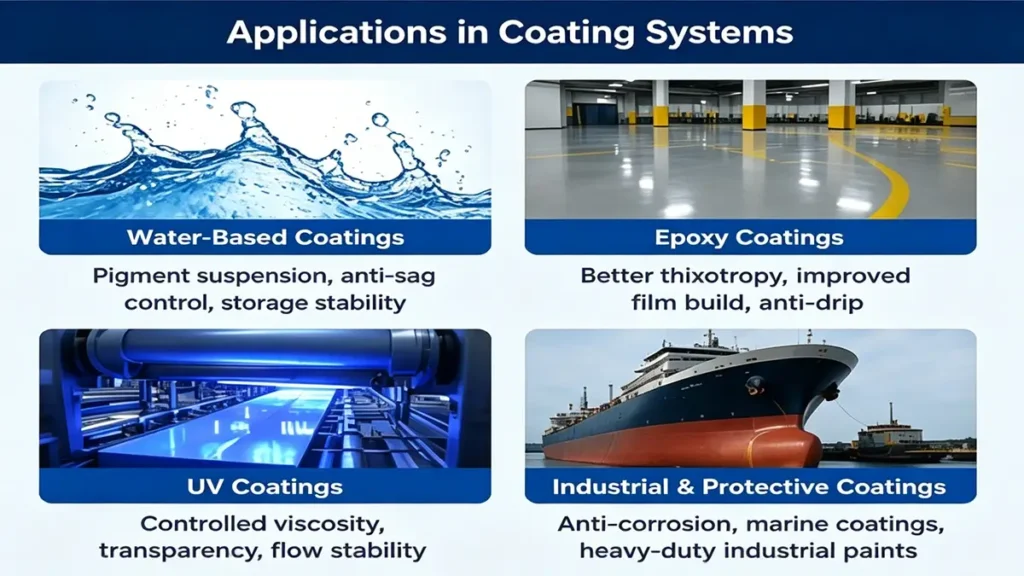
Fumed silica remains one of the most effective rheology modifiers for modern coating formulations. Its ability to improve viscosity control, anti-settling performance, thixotropy, and anti-sag resistance makes it essential in high-performance paints and coatings.
However, achieving stable rheology requires the correct balance of silica type, surface area, dosage, and dispersion technique. By optimizing these factors, formulators can significantly improve coating application properties, storage stability, and final film quality.
As coating technologies continue moving toward low-VOC, high-solids, and advanced industrial systems, companies such as Silico® are also contributing to the development of more efficient specialty material solutions for the global coatings industry.
Fumed silica acts as a rheology modifier, anti-settling agent, and anti-sag additive that improves coating viscosity control and storage stability.
Fumed silica is widely used in epoxy coatings, automotive paints, UV coatings, industrial coatings, inks, and high-solids formulations.
Most coating systems use between 0.5% and 3.0%, depending on the required rheological performance.
Proper dispersion maximizes thickening efficiency and prevents agglomeration, haze, and viscosity instability.
It depends on the coating system. Hydrophilic grades are better for waterborne systems, while hydrophobic grades perform better in solvent-based and high-solids coatings.