
Water-Based Silicone Mold Release Agents: How They Work and Where to Use Them
Water-based silicone mold release agents are widely used in rubber molding, plastic processing, polyurethane, composites, and other industrial forming processes. Instead of using an organic solvent as the carrier, these systems disperse silicone materials in water.
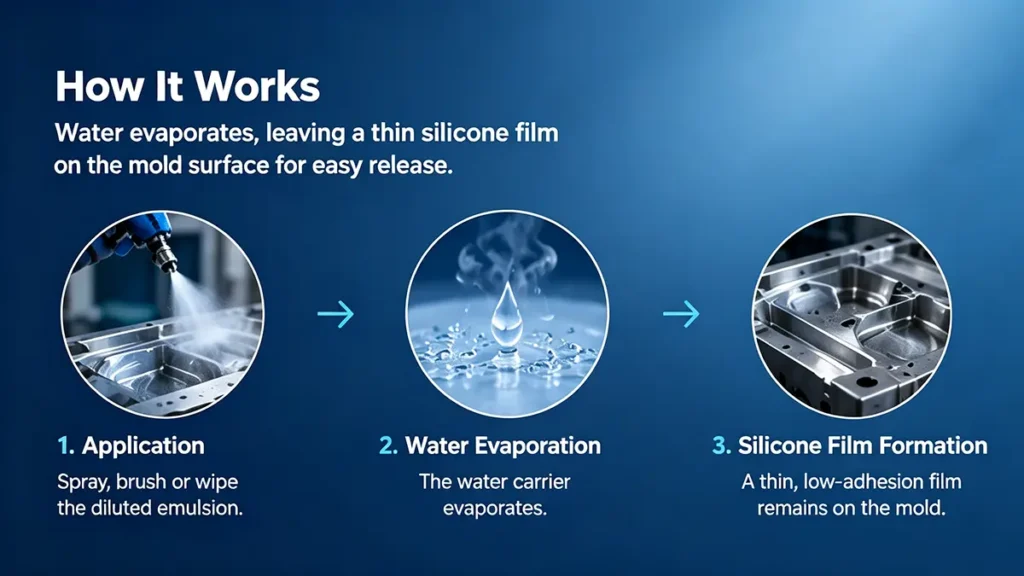
After application, the water evaporates and leaves a thin silicone-rich film on the mold surface. This film reduces adhesion between the mold and molded material, helping improve demolding, surface consistency, and production efficiency.
However, choosing a water-based silicone mold release agent involves more than comparing silicone content. Silicone chemistry, active content, dilution stability, mold temperature, application method, release durability, and compatibility with downstream processing all need to be considered.
For manufacturers and formulators evaluating silicone materials for water-based formulations, Silico® provides silicone-based materials for industrial applications where chemistry, processing conditions, and formulation compatibility need to be considered together.
Table of Contents
- 1. What Is a Water-Based Silicone Mold Release Agent?
- 2. How Does a Water-Based Silicone Mold Release Agent Work?
- 3. Key Advantages of Water-Based Silicone Release Systems
- 4. Active Content and Silicone Chemistry
- 5. How to Dilute Silicone Emulsion for Mold Release
- 6. Mold Temperature and Heat Resistance
- 7. Applications in Rubber, Plastic and PU Molding
- 8. How to Apply Water-Based Silicone Mold Release Agent
- 9. Common Mold Release Problems
- 10. Water-Based Silicone Emulsion vs. Silicone Fluid
- 11. How to Choose the Right Water-Based Silicone Mold Release Agent
- Frequently Asked Questions
- Conclusion
1. What Is a Water-Based Silicone Mold Release Agent?
A water-based silicone mold release agent is an aqueous dispersion or emulsion containing silicone materials such as polydimethylsiloxane (PDMS).
The silicone is not dissolved in water. Instead, small silicone droplets are dispersed throughout the aqueous phase with the help of an emulsification system.
Commercial silicone release emulsions are available at different active concentrations. For example, industrial products from major silicone manufacturers include grades with approximately 35%, 50%, and 60% active silicone, depending on the intended application. These are product-specific specifications rather than universal industry standards.
Common components include:
- PDMS or modified silicone fluid
- Water
- Emulsifiers
- Wetting or spreading additives
- Stabilizers
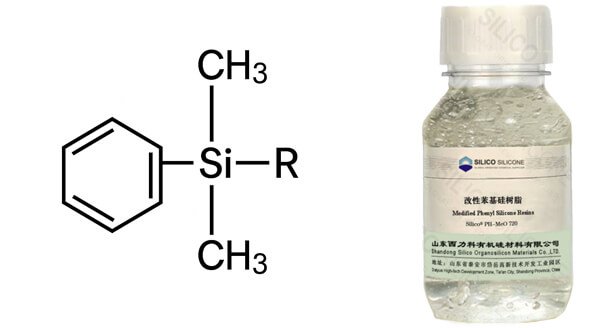
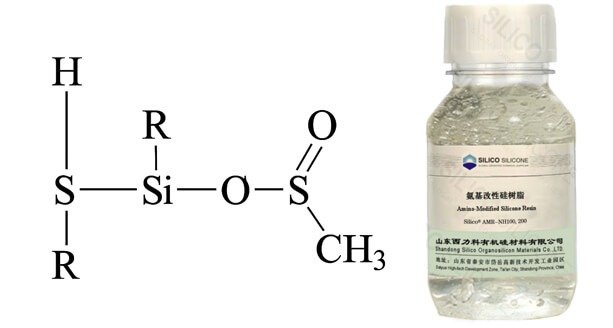
- Functional silicone or silicone resin, depending on the formulation
The water primarily acts as the carrier, while the silicone remaining on the mold surface provides the release effect.
2. How Does a Water-Based Silicone Mold Release Agent Work?
Application
The diluted silicone emulsion is sprayed, brushed, wiped, or otherwise distributed over the mold surface.
The release agent needs to wet the mold evenly. Poor coverage can create localized sticking even when the overall product is effective.
Water Evaporation
After application, water evaporates from the coating.
Drying depends on:- Mold temperature
- Ambient temperature
- Airflow
- Coating thickness
- Water content
- Application amount
Silicone Film Formation
As water evaporates, the silicone phase becomes concentrated at the surface and forms a thin release film.
The resulting interface has relatively low surface energy and low adhesion, allowing the molded component to separate from the mold more easily.
This is why a silicone emulsion should not simply be viewed as “silicone oil mixed with water.” Emulsion stability, particle size, emulsifier chemistry, wetting behavior, and film formation all influence actual release performance.
3. Key Advantages of Water-Based Silicone Release Systems
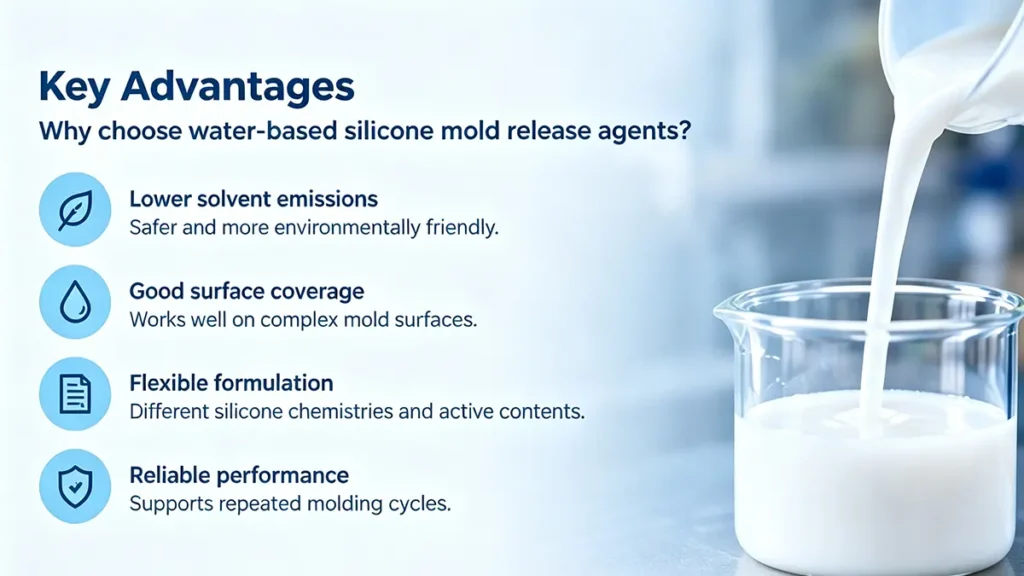
Lower solvent emissions
Water replaces the primary organic solvent carrier, which can reduce solvent fumes during application.
Easy dilution
Many commercial silicone emulsions are supplied as concentrates and can be diluted with water to achieve the required silicone deposition.
Good surface coverage
A properly formulated emulsion can spread over relatively large and complex mold surfaces.
Flexible formulation
Different silicone chemistries can be designed for different molding conditions, including:
- Medium-viscosity PDMS
- High-viscosity PDMS
- Functional silicone fluids
- Silicone resin-containing systems
Suitable for repeated molding
Some grades are designed for repeated molding cycles while minimizing mold buildup.
However, these benefits depend on the specific formulation. Water-based does not automatically mean better release performance.
4. Active Content and Silicone Chemistry
What does 35%, 50% or 60% active content mean?
If a silicone emulsion contains 35% active silicone, approximately 0.35 kg of silicone solids is present in 1 kg of product.
For a 60% active emulsion, the equivalent amount is approximately 0.60 kg.
Therefore, comparing release agents only by price per kilogram can be misleading.
A useful commercial calculation is:
Cost of active silicone = Product price × required dosage ÷ active content
But even this is not enough. A lower-active product may perform better in a particular mold because of its silicone chemistry, particle size, wetting properties, or film formation.
Silicone viscosity also matters
PDMS viscosity can range from relatively low-viscosity fluids to high-viscosity silicone materials.
Higher-viscosity silicone does not automatically provide better release. It may improve film persistence in some systems but can also affect:
- Dispersion
- Sprayability
- Dilution
- Surface coverage
- Mold buildup
The correct viscosity therefore depends on the application rather than simply being selected as high as possible.
5. How to Dilute Silicone Emulsion for Mold Release
There is no universal dilution ratio for water-based silicone mold release agents.
The appropriate concentration depends on:- Molded material
- Mold temperature
- Mold surface
- Silicone chemistry
- Active content
- Application method
- Desired release life
- Production cycle
Published technical data illustrate the large difference between commercial formulations. Some products are recommended at relatively concentrated dilutions, while others can be diluted many times with water.
For this reason, the supplier’s technical data sheet should always be used as the starting point.
A practical development approach is:
Supplier recommendation → small-scale trial → adjust concentration → production trial
Too little release agent can cause sticking or inconsistent release.
Too much can cause:- Mold buildup
- Silicone transfer
- Surface defects
- Adhesion problems during painting or bonding
- Increased production cost
The objective is not to apply the maximum amount of silicone. It is to achieve the minimum effective coating level that provides consistent release.
6. Mold Temperature and Heat Resistance
Mold temperature is one of the most important selection criteria.
Different water-based silicone release products have different temperature limitations. Commercial technical data include examples designed for processes around or above 150°C, while other grades have lower recommended temperature ranges.
Therefore, the actual molding temperature should be compared with the product’s technical specification.
Consider:- Mold temperature
- Heating method
- Cycle time
- Contact time
- Mold material
- Thermal exposure between applications
A release agent that performs well at 100°C may not provide the same result at 180°C or 200°C.
Do not select a release agent based only on the fact that it is silicone or water-based.
7. Applications in Rubber, Plastic and PU Molding
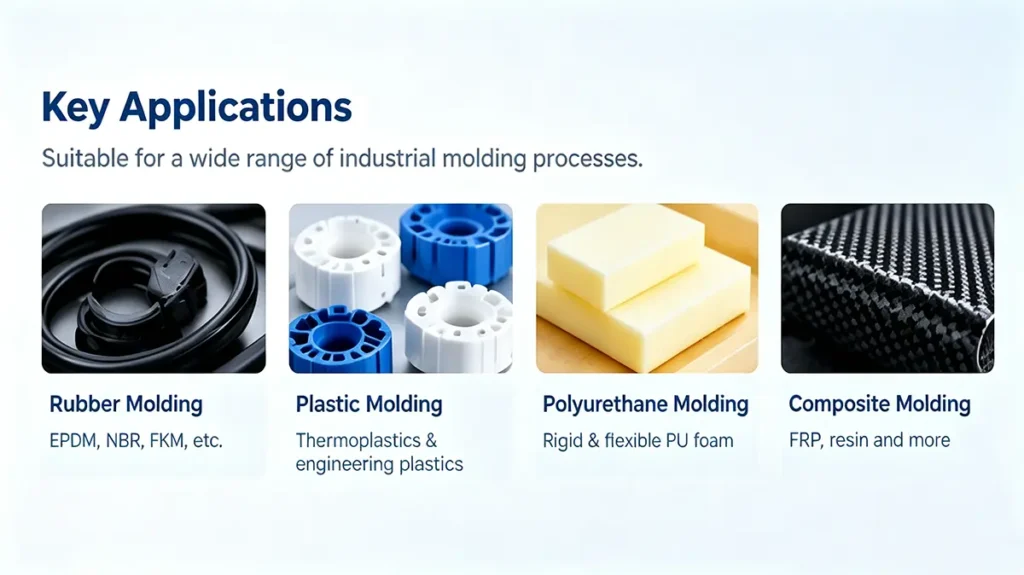
Rubber Molding
Rubber molding is one of the major applications for silicone release technology.
Potential materials include:- EPDM
- NBR
- FKM
- Natural rubber
- Silicone rubber
- Other elastomers
- Low release force
- Uniform mold coverage
- Thermal stability
- Release durability
- Low mold buildup
For high-volume rubber production, the number of consistent molding cycles between applications can be more important than the performance of the first cycle.
Plastic Molding
Water-based silicone release systems can also be used for selected plastic molding applications.
The key consideration is often surface transfer.
If the molded part will subsequently be painted, printed, bonded, or coated, excessive silicone transfer may interfere with adhesion.
The release agent therefore needs to be evaluated not only for demolding but also for the next manufacturing step.
Polyurethane Molding
Water-based silicone release technology can also be used in selected polyurethane applications, including certain rigid PU molding and foam processes.
The appropriate grade depends on:- PU formulation
- Mold temperature
- Mold material
- Required surface finish
- Release frequency
- Subsequent processing
Composite and Other Applications
- Composite molding
- Resin molding
- Fiberglass applications
- Foundry-related processes
- Industrial forming operations
The formulation should always be tested against the specific resin, substrate, and processing conditions.
8. How to Apply Water-Based Silicone Mold Release Agent
Step 1: Clean the mold
Remove old release residue, rubber deposits, resin, oil, dust, and other contaminants.
Step 2: Prepare the dilution
Use clean water and maintain a consistent dilution ratio.
Water quality can matter, particularly for systems sensitive to hardness, electrolytes, or pH.
Step 3: Apply a thin and uniform film
Spraying is commonly used for production because it can provide relatively consistent coverage.
Brushing or wiping may be suitable for smaller molds or laboratory testing.
Step 4: Allow sufficient drying
Water must evaporate sufficiently before molding.
Higher mold temperatures can accelerate evaporation, but excessive temperature may also affect the stability or film-forming behavior of certain formulations.
Step 5: Evaluate multiple molding cycles
Do not judge a release agent from only one demolding cycle.
Monitor:- Release performance
- Surface appearance
- Mold buildup
- Coating transfer
- Number of cycles
- Reapplication frequency
This provides a much more realistic evaluation of production performance.
9. Common Mold Release Problems
Why does the molded part still stick?
- Insufficient release film
- Uneven application
- Incorrect dilution
- Mold contamination
- Excessive temperature
- Incompatible release chemistry
Increasing the dosage is not always the correct solution. First determine whether the problem is caused by coverage, chemistry, temperature, or mold condition.
Why does the mold develop buildup?
- Excessive application
- High silicone concentration
- Incomplete drying
- Repeated over-application
- Incompatible additives
A lower concentration or different silicone chemistry may solve the problem.
Why does painting or bonding become difficult?
Silicone transfer onto the molded part can interfere with certain coatings and adhesives.
If secondary processing is required, test the molded surface after repeated production cycles rather than evaluating only the mold-release performance.
Why does the diluted emulsion separate?
- Poor water quality
- Excessive dilution
- pH changes
- Electrolytes
- Incompatible additives
- Insufficient dilution stability
Always evaluate the diluted working solution, not just the original concentrate.
10. Water-Based Silicone Emulsion vs. Silicone Fluid
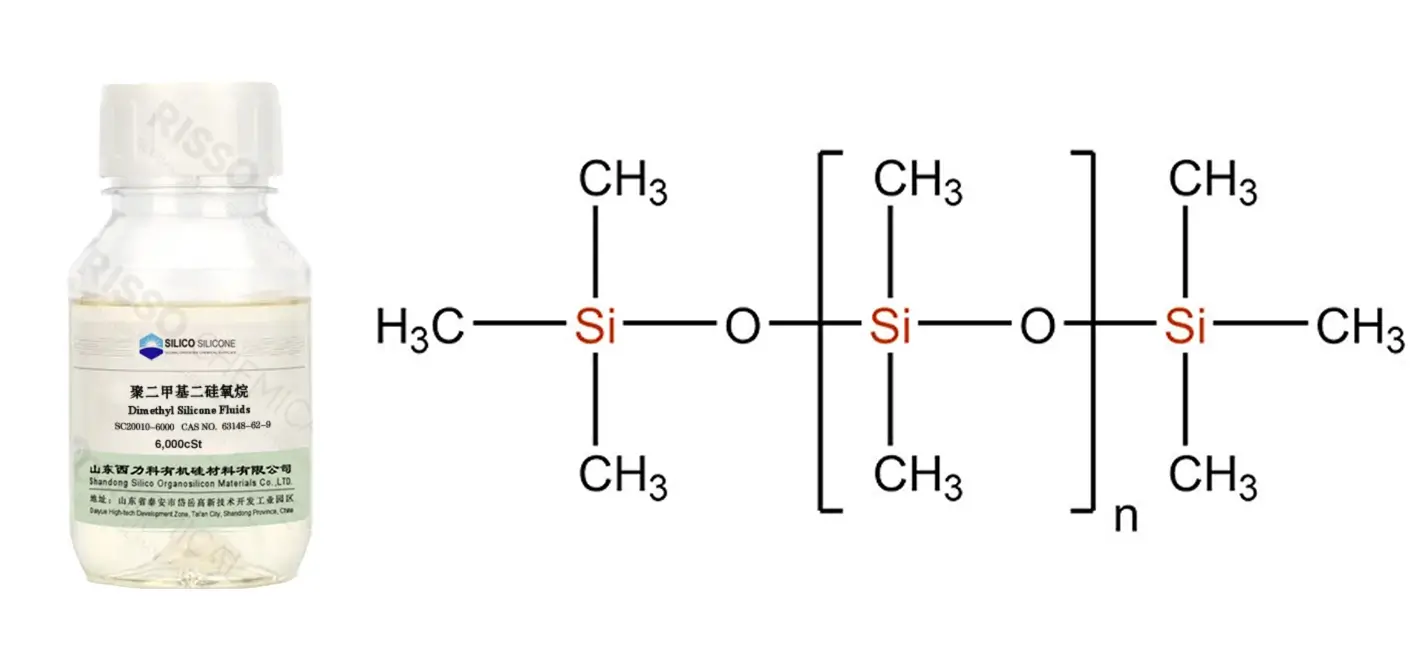
Silicone fluid and silicone emulsion serve different formulation purposes.
| Property | Silicone Fluid | Water-Based Silicone Emulsion |
|---|---|---|
| Silicone concentration | Typically near 100% | Often 30–60% in commercial examples |
| Carrier | None | Water |
| Dilution | Requires formulation/carrier | Usually diluted with water |
| Application | Direct or formulated | Spray, brush, wipe |
| VOC profile | Depends on formulation | Generally lower solvent emissions |
| Storage stability | Relatively simple material | Depends on emulsion stability |
| Release applications | Yes | Yes |
A silicone fluid may be preferable when a formulator needs a concentrated silicone raw material.
A silicone emulsion is often more convenient when the final release formulation needs an aqueous carrier and controlled dilution.
Therefore, silicone emulsion is not simply diluted silicone fluid. The emulsion structure and formulation chemistry have a direct effect on application performance.
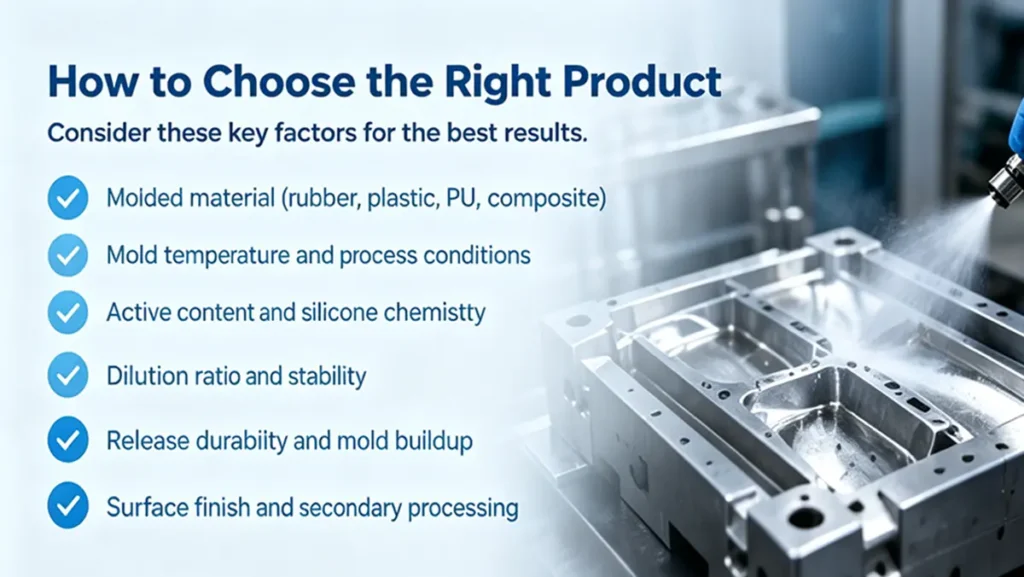
11. How to Choose the Right Water-Based Silicone Mold Release Agent
11.1. Molded material
Start with the material being molded:
Rubber → Plastic → PU → Composite → Other
11.2. Mold temperature
Compare the actual operating temperature with the product’s recommended range.
11.3. Silicone chemistry
- PDMS
- High-viscosity PDMS
- Functional silicone
- Silicone resin-containing technology
11.4. Active content
Compare the amount of actual silicone delivered at the working dilution.
11.5. Dilution stability
The emulsion should remain stable at the intended working concentration.
11.6. Release durability
Measure how many cycles can be completed before reapplication is required.
11.7. Mold buildup
Check the mold after repeated cycles.
11.8. Surface transfer
Especially important when painting, printing, coating, or bonding follows molding.
11.9. Application method
- Spray
- Brush
- Wipe
- Other application equipment
11.10 Total production cost
The most useful commercial comparison is often:
Cost per successful molding cycle
rather than simply:
Price per kilogram
This includes dosage, active content, reapplication frequency, mold cleaning, downtime, and production efficiency.
For manufacturers comparing water-based silicone emulsions, release agents, and related silicone materials, Silico® can provide technical product information for evaluating silicone chemistry, active content, application requirements, and formulation compatibility together.
Frequently Asked Questions
It is an aqueous silicone dispersion or emulsion used to create a low-adhesion film between a mold and the molded material, making demolding easier.
Not in every application. Water-based systems can reduce solvent emissions and offer convenient water dilution, but performance depends on the mold, material, temperature, application method, and downstream processing.
Yes. Silicone emulsions based on PDMS and other silicone chemistries are used in rubber, plastic, polyurethane, composite, and other industrial release applications.
There is no universal optimum. Commercial examples range from approximately 30% to 60% or higher depending on the formulation. Active content should be evaluated together with release performance and working dilution.
The correct ratio is product-specific. Follow the technical data sheet and optimize the concentration through controlled production trials.
Yes, some grades are designed for hot-mold applications. However, the maximum recommended temperature varies by product and must be checked against the actual molding process.
Yes. Silicone transfer can interfere with some paints, coatings, inks, and adhesives. If secondary processing is required, compatibility testing should be part of product selection.
Conclusion
Water-based silicone mold release agents provide an effective way to deliver silicone release technology through an aqueous system. After application and evaporation of the water phase, the remaining silicone film helps reduce mold adhesion and improve demolding.
The right product should not be selected simply by silicone content or price. Silicone chemistry, active content, dilution stability, mold temperature, application method, release durability, mold buildup, and surface transfer are all important.
For rubber, plastic, polyurethane, and composite molding, the best release agent is the one that provides consistent release under the actual production conditions while minimizing reapplication, mold cleaning, surface contamination, and overall process cost.
For industrial manufacturers and formulators looking for silicone materials for release-agent formulations and other applications, Silico® offers a broader silicone materials portfolio and technical support to help evaluate products according to specific processing and formulation requirements.
Silicone Fluid related products
If you want to know other questions about Sillcone Fluid, please contact us and we will provide professional answers.
Popular Recommendations
Get a Catalog & Best Price
- Quick and helpful reply within 24 hours;
- Tailored solutions provided for your project;
- One-stop purchasing service.
Need More Technical Information?
Silico® ORGANOSILICON
- Address: Daiyue Industrial Area, Taian, Shandong, China
- © Copyright 2022 Silico® . All Rights Reserved