
What Is Amino Silicone Emulsion and Where Is It Used?
Amino silicone emulsion is a water-based dispersion of amino-functional silicone polymers or silicone fluids. It is widely used in textile finishing, fabric softening, fiber lubrication, leather treatment, and selected surface-treatment applications.
Unlike conventional silicone oil, amino silicone emulsion allows silicone materials to be delivered through an aqueous system. The amino-functional groups can improve interaction with certain substrates, while the silicone backbone provides low surface friction, smoothness, softness, lubricity, and water-repellent properties.
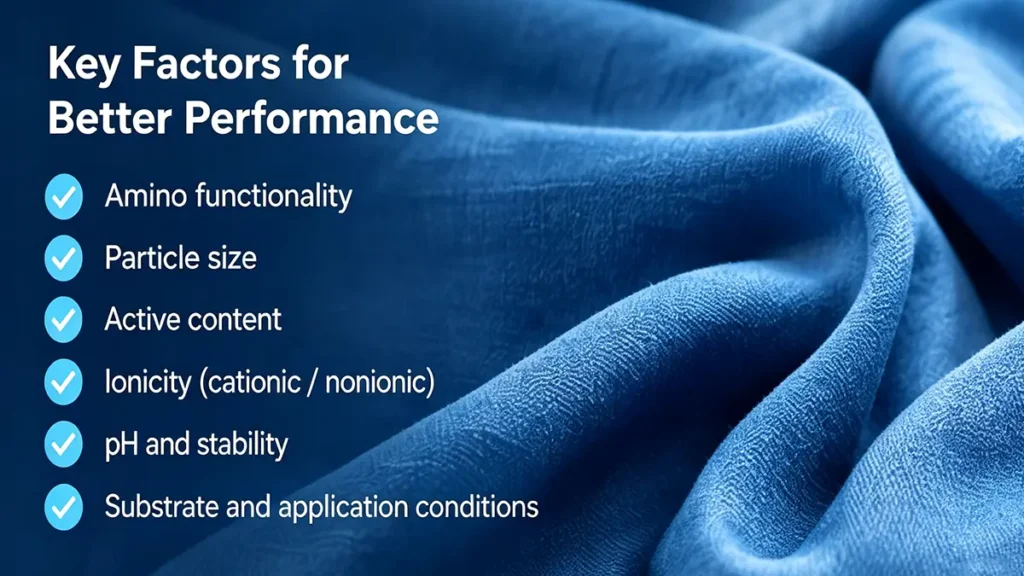
For formulators and industrial buyers, selecting an amino silicone emulsion requires more than comparing silicone content. Silicone chemistry, amino functionality, particle size, active content, ionic character, pH, stability, substrate, and application conditions all affect the final performance.
For companies looking for silicone materials for water-based formulations, Silico® provides silicone-based materials for industrial applications, including silicone emulsions and related silicone products.
Table of Contents
- 1. What Is Amino Silicone Emulsion?
- 2. How Does Amino Silicone Emulsion Work?
- 3. Key Properties of Amino Silicone Emulsion
- 4. Main Applications of Amino Silicone Emulsion
- 5. Amino Silicone Emulsion for Textile Softening
- 6. Particle Size and Active Content
- 7. Cationic vs. Nonionic Amino Silicone Emulsion
- 8. What Affects Amino Silicone Emulsion Stability?
- 9. How to Choose the Right Amino Silicone Emulsion
- 10. Amino Silicone Emulsion vs. Amino Silicone Fluid
- Frequently Asked Questions
- Conclusion
1. What Is Amino Silicone Emulsion?
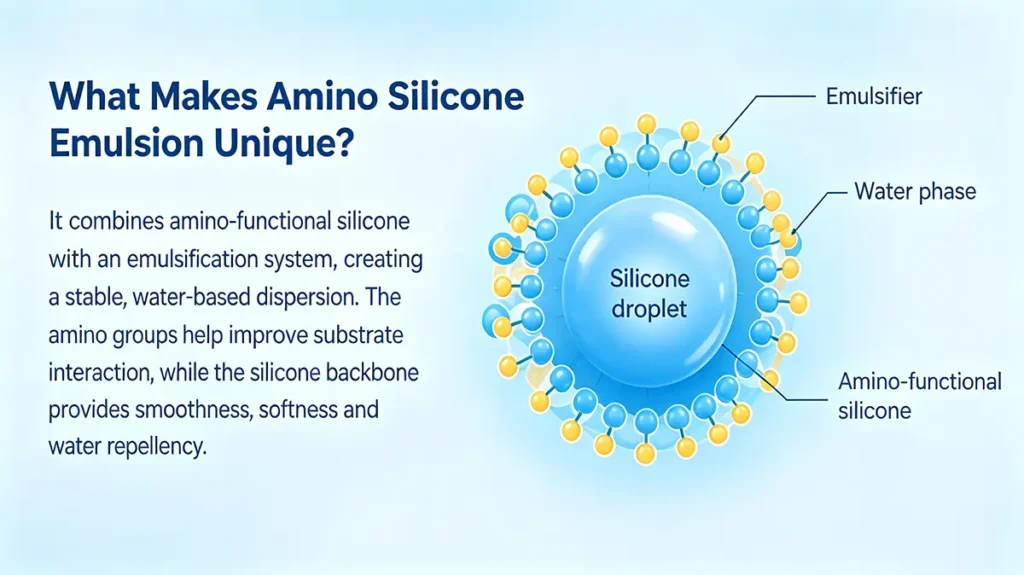
Amino silicone emulsion is an aqueous emulsion containing amino-functional silicone.
The silicone phase is generally based on a polysiloxane structure, often derived from PDMS, with amino-containing functional groups incorporated into the silicone polymer or fluid.
The basic structure is:
Amino-functional silicone + emulsification system + water → Amino silicone emulsion
The silicone is not normally dissolved in water. Instead, it is dispersed as small silicone droplets within the water phase.
Commercial products vary considerably in formulation. For example, Dow lists amino silicone emulsions with approximately 30–50% active content, while another product has a reported active content of 58%.
Therefore, amino silicone emulsion is a product category rather than one fixed chemical composition.
2. How Does Amino Silicone Emulsion Work?
The performance of amino silicone emulsion comes mainly from the combination of its silicone backbone and amino functionality.
The silicone backbone contributes:
- Low surface friction
- Lubricity
- Smoothness
- Flexibility
- Water repellency
- Soft hand feel
The amino groups can improve the interaction between the silicone and certain substrates.
During application, the emulsion is deposited on the substrate. As water is removed through drying or processing, a thin silicone layer remains on or around the treated surface.
In textile finishing, this can reduce friction between fibers and provide a smoother and softer fabric surface.
Research on amino-functional polysiloxane textile softeners has reported emulsion droplet sizes in the approximate 40–180 nm range, while also showing that particle-size distribution and emulsion stability can affect finishing performance.
3. Key Properties of Amino Silicone Emulsion
| Property | Why It Matters |
|---|---|
| Active content | Determines the amount of active silicone delivered |
| Ionicity | Affects compatibility and substrate affinity |
| Particle size | Influences distribution and penetration |
| pH | Important for stability and formulation compatibility |
| Viscosity | Affects handling and application |
| Dilution stability | Important when preparing water-based baths |
| Storage stability | Determines product reliability during storage |
| Yellowing resistance | Important for white and light-colored textiles |
| Durability | Determines performance after washing or repeated use |
For example, DOWSIL™ SM 8709 SR Emulsion is described as an amino-functional silicone emulsion with 30–50% active content and nonionic surfactant technology. Another Dow product, DOWSIL™ FM-6620 Emulsion, is a cationic amino silicone emulsion with 58% active content and a reported pH of 3–5.
These examples show why products should be evaluated from their complete technical specifications rather than the product name alone.

4. Main Applications of Amino Silicone Emulsion
Amino silicone emulsions are particularly important in textile and fiber treatment.
Common applications include:
- Textile softening
- Fabric finishing
- Fiber lubrication
- Yarn lubrication
- Leather treatment
- Fabric-care formulations
- Selected automotive and household polishes
- Water-based surface treatments
The required silicone chemistry depends on the substrate and the desired surface properties.
A formulation designed for cotton, for example, may not produce the same result on polyester or nylon.
5. Amino Silicone Emulsion for Textile Softening
Textile softening is one of the most established applications of amino silicone emulsion.
The objective is usually to improve several properties simultaneously:
- Softness
- Smoothness
- Drape
- Lubricity
- Elasticity
- Sewability
- Washing durability
- Yellowing resistance
Amino-functional silicone can reduce surface friction between fibers and create a smoother hand feel.
Commercial products are available for cotton, polyester, knitted fabrics, woven fabrics and blended textiles. Some are also designed to provide improved crease recovery, tear performance or washing durability.
However, higher silicone dosage does not necessarily mean better fabric performance. Excessive deposition can change fabric handle, rewetting behavior or subsequent processing.
The optimum dosage must therefore be established through laboratory and production trials.
6. Particle Size and Active Content
Particle Size
Particle size affects how an emulsion distributes over and, in some cases, penetrates into a substrate.
Silicone emulsions can range from conventional emulsions to much finer microemulsion systems. Smaller particle size may improve distribution, but it does not automatically produce better softness or durability.
For example, Dow reports an average particle size of approximately 5 nm for one silicone microemulsion product.
The appropriate particle size depends on:- Fabric construction
- Fiber type
- Required softness
- Penetration requirements
- Application process
- Desired durability
Active Content
Active content is another important parameter.
A simple calculation is:
Active silicone delivered = Product dosage × Active content
For example, 2 kg of a 50% active emulsion contains approximately 1 kg of active material.
When comparing products, buyers should therefore consider price per unit of active silicone, not only price per kilogram of emulsion.
7. Cationic vs. Nonionic Amino Silicone Emulsion
Cationic Amino Silicone Emulsion
Cationic systems are widely used in textile and fabric-care applications because their charge can provide strong affinity toward certain substrates.
DOWSIL™ FM-6620, for example, is identified as a cationic amino silicone emulsion with 58% active content.
Nonionic Amino Silicone Emulsion
Nonionic systems can provide broader compatibility in some water-based formulations.
DOWSIL™ SM 8709 SR is described as a nonionic amino-functional silicone emulsion with 30–50% active content.
Neither type is universally better.
The selection should consider:
substrate + formulation compatibility + pH + application process + required performance
8. What Affects Amino Silicone Emulsion Stability?
Amino silicone emulsions are colloidal water-based systems, so formulation stability is critical.
Common stability problems include:- Phase separation
- Creaming
- Coalescence
- Viscosity changes
- Poor dilution stability
- Sedimentation
Potential causes include:
pH
Changes in pH can affect the silicone, surfactant system and amino functionality.
Temperature
Repeated heating and cooling can reduce emulsion stability. Storage temperature should therefore follow the supplier’s technical specification.
Electrolytes
Salts and other ionic ingredients may destabilize some emulsion systems.
Dilution
A concentrated commercial emulsion may behave differently after dilution into a finishing bath.
Compatibility
Amino silicone emulsion should not automatically be mixed with every surfactant, softener or textile auxiliary.
For this reason, dilution and compatibility testing should be performed before production-scale use.
9. How to Choose the Right Amino Silicone Emulsion
9.1. Identify the substrate
Determine whether the product will be applied to:
- Cotton
- Viscose
- Polyester
- Nylon
- Blended fabrics
- Yarn
- Leather
- Other surfaces
9.2. Define the required hand feel
- Soft
- Silky
- Smooth
- Fluffy
- Elastic
- Slick
- Natural
9.3. Check particle size
Consider whether conventional emulsion or microemulsion technology is more appropriate.
9.4. Compare active content
Compare products according to active content and actual application dosage, rather than product price alone.
9.5. Check ionic character
Confirm whether the product is cationic, nonionic or another formulation type.
9.6. Check pH and dilution stability
The product should remain stable under the actual application conditions.
9.7. Evaluate durability
For washable textiles, test softness retention after repeated washing rather than measuring only the initial hand feel.
9.8. Test yellowing and color effects
This is particularly important for white and light-colored fabrics.
9.9. Run application trials
Final evaluation should use the actual:
fabric + dosage + pH + bath ratio + temperature + drying/curing conditions
used in production.
For B2B buyers comparing silicone emulsion grades, Silico® can be considered as a silicone materials supplier for industrial formulations where product chemistry, application requirements and formulation compatibility need to be evaluated together.

10. Amino Silicone Emulsion vs. Amino Silicone Fluid
| Feature | Amino Silicone Fluid | Amino Silicone Emulsion |
|---|---|---|
| Physical form | Silicone fluid | Silicone dispersed in water |
| Water compatibility | Requires formulation | Designed for aqueous systems |
| Active material | Highly concentrated | Diluted with water |
| Application | Raw material / formulation component | Ready-to-use or dilutable system |
| Textile finishing | Requires suitable emulsification | Convenient for water-based finishing |
An amino silicone fluid can also be used as a raw material for preparing an emulsion.
The main difference is therefore the delivery system, not simply the silicone chemistry.
Frequently Asked Questions
It is primarily used for textile softening, fabric finishing, fiber and yarn lubrication, as well as selected leather, polish and surface-treatment applications.
Usually, no. The silicone is generally dispersed in water rather than dissolved in water.
Amino silicone emulsion contains amino-functional silicone, while a general silicone emulsion may contain unmodified PDMS or another modified silicone. Amino functionality can change substrate affinity, softness and durability.
There is no universal standard. Commercial products can range from lower active systems to approximately 50–60% active content, depending on the formulation.
Yes. It is widely used for cotton and other textile substrates. The appropriate grade depends on softness, durability, yellowing resistance, hydrophilicity and the finishing process.
No. Smaller particles can improve distribution or penetration, but final performance also depends on silicone structure, amino functionality, dosage, substrate and processing conditions.
Possible causes include pH changes, electrolytes, incompatible additives, excessive dilution, temperature variation or insufficient emulsion stability. The actual cause should be confirmed through formulation testing.
Conclusion
Amino silicone emulsion is a specialized water-based delivery system for amino-functional silicone, combining the surface properties of silicone with the practical advantages of an aqueous formulation.
For textile and industrial applications, performance depends on more than active content. The most important variables are:
silicone chemistry → amino functionality → particle size → active content → ionic character → pH → stability → substrate → application conditions
A higher active content or smaller particle size does not automatically make one product better than another. The right amino silicone emulsion is the grade that delivers the required softness, lubricity, compatibility, stability and durability at the required dosage and under the actual production conditions.
For manufacturers, formulators and industrial buyers evaluating silicone-based materials, Silico® provides a broader silicone product portfolio and technical support for selecting materials according to specific application requirements.
Silicone Emulsion related products



If you want to know other questions about Silicone Emulsion, please contact us and we will provide professional answers.
Popular Recommendations
Get a Catalog & Best Price
- Quick and helpful reply within 24 hours;
- Tailored solutions provided for your project;
- One-stop purchasing service.
Need More Technical Information?
Silico® ORGANOSILICON
- Address: Daiyue Industrial Area, Taian, Shandong, China
- © Copyright 2022 Silico® . All Rights Reserved