
Silicone Selection Guide
Choose the right silicone material for your application.
Silico® helps you select the most suitable silicone solutions based on your performance requirements, viscosity needs, material compatibility, and application conditions.
- Home » Technical Center » Selection Guide
How to Select the Right Silicone Material?
Follow these 4 steps to find the best silicone solution for your needs.
1. Define Application Requirements
- Industry and process requirements
- Operating environment
- Key performance requirements
2. Identify Performance Requirements
- Temperature resistance
- Chemical resistance
- Electrical properties
- Surface properties
3. Select the Right Product
- Silicone Fluids
- Silane Coupling Agents
- Silicone Resins
- Silicone Rubber
4. Evaluate & Validate
- Sample testing
- Performance evaluation
- Final validation
Selection Guide Navigator
- Silicone Fluid Selection GuideSilicone Fluid Selection Guide
- PDMS Viscosity GuidePDMS Viscosity Guide
- Silicone Application GuidesSilicone Application Guides
- Silane Coupling Agent GuideSilane Coupling Agent Guide
- Silicone Resin GuideSilicone Resin Guide
- Silicone Rubber GuideSilicone Rubber Guide
- Silicone Basics Guide
- Frequently Asked Questions (FAQ)Frequently Asked Questions (FAQ)
Silicone Fluid Selection Guide
Choose the ideal PDMS silicone fluid based on viscosity and application requirements.
1. Select by Viscosity
| 0.65–10 cSt | Heat transfer, precision lubrication |
| 20–100 cSt | Coatings, release agents |
| 350–1,000 cSt | Lubricants, polishes |
| 5,000–10,000 cSt | Damping, industrial applications |
| 50,000+ cSt | High viscosity applications |
2. Select by Performance
| High Temperature Resistance | Heat transfer, high-temperature applications |
| Low Volatility | Precision lubrication, long-term stability |
| Low Surface Tension | Coatings, release, surface modification |
| Lubrication Performance | Industrial lubrication, friction reduction |
| Electrical Insulation | Electronics, electrical protection |
| Chemical Resistance | Chemical environments, industrial applications |
PDMS Viscosity Guide
PDMS viscosity is a key factor in silicone fluid selection, affecting flow behavior and application performance.
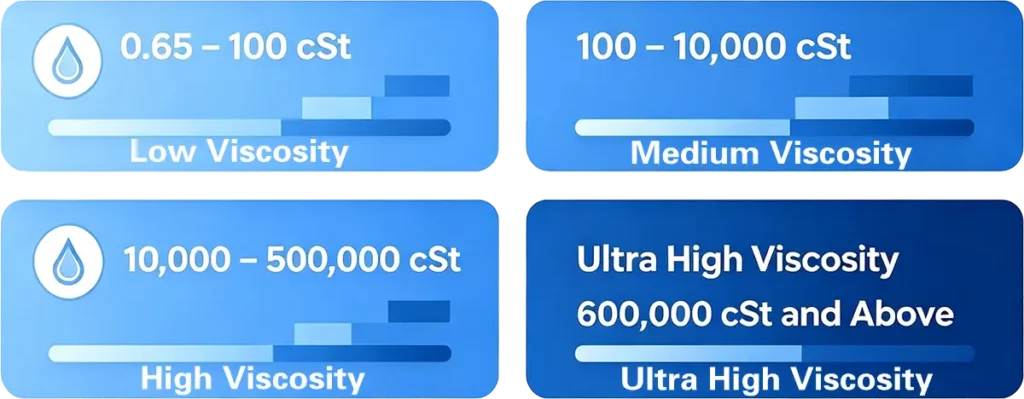
| Low Viscosity (0.65–100 cSt) | Fast flow, easy spreading, and low friction performance. |
| Medium Viscosity (100–10,000 cSt) | Balanced lubrication, stability, and film performance. |
| High Viscosity (10,000–500,000 cSt) | Excellent damping, lubrication, and long-term durability. |
| Ultra High Viscosity (600,000 cSt and Above) | Ultra-thick fluids for advanced damping and specialty applications. |
Silicone Fluid Application Guide
Find the Best Silicone Solution for Your Industry
- Automotive
 Automotive Lubrication, sealing, damping, protection, and adhesive solutions.
 - Electronics
 Electronics Thermal management, electrical insulation, protection, and potting applications.
 - Coatings & Paints
 Coatings & Paints Additives for improved flow, release performance, and durability.
 - Personal Care
 Personal Care Emollients, conditioning, smoothness, and enhanced spreadability.
 - Industrial
 Industrial Lubrication, release agents, antifoam, and processing aids.
Silane Coupling Agent Selection Guide
Select the ideal silane coupling agent based on substrate type, chemistry, and application requirements.
| Silane Type | Key Applications |
|---|---|
| Amino Silane | Adhesives, coatings, glass fiber, composites |
| Epoxy Silane | Epoxy systems, coatings, composites |
| Vinyl Silane | Polymer crosslinking, cables, rubber |
| Methacrylate Silane | Coatings, sealants, composites |
| Mercapto Silane | Rubber reinforcement, metal bonding |
Silicone Resin Selection Guide
Select the right silicone resin for coatings, insulation, and high-performance applications.
| Silicone Resin Type | Key Applications |
|---|---|
| Methyl Silicone Resin | Heat-resistant coatings, insulation materials |
| Methyl Phenyl Silicone Resin | High-temperature coatings, electrical applications |
| Phenyl Silicone Resin | Electronics, optical materials, specialty applications |
| Silicone Modified Resin | Coatings, adhesives, composites |
| Silicone Alkyd Resin | Industrial coatings, protective finishes |
Silicone Rubber Selection Guide
Choose the right silicone rubber for sealing, molding, and specialty applications.
| Silicone Rubber Type | Key Applications |
|---|---|
| RTV Silicone Rubber | Sealants, coatings, bonding, potting |
| HCR Silicone Rubber | Seals, gaskets, industrial components |
| LSR Silicone Rubber | Precision molding, medical, electronics |
| HTV Silicone Rubber | Automotive, insulation, high-temperature parts |
| Fluorosilicone Rubber | Chemical-resistant seals, specialty applications |
Performance Comparison
| Property | Silicone Fluids | Silicone Resin | Silicone Rubber | Silane |
|---|---|---|---|---|
| Heat Resistance | ★★★★★ | ★★★★☆ | ★★★★☆ | ★★★☆☆ |
| Chemical Resistance | ★★★★★ | ★★★★☆ | ★★★★☆ | ★★★★☆ |
| Flexibility | ★★★★★ | ★★☆☆☆ | ★★★★☆ | ★★★☆☆ |
| Electrical Properties | ★★★★☆ | ★★★★☆ | ★★★★☆ | ★★★☆☆ |
| Surface Properties | ★★★★★ | ★★★☆☆ | ★★★★☆ | ★★★★☆ |
Frequently Asked Questions
1. How do I choose the right silicone fluid viscosity?
Select viscosity according to flow requirements, operating conditions and application performance.
2. What viscosity grades of PDMS are available?
Silico® provides a wide range of PDMS viscosity grades from low to ultra-high viscosity.
3. Which silicone material is suitable for coatings?
Silicone fluids, silanes and silicone resins can improve coating performance depending on requirements.
4. What is the difference between silicone oil and silicone fluid?
Silicone oil and silicone fluid generally refer to the same PDMS-based materials. “Silicone fluid” is a broader technical term covering different viscosity grades and specialty silicone liquids.
5. Can Silico® provide samples for testing?
Yes, Silico® can provide samples for qualified applications to support product evaluation and performance testing.
Need Help Selecting the Right Silicone Material?
Silico® technical specialists can recommend suitable silicone products based on your application requirements.