
How Are Silicone Emulsions Manufactured? Formulation and Stability
Silicone emulsions are manufactured by dispersing silicone fluids, silicone polymers or other compatible silicone materials into a continuous aqueous phase using a suitable emulsifier system and controlled processing conditions. Depending on the product, manufacturing may involve high-shear mixing, homogenization, phase inversion or emulsion polymerization.
For industrial applications, the objective is not simply to produce a uniform white liquid. A well-designed silicone emulsion must maintain an appropriate particle-size distribution, meet its specified solids content and viscosity, remain compatible with the intended formulation, and retain acceptable performance during storage and use.
Silico® focuses on organosilicon materials, including silicone fluids and other silicone product categories used in industrial formulations. Understanding the relationship between silicone chemistry, emulsification and end-use requirements helps manufacturers and buyers identify the material properties that matter most when evaluating silicone emulsion solutions.
Table of Contents
- 1. What Is a Silicone Emulsion?
- 2. Raw Materials and Formulation Components
- 3. How Are Silicone Emulsions Manufactured?
- 4. Silicone Emulsification Methods Compared
- 5. Factors Affecting Silicone Emulsion Stability
- 6. Quality Control and Stability Testing
- 7. Common Manufacturing Problems and Solutions
- 8. Industrial Applications of Silicone Emulsions
- 9. How to Select a Silicone Emulsion
- 10. Conclusion
1. What Is a Silicone Emulsion?
A silicone emulsion is a dispersion in which silicone droplets are distributed throughout a continuous liquid phase, most commonly water. An emulsifier or other suitable stabilization system helps prevent the droplets from rapidly aggregating and separating.
Silicone fluids such as polydimethylsiloxane (PDMS) are generally immiscible with water. Simply mixing silicone fluid and water does not produce a stable, homogeneous aqueous formulation. Emulsification creates a dispersed system that can be easier to dilute, pump, distribute and apply in water-based industrial processes.
Oil-in-water and water-in-oil emulsions
 Oil-in-water (O/W) silicone emulsion Oil-in-water (O/W) silicone emulsionSilicone forms the dispersed phase, while water is the continuous phase. This is a common format for industrial silicone emulsions used in textile finishing, surface treatment and water-based formulations.
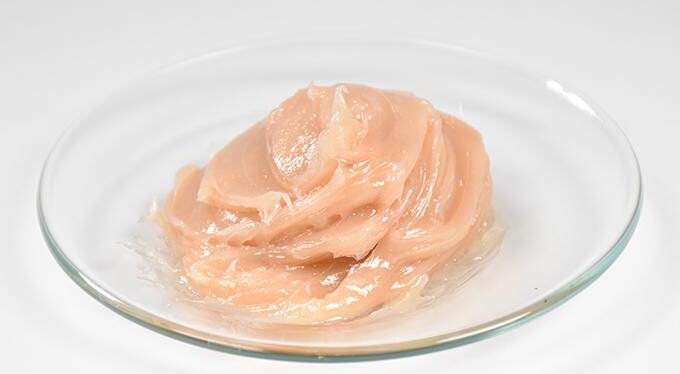 Water-in-oil (W/O) emulsion Water droplets are dispersed within a continuous oil phase. This structure is used in selected specialized formulations and requires an emulsifier system suited to the intended phase arrangement.
The distinction matters because an emulsifier that works well in an O/W formulation may not stabilize a W/O system. Silicone emulsifiers are available with different hydrophilic and hydrophobic structures, allowing manufacturers to select systems suited to the silicone phase and intended emulsion type.
Common types of silicone emulsions
| Type | Main characteristics | Potential applications |
|---|---|---|
| Dimethyl silicone emulsion | Lubricity, slip and release properties | Mold release, polishing and textile treatment |
| Amino-functional silicone emulsion | Substrate affinity and conditioning effects | Textile finishing and leather treatment |
| Reactive silicone emulsion | May form a durable film under suitable curing conditions | Water repellency and protective surface treatment |
| Silicone resin emulsion | Film-forming properties depend on resin structure | Coatings and surface modification |
| Silicone antifoam emulsion | Designed to control or suppress foam | Industrial processing and water-based systems |
These categories differ in chemistry and function. A non-reactive PDMS emulsion should not be assumed to provide the same film formation, adhesion or curing performance as a reactive silicone formulation.
It is also important to distinguish a conventional emulsion from a microemulsion. Conventional emulsions are generally kinetically stabilized, meaning that separation is slowed rather than thermodynamically eliminated. Microemulsions are a distinct class of formulation with different phase behavior.
2. Raw Materials and Formulation Components
The formulation of a silicone emulsion starts with the intended application. Silicone chemistry, viscosity, emulsifier compatibility, water quality and required solids content all influence the manufacturing route.
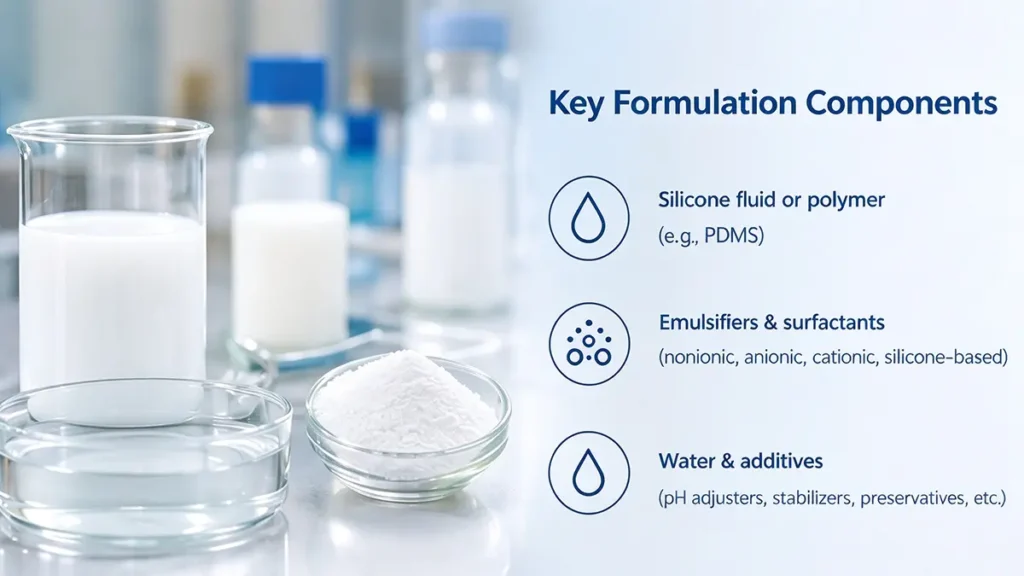
2.1 Silicone fluid or polymer
The silicone phase provides the principal functional properties of the emulsion.
PDMS is commonly selected for lubrication, surface slip and release applications. Amino-functional silicones may be used where interaction with particular substrates is important, while reactive silicones may be chosen when film formation or chemical attachment is required.
Silicone viscosity is a critical processing variable. A peer-reviewed review of silicone oil emulsions discusses studies using silicone oils with viscosities of 1, 10, 100 and 1,000 mPa·s. Under the investigated conditions, increasing oil viscosity generally resulted in larger droplets and broader size distributions. The finding illustrates why a high-viscosity silicone fluid may require different processing conditions from a low-viscosity grade.
2.2 Emulsifiers and surfactants
- Nonionic emulsifiers: Often considered when compatibility with different formulation ingredients is important.
- Anionic emulsifiers: Provide electrostatic stabilization in suitable formulations.
- Cationic emulsifiers: Used in selected systems, including certain amino-functional silicone emulsions.
- Silicone-based emulsifiers: Designed with silicone-compatible hydrophobic structures and hydrophilic groups.
2.3 Water and other formulation ingredients
- pH-adjusting agents;
- stabilizers or rheology modifiers;
- preservatives, where required;
- compatible application-specific additives.
3. How Are Silicone Emulsions Manufactured?
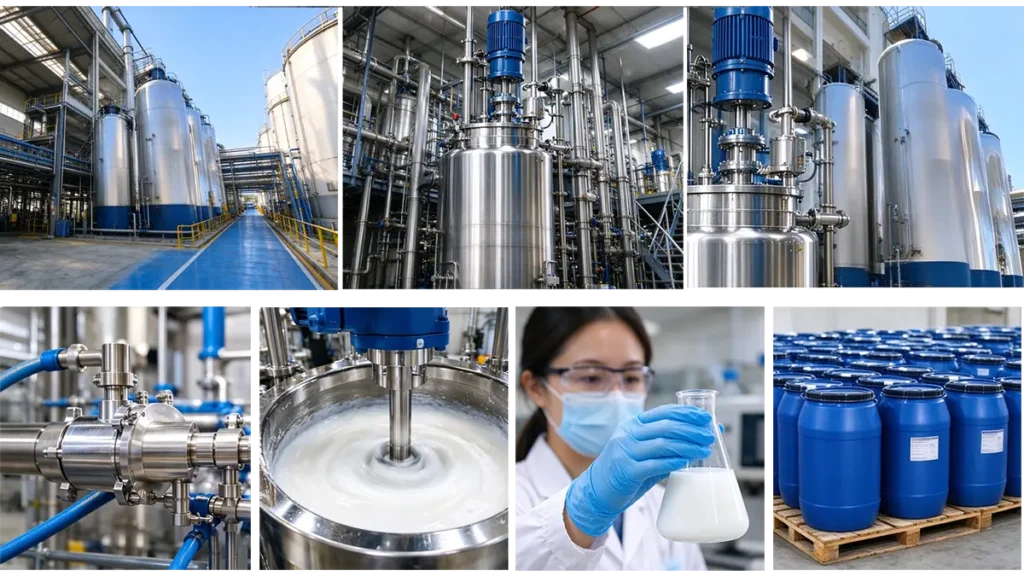
The manufacturing process depends on whether the producer is dispersing an existing silicone fluid or forming silicone polymer through emulsion polymerization.
These are distinct production routes and should not be treated as interchangeable.
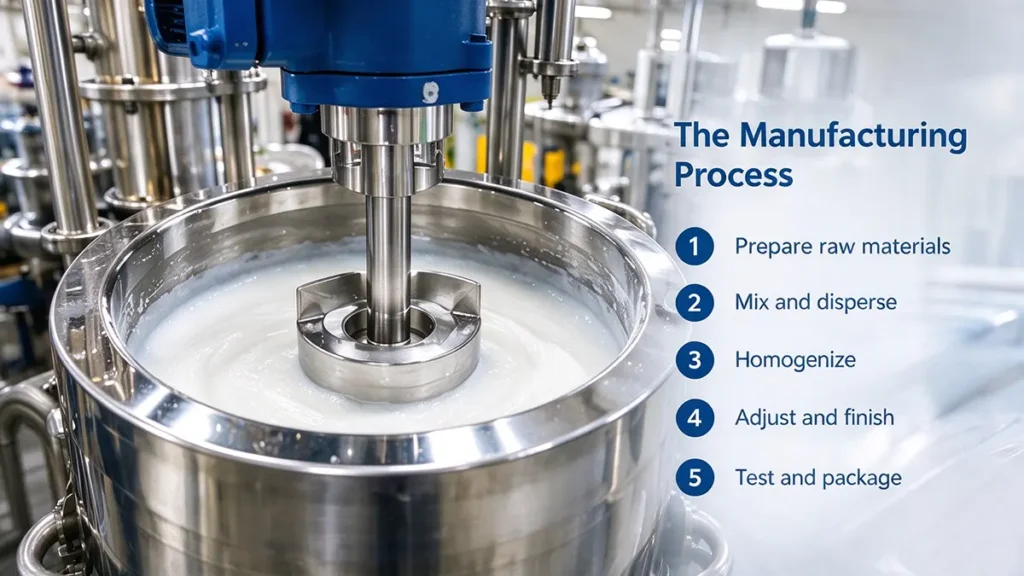
Step 1: Define the target product specification
- Silicone type and intended function.
- Active silicone content or total solids.
- Viscosity and measurement temperature.
- Emulsion type and ionic character.
- Particle size and distribution, where relevant.
- pH, appearance and dilution compatibility.
- Storage and transport requirements.
Step 2: Prepare the silicone and aqueous phases
The silicone phase and aqueous phase are prepared according to the selected formulation.
The silicone may be conditioned or premixed with a compatible emulsifier. The aqueous phase is prepared with the required emulsifier and other ingredients.
Ingredient order, temperature and premixing conditions must be established for the particular system. Poor initial dispersion can make it more difficult to obtain a uniform final particle-size distribution.
Step 3: Produce a preliminary emulsion
The silicone phase is dispersed into the aqueous phase, or the ingredients are processed using a suitable phase-inversion route.
High-shear mixing can break the silicone into smaller droplets and produce a preliminary emulsion. The dispersion may still contain a broad range of droplet sizes, so additional homogenization may be required.
The objective is to create a consistent intermediate for subsequent processing, not simply to achieve a uniform appearance.
Step 4: Homogenize and control droplet size
| Variable | Effect on the process |
|---|---|
| Silicone viscosity | Influences how readily droplets deform and break |
| Emulsifier system | Affects interfacial stabilization after droplet breakup |
| Mixing intensity | Influences droplet breakup and dispersion uniformity |
| Processing time or number of passes | Determines total energy input and can affect the size distribution |
| Temperature rise | May change viscosity and emulsifier behavior |
Higher energy input can reduce droplet size, but continued processing does not always improve the product. The operating window should be established through particle-size analysis, stability testing and application performance.
Step 5: Complete and adjust the formulation
After homogenization, the product may undergo cooling, controlled dilution, pH adjustment, deaeration or other finishing operations.
Reactive silicone emulsions may require additional formulation or curing considerations. Their film-forming behavior depends on the silicone chemistry and intended curing conditions.
Any preservative system must be compatible with the formulation and appropriate for its intended market and use.
Step 6: Test, package and release
The finished product is tested against its specification. Typical checks include solids content, viscosity, pH, appearance and particle size where applicable.
Stability and compatibility tests may also be required before release. Packaging must be compatible with the product, and storage instructions should reflect its validated conditions.
A product that appears uniform immediately after manufacturing is not necessarily stable during storage or after dilution.
An alternative route: Emulsion polymerization
In emulsion polymerization, silicone polymer is formed or grows within an emulsion system rather than being introduced solely as a pre-existing finished fluid.
For example, Momentive’s technical information for Indusil 2112 describes a reactive silicone emulsion produced by emulsion polymerization, with a stated total solids range of 35–41%. This is a specific commercial example, not a universal solids target for silicone emulsions.
4. Silicone Emulsification Methods Compared
| Method | Main purpose | Important considerations |
|---|---|---|
| High-shear mixing | Initial dispersion and droplet breakup | Performance depends on mixer design and formulation |
| High-pressure homogenization | Producing finer dispersions | Pressure, passes, temperature and cooling need control |
| Phase-inversion emulsification | Creating a suitable phase structure through controlled formulation or process changes | Strongly dependent on ingredient ratios and phase behavior |
| Ultrasonication | Specialized fine emulsions and laboratory development | Scale-up, energy distribution and heating can be limiting factors |
| Membrane emulsification | Controlling droplet formation in suitable systems | Throughput and membrane compatibility need evaluation |
A peer-reviewed review identifies homogenization, ultrasonication and mechanical stirring among the conventional approaches used to prepare silicone oil emulsions. It also highlights the importance of droplet size and uniformity in stability and application performance.
The method should be selected based on the required product properties rather than on the assumption that the most intensive process will always produce the best emulsion.
5. Factors Affecting Silicone Emulsion Stability
5.1 Particle size and size distribution
Silico®’s silicone emulsion technical overview reports that particle sizes for many silicone emulsions are typically around 0.2–0.5 μm. The same source describes differences in appearance and stability across particle-size ranges. These values are useful as a reference, not as a universal target for all silicone emulsions.
Smaller droplets can reduce the rate of gravitational separation under suitable conditions, but particle size alone does not guarantee stability. The width of the size distribution, emulsifier coverage and continuous-phase properties also matter.
5.2 Silicone viscosity
Higher-viscosity silicone fluids can be more difficult to break into small droplets under otherwise comparable processing conditions.
A formulation using a high-viscosity silicone may therefore require a different mixing strategy, emulsifier system or homogenization process. The final choice should be based on measured particle size and stability rather than viscosity alone.
rmance under storage and temperature cycling.
5.3 Emulsifier concentration and compatibility
An appropriate emulsifier concentration helps cover newly formed droplet surfaces and limits coalescence.
However, increasing emulsifier concentration indefinitely is not an effective universal solution. The optimal concentration depends on the silicone phase, water phase and manufacturing conditions. Excess emulsifier may also affect cost, foam, application properties or compatibility with other ingredients.
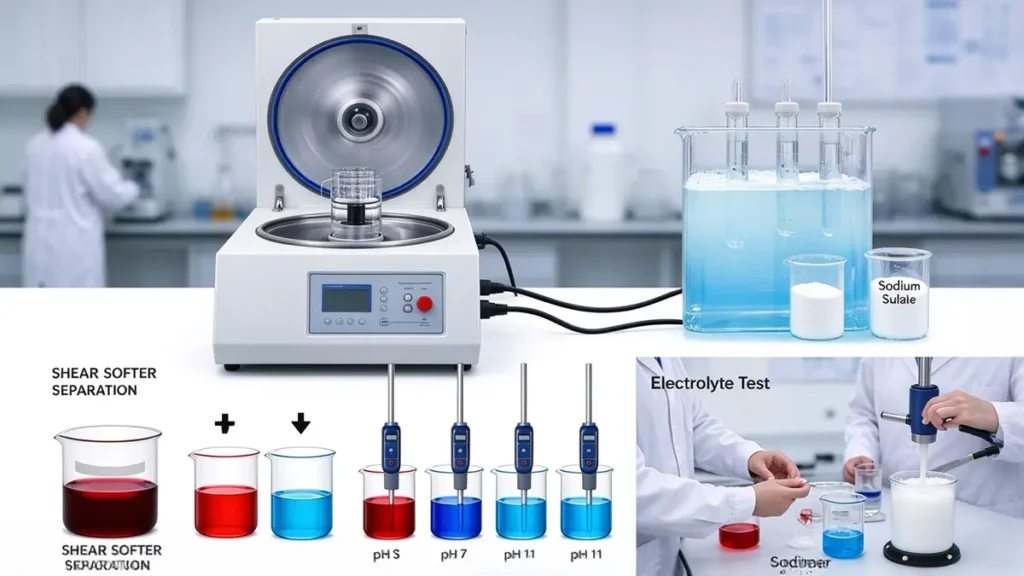
5.4 Water quality, pH and electrolytes
Water hardness and dissolved salts may affect charge-based stabilization. pH changes can also influence certain emulsifier systems and functional silicone materials.
For example, Momentive’s guidance for a particular reactive silicone emulsion recommends softened water when water hardness is at or above 200 ppm. This is a product-specific recommendation, not a general limit for every silicone emulsion.
Water quality and pH requirements should therefore be established for the specific formulation and downstream process.
5.5 Temperature and storage
Temperature changes can alter viscosity, interfacial behavior and the rate of physical changes during storage. Freezing and thawing can damage some formulations.
Stability evaluation should reflect realistic storage, transport and application conditions. Accelerated aging can help compare candidate formulations, but it should not be used alone to claim a commercial shelf life without supporting validation.
Common instability mechanisms
| Mechanism | What happens | What to investigate |
|---|---|---|
| Creaming | Droplets migrate upward | Droplet size, density difference and continuous-phase viscosity |
| Flocculation | Droplets form clusters | Emulsifier coverage, ionic strength and compatibility |
| Coalescence | Droplets merge into larger droplets | Interfacial stabilization and processing conditions |
| Phase inversion | The continuous and dispersed phases change roles | Formulation ratios and phase behavior |
| Microbial deterioration | Microorganisms affect a susceptible water-based product | Manufacturing hygiene, preservation and microbiological testing |
The corrective action should target the mechanism responsible for instability. Increasing viscosity, for example, may slow creaming without resolving chemical incompatibility or coalescence.
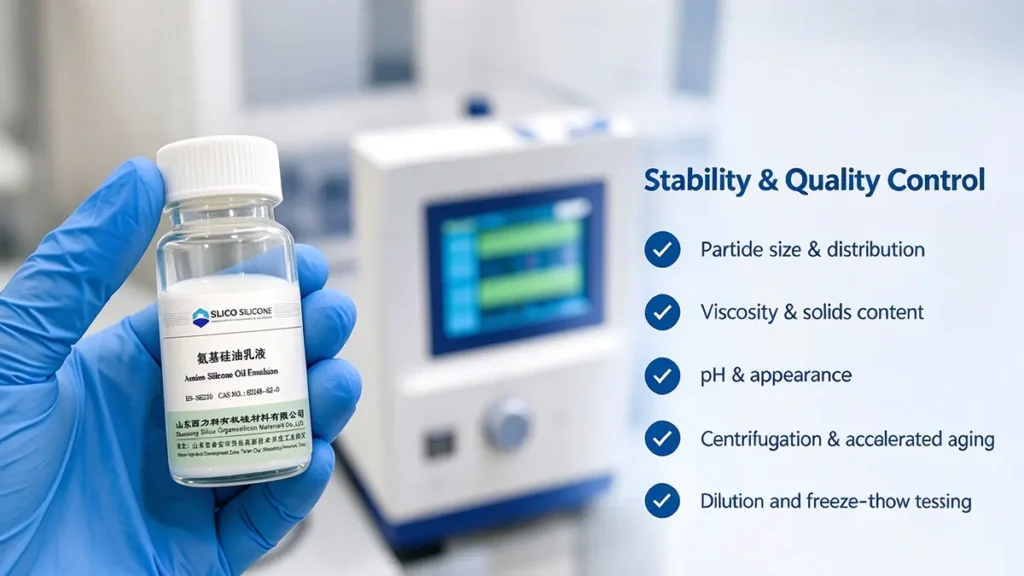
6. Quality Control and Stability Testing
| Test | Purpose |
|---|---|
| Appearance | Detect visible separation, coagulation and foreign matter |
| Solids content | Verify formulation consistency using a defined method |
| pH | Check compliance with the product specification |
| Viscosity | Evaluate flow behavior under specified conditions |
| Particle-size distribution | Assess dispersion quality and changes during storage |
| Centrifugation | Screen for susceptibility to accelerated separation |
| Accelerated aging | Compare formulation behavior at elevated temperature |
| Dilution compatibility | Determine whether the emulsion remains stable in intended process water |
| Freeze–thaw testing | Evaluate sensitivity to relevant low-temperature conditions |
Particle-size analysis
Dynamic light scattering can be useful for suitable fine dispersions, while laser diffraction may be more appropriate for other particle-size ranges. Sample dilution, measurement settings and data processing can affect the reported results.
Comparisons between production batches and stability samples should use a consistent method.
Zeta potential
Zeta potential can help characterize the electrostatic behavior of suitable dispersed systems. It is particularly relevant when the emulsion relies on charge-based stabilization.
However, no single zeta-potential value guarantees stability for every silicone emulsion. Nonionic systems may rely more heavily on steric stabilization, so zeta potential should be interpreted alongside particle size, viscosity, formulation chemistry and storage results.
Accelerated stability testing
Centrifugation and elevated-temperature storage can help identify weaknesses in a candidate formulation before longer-term evaluation is complete.
A published silicone nanoemulsion study reported an average particle size of approximately 300 nm initially and 315 ± 113 nm after 30 days at 40°C. This illustrates the use of measured particle-size data in stability assessment, but the result applies to that specific experimental formulation.
Commercial release criteria and shelf-life claims should be based on product-specific evidence and validated testing procedures.
7. Common Manufacturing Problems and Solutions
| Problem | Possible cause | Recommended investigation |
|---|---|---|
| Visible creaming or separation | Large droplets or insufficient resistance to droplet movement | Review particle size, rheology and storage conditions |
| Coagulation during production | Incompatible ingredients or inadequate interfacial stabilization | Check emulsifier compatibility, addition sequence and mixing conditions |
| Separation after dilution | Water hardness, salts, pH or incompatible additives | Test the actual dilution water and application formulation |
| Inconsistent viscosity | Changes in solids content, droplet distribution or processing | Review raw materials, solids, temperature and production records |
| Excessive foam | Air entrainment or unsuitable mixing conditions | Review agitation, equipment design and deaeration |
| Poor surface performance | Incorrect silicone chemistry or application dosage | Evaluate the silicone type, substrate and process conditions |
| Instability during storage | Temperature exposure or gradual physical changes | Compare retained samples, particle size and storage history |
A common mistake is to assume that all separation problems can be solved by increasing mixing intensity. Better homogenization may improve the initial dispersion, but it will not necessarily correct an incompatible emulsifier system or unsuitable water chemistry.
8. Industrial Applications of Silicone Emulsions
Silicone emulsions allow silicone functionality to be incorporated into a range of aqueous processes. The required chemistry and stability profile depend on the application.
Textile finishing
Silicone emulsions can provide softness, lubrication and improved fabric handling. Different silicone chemistries can produce different fabric feel, deposition and durability characteristics.
Mold release and industrial processing
Silicone emulsions are used in selected mold-release applications involving rubber, plastics and other materials. Release performance should be evaluated alongside residue, substrate compatibility and any effects on subsequent coating or bonding.
Coatings, leather and water repellency
Certain reactive silicone emulsions can form films after water evaporation and suitable curing. Depending on their chemistry, they may contribute to hydrophobicity, surface modification or coating performance.
Not all silicone emulsions are reactive or capable of producing durable crosslinked films. The relevant properties must be verified for the specific product.
Polishing, lubrication and surface treatment
Silicone emulsions can contribute slip, lubrication, gloss or water repellency in selected formulations. Stability in the supplied concentrate does not automatically guarantee stability after blending with other ingredients, so application-specific compatibility testing remains important.

9. How to Select a Silicone Emulsion
- Application: Is the product intended for textile finishing, mold release, surface treatment, coatings or another use?
- Silicone chemistry: Is dimethyl silicone, amino-functional silicone, reactive silicone or another type appropriate?
- Solids content: What concentration is required, and how will the product be diluted?
- Physical properties: Which viscosity, particle-size and appearance requirements are necessary?
- Compatibility: Will the product contact hard water, salts, surfactants, polymers or other additives?
- Stability: What storage temperatures, transport conditions and shelf-life requirements apply?
- Quality documentation: Which specification limits, test methods and supporting technical documents are required?
10. Conclusion
Silicone emulsion manufacturing requires coordinated control of silicone chemistry, emulsifier selection, droplet formation, homogenization and storage conditions. The best formulation is not necessarily the one with the smallest droplets or the highest emulsifier concentration, but the one that meets the required application performance while maintaining consistent quality and stability.
For industrial producers and buyers, a systematic approach—defining specifications, selecting compatible raw materials, optimizing processing conditions and validating stability—is more reliable than relying on appearance alone.
Silico® provides a portfolio of organosilicon materials for industrial applications. For silicone emulsion-related inquiries, defining the intended use, silicone chemistry, target solids content, viscosity and compatibility requirements is a practical starting point for identifying an appropriate material and evaluating its performance.
Frequently Asked Questions (FAQs)
Conventional silicone emulsions are generally produced by dispersing silicone fluid or polymer into an aqueous phase with a suitable emulsifier, followed by mixing and, where required, homogenization. Other products are produced through emulsion polymerization.
Typical ingredients include a silicone phase, water and an emulsifier. Depending on the formulation, stabilizers, pH-adjusting agents, preservatives or other additives may also be used.
Silico® reports a typical particle-size range of approximately 0.2–0.5 μm for many silicone emulsions. Actual values vary with silicone chemistry, emulsifier system and production method.
There is no universal value. Commercial products are available at different concentrations depending on their chemistry and intended use. For example, one reactive silicone emulsion technical data sheet reports 35–41% total solids. The figure should not be generalized to all silicone emulsions.
Separation can result from creaming, flocculation, coalescence, incompatible ingredients, unsuitable water quality or temperature exposure. Identifying the actual mechanism is the first step toward correcting the problem.
No. Smaller droplets may reduce gravitational separation in suitable systems, but long-term stability also depends on emulsifier coverage, particle-size distribution, continuous-phase properties and chemical compatibility.
Many are designed for dilution, but compatibility depends on the product, water hardness, pH and other ingredients. The recommended dilution procedure should be checked under actual application conditions.
Silicone fluid is the silicone material itself, such as liquid PDMS. A silicone emulsion is a dispersion of silicone droplets in a continuous phase, usually water, maintained by an appropriate stabilization system.
Silicone Emulsion related products



If you want to know other questions about Silicone Emulsion, please contact us and we will provide professional answers.
Popular Recommendations
Get a Catalog & Best Price
- Quick and helpful reply within 24 hours;
- Tailored solutions provided for your project;
- One-stop purchasing service.
Need More Technical Information?
Silico® ORGANOSILICON
- Address: Daiyue Industrial Area, Taian, Shandong, China
- © Copyright 2022 Silico® . All Rights Reserved