
Why Does Silicone Emulsion Separate? Causes and Solutions
Silicone emulsions are widely used in textile finishing, mold release, rubber and plastic processing, polishing, coatings, lubrication, personal care and other water-based applications. They provide an efficient way to deliver silicone fluids in a water-dispersible form.
However, silicone emulsion separation is a common formulation and storage problem. An emulsion may initially appear uniform but later develop a clear water layer, silicone-rich layer, sediment, cream-like concentration, flocculation or complete phase separation.
The important point is that separation is not caused by a single mechanism. It may result from creaming, flocculation, coalescence, Ostwald ripening, or a combination of these processes.
Understanding the type and timing of separation is the first step toward finding the right solution.
Silico® provides silicone fluid materials for different industrial applications, while the final stability of a silicone emulsion depends on the complete formulation, emulsifier system, processing conditions and application requirements.
Table of Contents
- 1. What Is a Silicone Emulsion?
- 2. What Does Silicone Emulsion Separation Look Like?
- 3. Why Does Silicone Emulsion Separate?
- 4. Cause 1: Insufficient or Incompatible Emulsifier
- 5. Cause 2: Droplet Size and Particle Size Distribution
- 6. Cause 3: pH Changes
- 7. Cause 4: Electrolytes and Other Additives
- 8. Cause 5: Incorrect Dilution
- 9. Cause 6: Temperature and Freeze-Thaw Conditions
- 10. Cause 7: Inadequate Mixing and Shear
- 11. Cause 8: Silicone Chemistry and Viscosity
- 12. How to Diagnose a Separating Silicone Emulsion
- 13. How to Improve Silicone Emulsion Stability
- 14. Practical Stability Testing
- Frequently Asked Questions
- Conclusion
1. What Is a Silicone Emulsion?
A silicone emulsion is a dispersion of silicone fluid in water, normally stabilized by an emulsifier or surfactant system.
Silicone fluids such as polydimethylsiloxane (PDMS) are generally insoluble in water. During emulsification, the silicone phase is broken into small droplets and distributed throughout the aqueous phase.
Commercial silicone emulsions may contain approximately 20–60% silicone solids, depending on the product and application. Silicone emulsions can also be classified by droplet size, with macroemulsions and microemulsions showing different physical properties and application behavior.
A typical silicone emulsion contains three main components:
- Silicone phase
- Water phase
- Emulsifier or stabilizer system
The stability of the emulsion depends largely on how these components interact at the silicone-water interface.
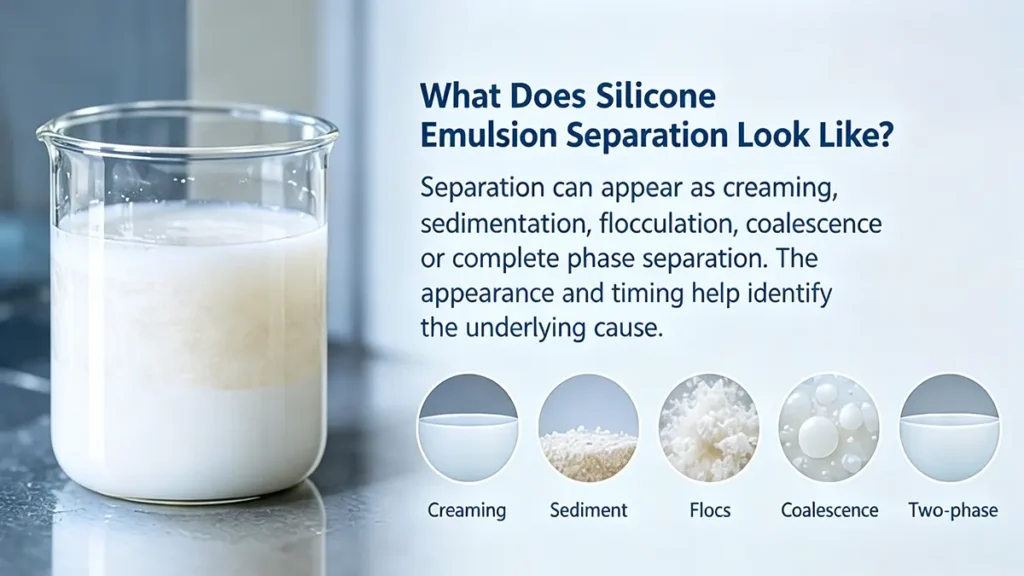
2. What Does Silicone Emulsion Separation Look Like?
Creaming
Silicone droplets move upward because the silicone phase is generally less dense than water.
The concentrated layer may still be easily redispersed, so creaming does not necessarily mean irreversible failure.Sedimentation
Flocculation
Droplets remain individually intact but form loose clusters.
Depending on the formulation, flocculation may be reversible.Coalescence
Two or more silicone droplets merge into a larger droplet.
Significant coalescence can permanently change the original droplet-size distribution and make recovery difficult.Complete Phase Separation
A distinct silicone-rich layer and water-rich layer form.
At this stage, simple stirring may no longer restore the original emulsion structure.
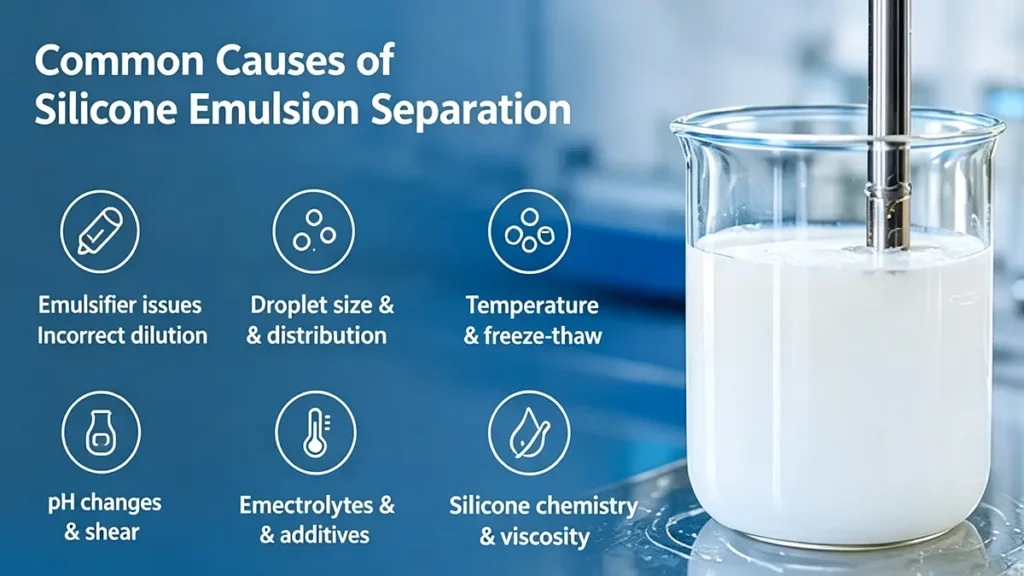
3. Why Does Silicone Emulsion Separate?
| Cause | Typical Result | Practical Approach |
|---|---|---|
| Incorrect emulsifier system | Flocculation or coalescence | Optimize emulsifier chemistry |
| Insufficient emulsifier | Large droplets, poor stability | Optimize emulsifier level |
| Broad droplet-size distribution | Faster aging and separation | Improve homogenization |
| Unsuitable pH | Loss of interfacial stability | Control formulation pH |
| Electrolytes | Changed droplet interactions | Control ionic strength |
| Incompatible additives | Flocculation or precipitation | Test compatibility |
| Incorrect dilution | Shock instability | Optimize dilution procedure |
| High temperature | Faster degradation | Control storage temperature |
| Freezing | Interfacial damage | Avoid freeze-thaw exposure |
| Inadequate or excessive shear | Poor dispersion or instability | Optimize mixing conditions |
| High silicone viscosity | Difficult emulsification | Adjust process conditions |
| Long storage | Gradual droplet growth | Improve formulation stability |
4. Cause 1: Insufficient or Incompatible Emulsifier
The emulsifier is one of the most important components of a silicone emulsion.
During emulsification, new silicone-water interfacial area is created. Surfactant molecules must adsorb at the interface and provide sufficient protection.
If the emulsifier level is too low, silicone droplets may not be adequately stabilized. This can lead to:
large droplets → droplet collision → film drainage → coalescence → phase separation
Increasing emulsifier concentration can improve stability in some systems, but adding more surfactant is not always the best solution.
Excess surfactant may affect:
- Foaming
- Wetting
- Viscosity
- Surface feel
- Water resistance
- Additive compatibility
The goal is therefore to select an appropriate emulsifier system and concentration, rather than simply maximizing surfactant content.
5. Cause 2: Droplet Size and Particle Size Distribution
Droplet size is an important factor in silicone emulsion stability.
Poor emulsification can produce:
- Large droplets
- Very small droplets
- A broad droplet-size distribution
Large droplets generally cream faster, while a broad distribution can contribute to long-term instability.
Smaller and more uniform droplets can improve stability in many systems, but smaller is not automatically better.
The appropriate droplet size depends on:
- Silicone viscosity
- Emulsifier chemistry
- Active content
- Application method
- Required appearance
- Storage conditions
A macroemulsion and a microemulsion may both be stable but behave differently during dilution, storage and application.
6. Cause 3: pH Changes
pH can strongly affect silicone emulsion stability, particularly when ionic or pH-sensitive stabilizers are used.
A pH change can affect:
- Surface charge
- Surfactant ionization
- Polymer behavior
- Interfacial adsorption
- Electrostatic repulsion
As a result, an emulsion that is stable at its original pH may become unstable after an acidic or alkaline ingredient is introduced.
There is no universal ideal pH for all silicone emulsions. The suitable range depends on the silicone chemistry and stabilizer system.
Practical Recommendation
When developing a formulation:
- Measure the starting pH.
- Adjust pH gradually.
- Observe the emulsion after adjustment.
- Check stability after 24 hours and 7 days.
- Repeat testing at the intended working concentration.
Large pH adjustments should be avoided during a single addition.
7. Cause 4: Electrolytes and Other Additives
Electrolytes are another common cause of unexpected silicone emulsion instability.
Potential sources include:
- Sodium chloride
- Calcium salts
- Magnesium salts
- Dyes
- Textile auxiliaries
- Preservatives
- pH buffers
- Ionic polymers
- Water-treatment chemicals
Electrolytes can change droplet interactions and, in some systems, reduce electrostatic stabilization.
Importantly, electrolytes do not always cause immediate phase separation. They may first change rheology, droplet interactions or creaming behavior, followed by visible instability during storage.
Practical Compatibility Test
If separation occurs only after another ingredient is added, prepare:
- Silicone emulsion + water
- Silicone emulsion + additive
- Silicone emulsion + complete formulation
Comparing these samples can help identify the incompatible component.
8. Cause 5: Incorrect Dilution
Many commercial silicone emulsions are supplied as concentrates and diluted before use.
Dilution changes the relative concentrations of:
- Silicone
- Water
- Emulsifier
- Stabilizer
- Electrolytes
An unsuitable dilution procedure can disturb the stabilizing system and cause rapid separation.
Recommended Dilution Practice
- Use clean, compatible water.
- Start gentle agitation.
- Add the emulsion gradually.
- Avoid excessive foam.
- Continue mixing until uniform.
- Allow the diluted system to equilibrate before evaluating stability.
The correct dilution ratio and addition sequence are product-specific. The supplier’s technical data should therefore take priority over a general dilution rule.
9. Cause 6: Temperature and Freeze-Thaw Conditions
Temperature has a significant effect on silicone emulsion stability.
High temperatures may accelerate:
- Surfactant redistribution
- Droplet collisions
- Chemical degradation
- Microbial growth in susceptible systems
- Viscosity changes
Freezing creates a different problem. When an aqueous silicone emulsion freezes, water crystallization can concentrate silicone droplets and stabilizers into smaller unfrozen regions. This may damage the interfacial structure and promote coalescence after thawing.
Storage Recommendation
Whenever possible:
- Avoid freezing.
- Avoid prolonged high-temperature exposure.
- Keep containers properly closed.
- Minimize repeated temperature cycling.
- Follow the recommended storage conditions.
Heat aging and freeze-thaw testing should be based on the actual product specification and expected transportation and storage conditions.
10. Cause 7: Inadequate Mixing and Shear
Mixing affects both the initial emulsion structure and its behavior during dilution.
Too little shear can result in:
- Large droplets
- Incomplete dispersion
- Broad droplet-size distribution
Too much shear may also be undesirable in certain formulations because it can increase temperature or disturb some polymeric and surfactant stabilization systems.
The objective is not simply more shear, but the right combination of:
- Mixing speed
- Mixing time
- Equipment geometry
- Temperature
- Addition rate
- Energy density
During scale-up, laboratory rpm should not simply be transferred to a production tank. The actual mixing and energy environment must be considered.
11. Cause 8: Silicone Chemistry and Viscosity
Not all silicone fluids behave the same way during emulsification.
PDMS viscosity can range from low-viscosity fluids to very high-viscosity materials. As viscosity increases, droplet breakup becomes more difficult and the required emulsification conditions may change.
Functional silicone fluids can also behave differently from conventional dimethyl silicone fluids because functional groups may affect:
- Interfacial adsorption
- Emulsifier requirements
- Water compatibility
- Droplet interactions
- Final film properties
For example, changing from a 100 cSt silicone fluid to a 1,000 cSt silicone fluid while keeping the same emulsifier package and process conditions may result in a significantly different emulsion.
The silicone polymer should therefore be considered part of the overall stabilization system.
12. How to Diagnose a Separating Silicone Emulsion
When a silicone emulsion separates, the first question should not be:
“Which stabilizer should we add?”
A better starting point is:
“What type of separation is occurring, and when did it begin?”
Step 1: Check the Appearance
- Thin water layer
- Silicone-rich layer
- Creaming
- Sediment
- Flocs
- Large visible droplets
- Complete two-phase separation
Step 2: Check the Timeline
- Immediately after manufacture
- After dilution
- After adding another chemical
- After several days
- After heating
- After freezing
- After transportation
The timing often provides an important clue.
Step 3: Measure pH
Compare the current pH with the original product specification.
Step 4: Check Dilution Water
- Hardness
- Conductivity
- Total dissolved solids
- Chloride
- Calcium and magnesium
Step 5: Check Droplet Size
- Normal droplets
- Flocculated droplets
- Enlarged droplets
- Strong coalescence
Step 6: Check Viscosity
A significant viscosity change may indicate changes in droplet interactions or the continuous-phase structure.
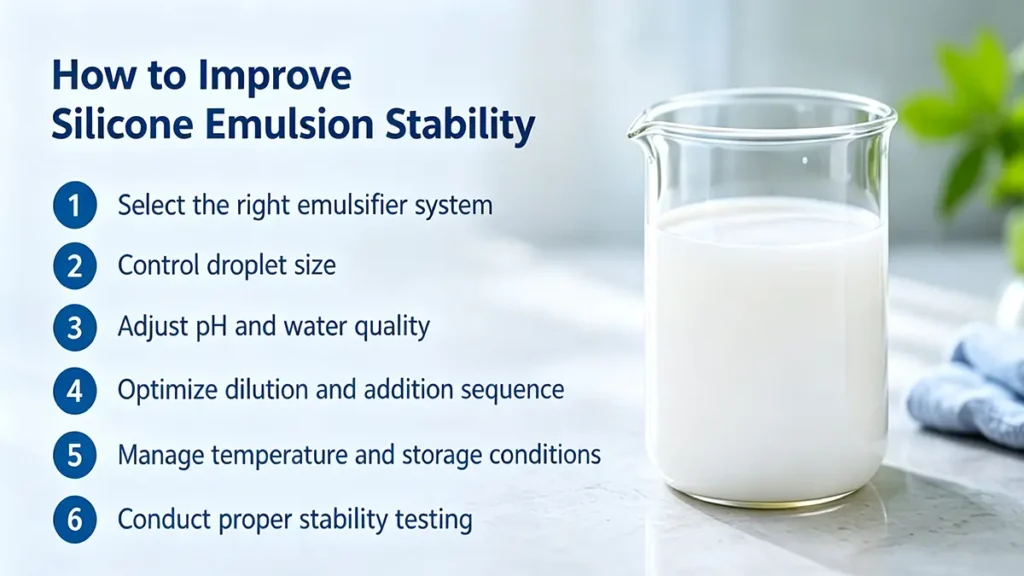
13. How to Improve Silicone Emulsion Stability
13.1 Select the Correct Emulsifier System
- Silicone chemistry
- Water phase
- Ionic character
- Target pH
- Application additives
An emulsifier system suitable for one silicone chemistry should not automatically be applied to another.
13.2 Optimize Emulsifier Concentration
Too little emulsifier may leave the interface inadequately protected, while excessive emulsifier can create other formulation problems.
Optimization should be based on controlled testing.
13.3 Control Droplet Size
Use an appropriate homogenization process to achieve a controlled droplet-size distribution. Measurement is preferable to relying only on mixing time or equipment settings.
13.4 Control pH
Establish the stable pH range experimentally rather than assuming that all silicone emulsions should operate near neutral pH.
13.5 Control Water Quality
For sensitive formulations, controlled-quality or deionized water may be preferable. Hard water can introduce calcium and magnesium ions that affect surfactants and polymers.
13.6 Control Addition Sequence
Addition order can significantly affect stability. Concentrated electrolytes, polymers or acids should not automatically be added directly into a concentrated silicone emulsion.
Different addition sequences should be tested at laboratory scale.
13.7 Establish Realistic Storage Specifications
A silicone emulsion should be evaluated under the temperatures and storage periods it is expected to experience.
A product that remains stable for seven days at room temperature may still change after:- Extended elevated-temperature storage
- Multiple freeze-thaw cycles
- Long-distance transportation
- Repeated temperature fluctuations
14. Practical Stability Testing
| Test | Typical Purpose |
|---|---|
| Appearance | Detect visible separation |
| pH | Monitor formulation changes |
| Viscosity | Detect rheological changes |
| Particle size | Detect droplet growth |
| Centrifugation | Accelerated screening |
| Heat aging | Evaluate temperature stability |
| Freeze-thaw | Evaluate low-temperature resistance |
| Dilution test | Evaluate working-solution stability |
| Compatibility test | Identify additive interactions |
A Practical Laboratory Protocol
Prepare identical samples and expose them to several conditions, such as:
- Room temperature
- Elevated temperature
- Diluted condition
- Diluted + electrolyte
- Diluted + target formulation
- Freeze-thaw cycle
Record appearance and relevant physical properties at fixed intervals.
A practical evaluation schedule is:
0 h → 24 h → 72 h → 7 days → 14 days → 28 days
The exact conditions should be adapted to the product, formulation and intended shelf life.
For commercial silicone emulsions, supplier specifications should always take precedence over generic stability conditions.
Frequently Asked Questions
Dilution changes the concentration of silicone, emulsifier, stabilizer and dissolved salts. Unsuitable dilution methods or water quality can disturb interfacial stabilization.
Salt increases ionic strength and can change electrostatic interactions or the structure of the stabilizing layer. The effect depends on the emulsifier and silicone chemistry.
Yes. Changes in pH can affect surfactant ionization, polymer behavior and interfacial charge. The acceptable pH range is product-specific.
Yes. Freezing can concentrate droplets and stabilizers in unfrozen regions and damage the interfacial structure. Coalescence may become visible after thawing.
Slow instability mechanisms such as creaming, flocculation, coalescence and Ostwald ripening can develop over time. An emulsion may therefore appear stable initially but gradually lose its original droplet structure.
Not necessarily. Additional surfactant may improve stability in some formulations, but if significant coalescence has already occurred or another ingredient is incompatible, it may not restore the original emulsion.
If the concentrated layer can be easily redispersed and microscopy shows that droplets remain largely intact, creaming may be dominant. If droplets have merged into much larger droplets, coalescence has occurred and recovery is more difficult.
Conclusion
Silicone emulsion separation is usually caused by an interaction of several factors rather than one isolated problem.
The main variables include:
silicone chemistry → emulsifier system → droplet size → pH → electrolytes → dilution → temperature → mixing conditions
The key distinction is between temporary physical concentration and irreversible emulsion breakdown.
- Creaming may be reversible.
- Flocculation may be reversible depending on the formulation.
- Coalescence is more serious because individual droplets merge.
- Ostwald ripening can gradually increase droplet size and reduce long-term stability.
For this reason, the solution is not simply to add more surfactant or increase mixing speed. A reliable silicone emulsion should be designed, processed and tested as a complete system.
A practical troubleshooting sequence is:
Identify the separation mechanism → check pH and water quality → examine droplet size → review emulsifier compatibility → check dilution and addition order → evaluate temperature history → conduct controlled stability tests.
For silicone emulsion manufacturers and formulators, this systematic approach can reduce trial-and-error during product development and help distinguish formulation problems from storage or processing issues.
For companies evaluating silicone fluid materials for emulsion development, Silico® offers a range of silicone materials for different industrial formulation and application requirements, providing a practical starting point for material selection and technical evaluation.
Silicone Emulsion related products


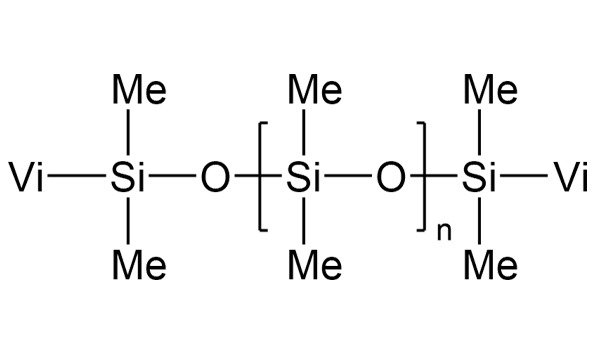

If you want to know other questions about Silicone Emulsion, please contact us and we will provide professional answers.
Popular Recommendations
Get a Catalog & Best Price
- Quick and helpful reply within 24 hours;
- Tailored solutions provided for your project;
- One-stop purchasing service.
Need More Technical Information?
Silico® ORGANOSILICON
- Address: Daiyue Industrial Area, Taian, Shandong, China
- © Copyright 2022 Silico® . All Rights Reserved