
How Silicone Additives Improve Paint and Coating Performance
Silicone additives play an important role in modern paint and coating formulations by improving substrate wetting, flow and leveling, surface slip, scratch resistance and foam control. Depending on their chemical structure and compatibility with the coating system, selected silicone additives can also improve water repellency, surface appearance and processing efficiency.
Unlike the primary binder, which forms the coating film and contributes to its mechanical and protective properties, silicone additives are generally used to modify specific formulation or surface characteristics. Their performance depends on factors such as molecular structure, active content, dosage, binder chemistry, substrate properties and curing conditions.
For coating manufacturers, selecting the right silicone additive requires more than identifying a desired benefit. A material that improves surface slip, for example, may affect intercoat adhesion or recoating performance if its chemistry or dosage is unsuitable.
Silico® works with organosilicon materials used in industrial applications, including silicone fluids, silicone resins and related silicone-based materials. Understanding the differences between these material categories helps formulators identify suitable candidates for their coating systems and establish appropriate performance tests.
Table of Contents
- 1. What Are Silicone Additives for Paint and Coatings?
- 2. How Silicone Additives Improve Coating Performance
- 3. Silicone Additives for Different Coating Applications
- 4. How to Select the Right Silicone Additive
- 5. Silicone Additive Dosage and Formulation Testing
- 6. Common Formulation Problems and Solutions
- 7. Conclusion
- Frequently Asked Questions
1. What Are Silicone Additives for Paint and Coatings?
- Wetting agents: Improve coating spread and coverage on suitable substrates.
- Flow and leveling agents: Help control surface uniformity during film formation.
- Slip additives: Reduce surface friction and improve handling characteristics.
- Defoamers: Control unwanted foam during mixing, processing and application.
- Hydrophobic additives: Modify the interaction between water and the coating surface.
- Reactive surface modifiers: Provide specific surface effects and, where designed to do so, participate in or become integrated into the coating network.
Silicone Additives vs. Silicone Fluids vs. Silicone Resins
| Material category | Primary role | Typical consideration |
|---|---|---|
| Silicone additives | Modify specific coating properties | Compatibility, dosage and targeted performance |
| Silicone fluids | Provide fluid-phase or surface-modifying functionality in suitable formulations | Viscosity, chemical structure and compatibility |
| Silicone resins | Serve as film-forming or resin components in appropriate coating systems | Heat resistance, film properties, curing and binder compatibility |
| Silane coupling agents | Promote interfacial bonding in suitable systems | Functional groups, substrate chemistry and reaction conditions |
The categories may overlap in some applications, but they should not be treated as equivalent. Some specialty silicone fluids are formulated and marketed as coating additives, while other silicone fluids require modification or formulation work before they are suitable for a particular coating system.
2. How Silicone Additives Improve Coating Performance
2.1 Improve Substrate Wetting and Coating Coverage
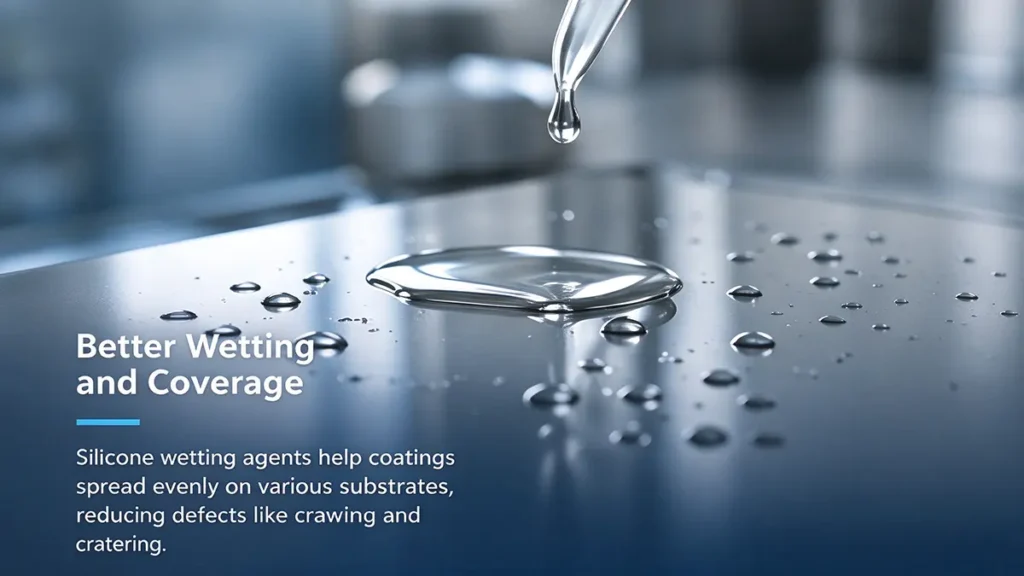
- Improved coverage on difficult-to-wet substrates.
- Reduced tendency toward crawling and certain cratering defects.
- More uniform film formation.
- Better application consistency on suitable plastic, metal and other surfaces.
2.2 Improve Flow, Leveling and Surface Appearance
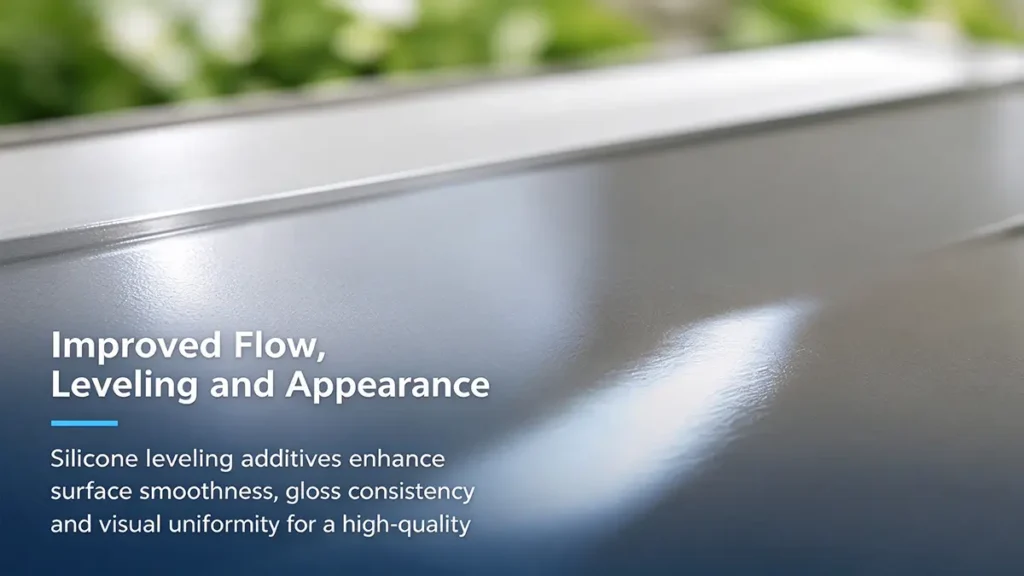
- Surface smoothness and visual uniformity.
- Gloss consistency.
- Resistance to certain surface defects.
- Appearance in suitable high-gloss and clear-coat formulations.
2.3 Improve Surface Slip, Mar Resistance and Scratch Performance
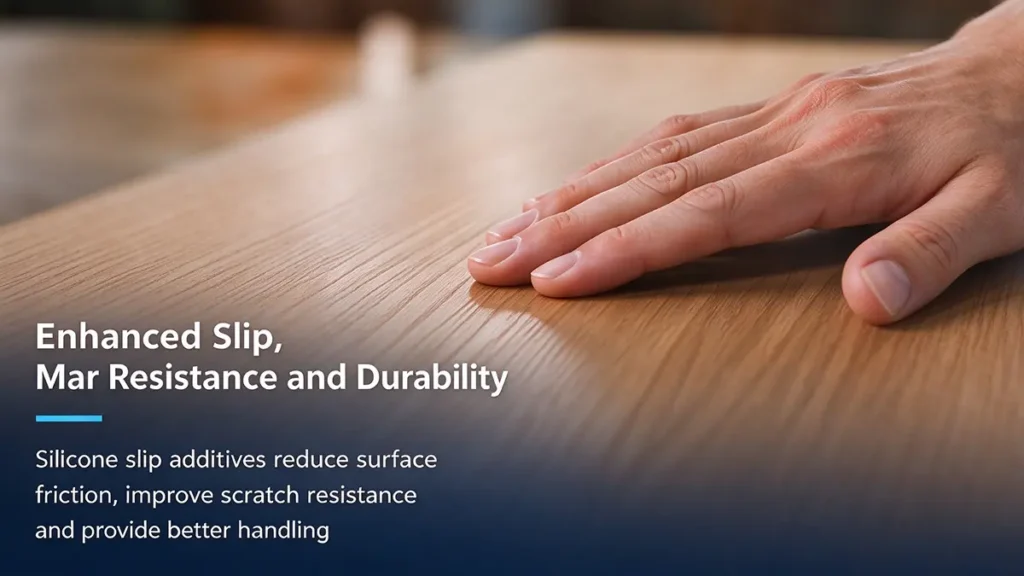
- Lower surface friction.
- Improved resistance to scuffing and visible marring.
- Better handling and sliding properties.
- Reduced blocking between contacting coated surfaces.
- Improved abrasion-related performance in suitable formulations.
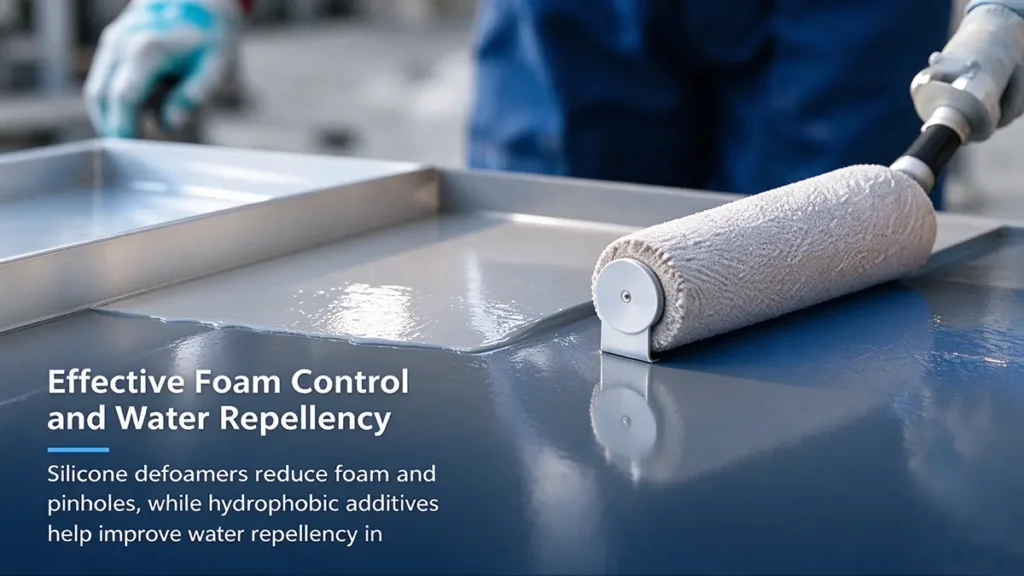
2.4 Control Foam and Reduce Pinholes
- Waterborne or solventborne chemistry.
- Binder type and pigment loading.
- Mixing intensity and application method.
- Surface foam versus entrained microbubbles.
- Risk of cratering or other surface defects.
2.5 Improve Water Repellency in Suitable Coatings
- Water repellency: The tendency of a surface to resist wetting by liquid water.
- Water resistance: The ability of a coating to withstand water exposure without unacceptable deterioration.
- Waterproofing: The ability of a complete material or system to limit water penetration according to the relevant application requirements.
2.6 Balance Surface Modification with Adhesion and Recoatability
Silicone additives do not automatically improve adhesion. An additive may help a liquid coating spread over a substrate without improving the strength of the cured interface.
Excessive surface modification can also create difficulties when a subsequent coating layer must adhere to the first. Some additives can migrate or concentrate near the surface, depending on their structure and formulation conditions.
For multilayer coatings, automotive finishes, industrial protective systems and other applications requiring recoating, intercoat adhesion should therefore be part of the evaluation.
Where stronger bonding to glass, metals, mineral surfaces or other substrates is the main objective, a suitable silane coupling agent or dedicated adhesion promoter may be more appropriate than a general-purpose silicone surface additive.
The goal is to optimize the complete coating system rather than maximize one isolated surface property.
3. Silicone Additives for Different Coating Applications
The most suitable silicone additive depends on the coating’s intended function, the binder system and the manufacturing process.
| Coating application | Typical challenge | Potential additive function |
|---|---|---|
| Waterborne acrylic coatings | Wetting, foam and surface defects | Wetting agents, leveling additives and suitable defoamers |
| Waterborne polyurethane coatings | Scuffing, surface friction and blocking | Slip and surface-modifying additives |
| Solventborne industrial coatings | Surface appearance and application defects | Flow, leveling and wetting additives |
| UV-curable coatings | Surface control and high-speed processing | Compatible wetting, leveling and slip additives |
| Wood and furniture coatings | Surface smoothness, mar resistance and handling | Slip and leveling additives |
| Plastic coatings | Difficult wetting and substrate compatibility | Suitable wetting agents and, where required, dedicated adhesion promoters |
| Automotive and protective coatings | Appearance, multilayer compatibility and durability | Application-specific surface-control additives |
| Paper, film and printing coatings | Friction, surface uniformity and processing | Suitable slip, wetting and surface-modifying additives |
Waterborne vs. Solventborne Coatings
- Compatibility with the binder and other formulation ingredients.
- Suitability for the intended carrier system and curing mechanism.
- Effect on gloss, foam, surface friction and film appearance.
- Recoatability and intercoat adhesion.
- Recommended addition stage and dosage basis.
- Any restrictions related to curing conditions or end-use requirements.
4. How to Select the Right Silicone Additive
A systematic selection process reduces unnecessary formulation changes and makes laboratory results easier to interpret.
Step 1: Define the Main Performance Requirement
Identify the principal issue: poor wetting, surface defects, excessive foam, inadequate slip, scratch sensitivity or insufficient water repellency.
Where possible, translate the issue into a measurable target, such as gloss consistency, coefficient of friction, foam persistence, adhesion strength or water uptake.
Step 2: Identify the Coating Chemistry
Document the binder type, carrier system, solids content, pigment loading, curing mechanism and relevant processing conditions.
An additive designed for a waterborne acrylic system may not provide the same balance of compatibility and surface activity in a solventborne epoxy or UV-curable formulation.
Step 3: Consider the Substrate and Application Method
Substrate properties and application conditions affect the result. Spraying, dipping, brushing and roll coating impose different requirements on wetting, leveling and film formation.
The intended substrate—such as wood, plastic, steel, glass or a mineral surface—should be specified before selecting a candidate additive.
Step 4: Evaluate Compatibility and Trade-Offs
Assess the desired improvement alongside potential side effects.
For example, improved slip may influence recoating, while reduced surface tension may resolve one wetting problem but change the behavior of foam or other surface-active ingredients.
Step 5: Review the Technical Data Sheet
Before testing, confirm the product’s intended application, active content, recommended dosage, addition stage, compatibility guidance and relevant limitations.
For coating manufacturers sourcing organosilicon materials, Silico® can be approached with a defined application brief covering the coating type, binder chemistry, substrate, target performance and required technical parameters. This makes product discussions more specific and helps establish a relevant evaluation plan without assuming that one material will suit every formulation.
5. Silicone Additive Dosage and Formulation Testing
| Commercial example | Intended function | Published dosage guidance |
|---|---|---|
| DOWSIL™ 501W | Wetting in waterborne and radiation-curable coatings, inks and overprint varnishes | 0.1–0.4% as supplied, based on total formulation |
| DOWSIL™ 106F | Foam control in waterborne coatings | 0.1–0.5 wt% for waterborne coating systems |
| DOWSIL™ 14 | Slip, leveling and related surface modification | Varies by application; supplied at 10% active concentration |
A Practical Laboratory Testing Procedure
- Prepare a control formulation. Use the original formulation without the candidate additive.
- Establish a dosage series. Test several concentrations within the manufacturer’s recommended range.
- Standardize application conditions. Keep substrate preparation, film thickness, application method and curing conditions consistent.
- Inspect the wet and cured films. Record wetting, foam, craters, pinholes, gloss and surface uniformity.
- Measure the target property. Use the relevant test for slip, abrasion, adhesion, water resistance or another defined requirement.
- Evaluate recoatability and stability. Check for side effects in subsequent layers and during storage where relevant.
6. Common Formulation Problems and Solutions
Excessive Silicone Additive Dosage
Increasing the dosage does not necessarily improve performance. Excessive addition may cause poor intercoat adhesion, surface defects or changes in the coating’s handling characteristics.
Recommended approach: Identify the lowest dosage that consistently meets the performance target.
Incorrect Silicone Chemistry
Different silicone structures provide different compatibility and surface-modifying effects. A general-purpose silicone fluid should not automatically replace a specialty coating additive.
Recommended approach: Match the material to the coating chemistry and intended function, then confirm its suitability through testing.
Confusing Wetting with Adhesion
Improved spreading does not guarantee a strong bond between the cured coating and substrate.
Recommended approach: Evaluate wetting and adhesion separately. If adhesion remains inadequate, investigate substrate preparation, surface treatment, binder chemistry and dedicated adhesion promoters.
Foam or Cratering After Addition
A surface additive may not address the actual cause of a foam problem and may create new surface defects if its compatibility is unsuitable.
Recommended approach: Examine the formulation during mixing and application, identify the type of defect and select an additive designed for that specific issue.
Poor Recoatability
A coating may perform well as a single layer but fail when another coating is applied.
Recommended approach: Test intercoat adhesion using the actual coating sequence, curing schedule and overcoat conditions.
7. Conclusion
Silicone additives can improve coating performance by modifying substrate wetting, flow and leveling, surface friction, foam behavior and, where appropriate, water repellency. Their effectiveness depends on matching the silicone chemistry to the coating formulation, substrate, processing conditions and required end-use properties.
For coating manufacturers, the most reliable approach is to define a measurable performance target, select a suitable candidate based on technical documentation and verify the result through controlled formulation trials. Particular attention should be paid to dosage, compatibility, recoating and long-term durability.
Silico® supports the exploration of organosilicon materials for industrial applications, including silicone fluids, silicone resins and related materials. When evaluating a coating formulation, specifying the intended application, binder system, substrate and required technical parameters provides a practical starting point for identifying suitable materials and planning further testing.
Frequently Asked Questions
Silicone additives modify specific properties of paint and coating formulations. Depending on their chemistry, they can improve wetting, flow and leveling, surface slip, foam control or water repellency. Individual products do not necessarily provide all these functions.
Not necessarily. Some improve wetting, helping the coating spread over a substrate, but wetting is not the same as adhesion. Durable bonding also depends on substrate preparation, binder chemistry, curing and the interface between the coating and substrate.
The appropriate level depends on the specific product, active content, binder system and target function. For example, Dow publishes a dosage of 0.1–0.4% as supplied for DOWSIL™ 501W based on total formulation. This figure should not be applied automatically to other additives. Follow the relevant technical data sheet and confirm the dosage through formulation testing.
Yes. Specific silicone additives are designed for waterborne coatings and may be used for wetting, surface modification, slip or foam control. Suitability depends on the binder, compatibility, dosage and application conditions.
No, not automatically. Certain silicone additives improve water repellency, but water repellency, water resistance and waterproofing are different performance characteristics. The complete coating system must be tested against its intended requirements.
Silicone additives generally modify specific formulation or surface properties, often at relatively low concentrations. Silicone resins can serve as film-forming or resin components in suitable coatings, including certain heat-resistant systems. Their functions, dosage requirements and testing criteria differ.
Yes. Excessive dosage or unsuitable compatibility may cause cratering, surface irregularities, reduced intercoat adhesion or other formulation problems. Controlled dosage trials are preferable to increasing the addition level without identifying the cause of the defect.
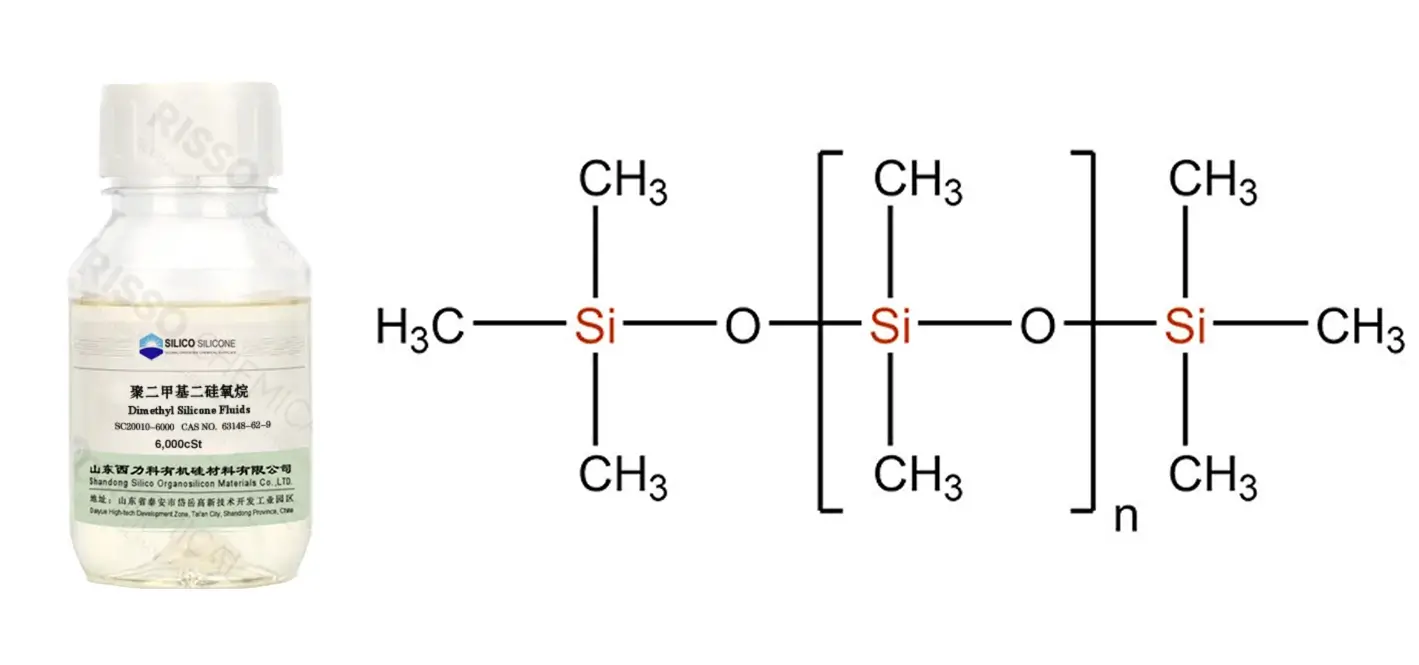
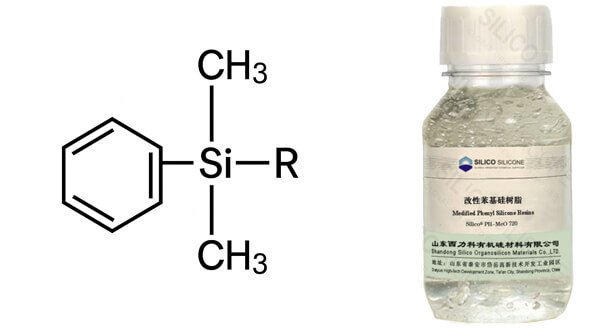
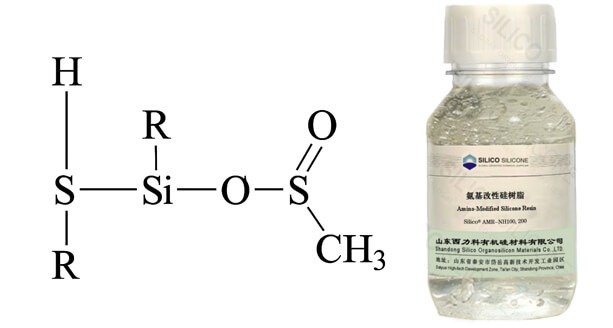
Silicone Fluid related products
If you want to know other questions about Sillcone Fluid, please contact us and we will provide professional answers.
Popular Recommendations
Get a Catalog & Best Price
- Quick and helpful reply within 24 hours;
- Tailored solutions provided for your project;
- One-stop purchasing service.
Need More Technical Information?
Silico® ORGANOSILICON
- Address: Daiyue Industrial Area, Taian, Shandong, China
- © Copyright 2022 Silico® . All Rights Reserved