
How Are Silicone Emulsions Manufactured? Formulation and Stability
Fumed silica, also known as pyrogenic silica, is a synthetic amorphous silicon dioxide (SiO₂) produced primarily through high-temperature flame hydrolysis of silicon tetrachloride. The process forms nanoscale primary particles that fuse into branched aggregates, creating the high specific surface area and distinctive functional properties used in coatings, silicone rubber, adhesives, sealants and other industrial formulations.
Understanding how fumed silica is manufactured helps buyers evaluate BET surface area, surface chemistry, product consistency and application suitability. Silico® focuses on organosilicon materials and industrial formulation requirements, making manufacturing knowledge an important starting point when assessing silica grades for specific applications.
Table of Contents
- 1. What Is Fumed Silica?
- 2. How Is Fumed Silica Manufactured?
- 3. Step 1: Raw Material Preparation
- 4. Step 2: Flame Hydrolysis and Silica Formation
- 5. Step 3: Primary Particle Growth and Aggregate Formation
- 6. Step 4: Cooling, Collection and Residual Acid Control
- 7. Step 5: Surface Treatment and Product Finishing
- 8. How Manufacturing Conditions Affect Fumed Silica Properties
- 9. Fumed Silica Quality Control and Specifications
- 10. Fumed Silica vs. Precipitated Silica
- 11. Industrial Applications of Fumed Silica
- 12. Conclusion
1. What Is Fumed Silica?
Fumed silica is a synthetic form of amorphous silicon dioxide manufactured through a gas-phase process. It consists of extremely fine primary particles that fuse together to form aggregates, giving the material a high specific surface area and the ability to modify rheology, stabilize dispersed solids and reinforce selected polymer systems.
Fumed silica is also known as pyrogenic silica. These terms generally describe silica produced through flame-based processes, particularly flame hydrolysis. Unlike crystalline silica minerals such as quartz, commercial fumed silica is amorphous rather than crystalline.
Typical commercial grades have BET specific surface areas of approximately 50–400 m²/g, while primary particle dimensions are commonly on the order of 5–50 nm. These are broad industry reference ranges, not universal specifications; individual products may fall outside them depending on the manufacturing process and intended application.
Key properties of fumed silica
- High specific surface area: Provides extensive surface interaction with surrounding liquids and polymers.
- Structured particle morphology: Fused aggregates contribute to rheological behavior and reinforcement.
- Surface silanol groups: Enable hydrogen bonding and interactions with compatible formulation components.
- Adjustable surface chemistry: Surface treatment can produce hydrophobic grades with different moisture and compatibility characteristics.
- Multifunctional performance: Depending on the grade, fumed silica can support thickening, thixotropy, anti-settling, anti-sag performance and reinforcement.
2. How Is Fumed Silica Manufactured?
Fumed Silica Manufacturing Process Flow
Raw Material Preparation
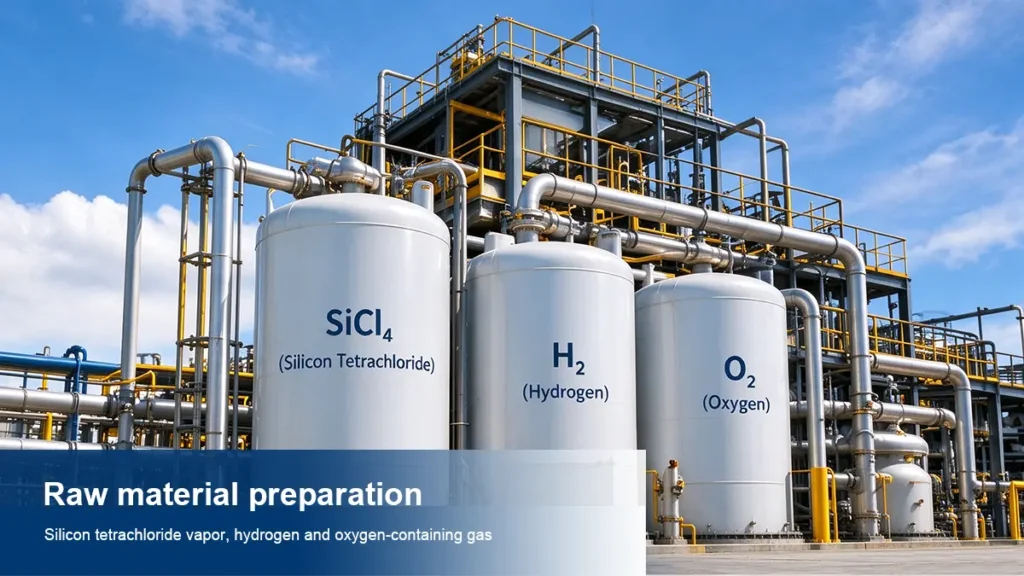
Silicon tetrachloride vapor, hydrogen and oxygen-containing gas are prepared for the reaction.
Flame Hydrolysis
A high-temperature reaction forms amorphous silicon dioxide (SiO₂) and hydrogen chloride (HCl).
Particle Formation
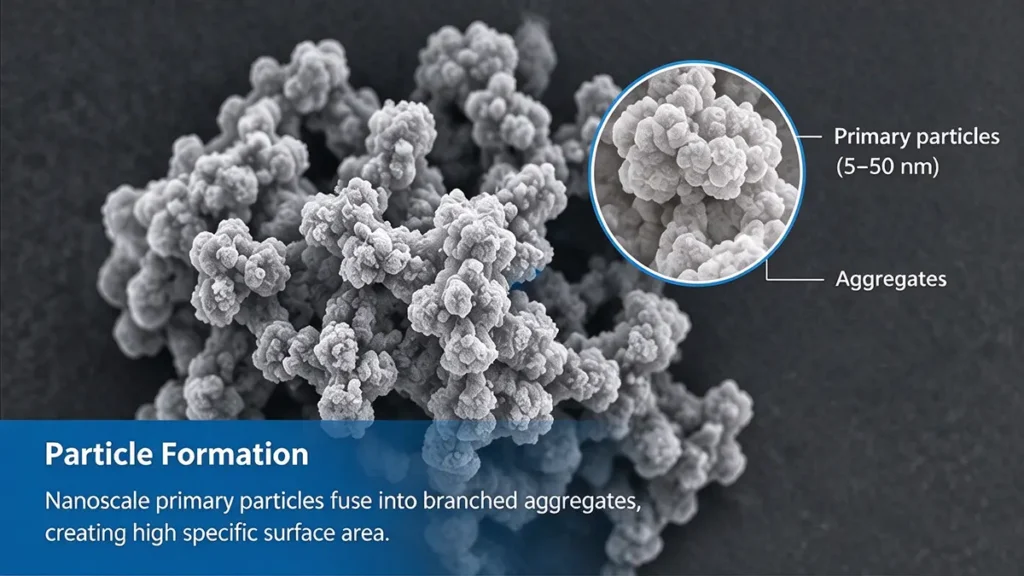
Nucleation, particle growth and fusion produce primary particles and aggregates.
Cooling and Collection
The process stream is cooled, and silica is separated from the gas stream with appropriate acid-gas handling.
Finishing and Quality Control
Optional surface treatment, specification testing and packaging prepare the product for delivery.
3. Step 1: Raw Material Preparation
The first stage involves preparing and controlling the raw materials supplied to the reaction system.
Silicon tetrachloride as the principal precursor
Silicon tetrachloride is widely used because it can be vaporized and introduced into the reactor as a gaseous precursor. Its delivery rate, purity and consistency are important for maintaining stable reaction conditions.
The liquid precursor is vaporized before entering the burner system. Hydrogen and an oxygen-containing gas are then supplied in controlled proportions to establish the required combustion and reaction environment.
Why feed control matters
Changes in precursor delivery, gas composition and flow conditions can affect the temperature profile and particle formation inside the reactor. Stable feed conditions help maintain reproducible product characteristics across production batches.
Industrial manufacturing therefore depends on controlled precursor vaporization, burner design, gas-flow management and process monitoring. Raw material preparation is not simply a preliminary handling operation; it establishes the conditions under which the silica structure develops.
4. Step 2: Flame Hydrolysis and Silica Formation
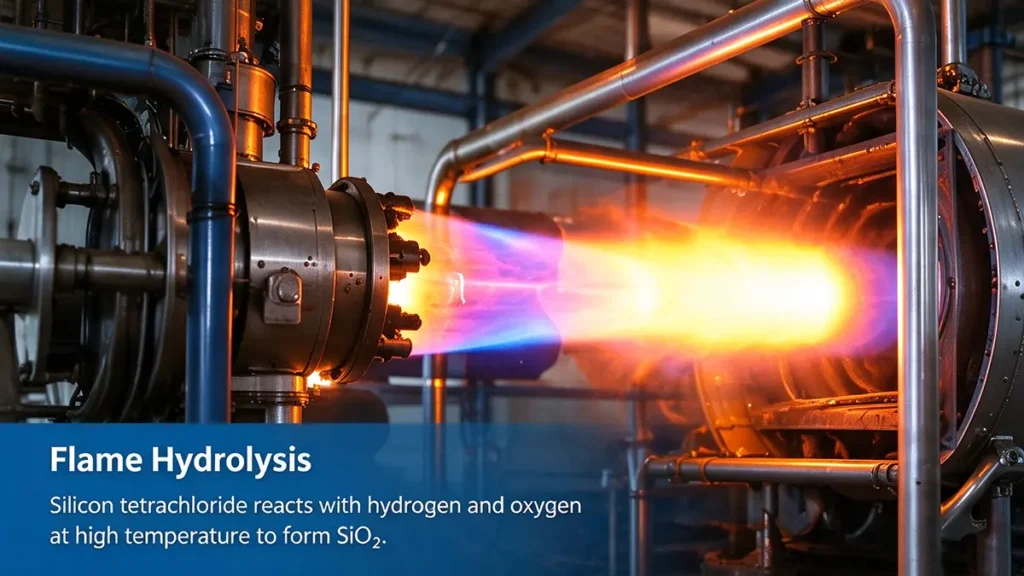
Together, these reactions yield the simplified overall equation given above.
The reaction occurs in a high-temperature environment. Industrial descriptions commonly cite approximate temperatures in the range of 1,000–1,800°C, although the actual temperature depends on reactor design, process conditions and measurement location. Local flame temperatures should not be confused with the average temperature of the downstream process gas.
As the precursor is converted, silicon dioxide forms as a fine aerosol. The freshly generated material continues to evolve as it passes through the reaction zone.
What controls the reaction?
- Precursor concentration and feed rate.
- Hydrogen-to-oxygen balance and combustion conditions.
- Mixing and residence time within the reaction zone.
- Reactor geometry and temperature distribution.
- Cooling conditions after the principal reaction.
5. Step 3: Primary Particle Growth and Aggregate Formation
Fumed silica’s distinctive performance is closely linked to the structure formed during particle growth.
Three terms are important: primary particles, aggregates and agglomerates.
Primary particles: the nanoscale building blocks
Primary particles form through nucleation and growth in the hot reaction zone. Their dimensions are generally measured in nanometers.
Because the particles are very small, they provide a large surface area relative to their mass. This contributes to the strong surface interactions that make fumed silica useful in rheology modification and reinforcement.
Aggregates: fused particle structures
As the primary particles collide at elevated temperatures, they can fuse together through coalescence or sintering. The resulting aggregates contain interconnected primary particles with relatively persistent fused junctions.
Aggregate morphology influences how the silica structure interacts with the surrounding formulation. It can affect network formation, thickening behavior and reinforcement, although the final response also depends on surface chemistry and processing.
Agglomerates: larger associations of aggregates
| Structural level | Formation mechanism | Practical significance |
|---|---|---|
| Primary particles | Nucleation and growth in the reaction zone | Contribute to specific surface area |
| Aggregates | Fusion of primary particles | Influence structure, rheology and reinforcement |
| Agglomerates | Association of aggregates through weaker interactions | Affect powder handling and dispersion requirements |
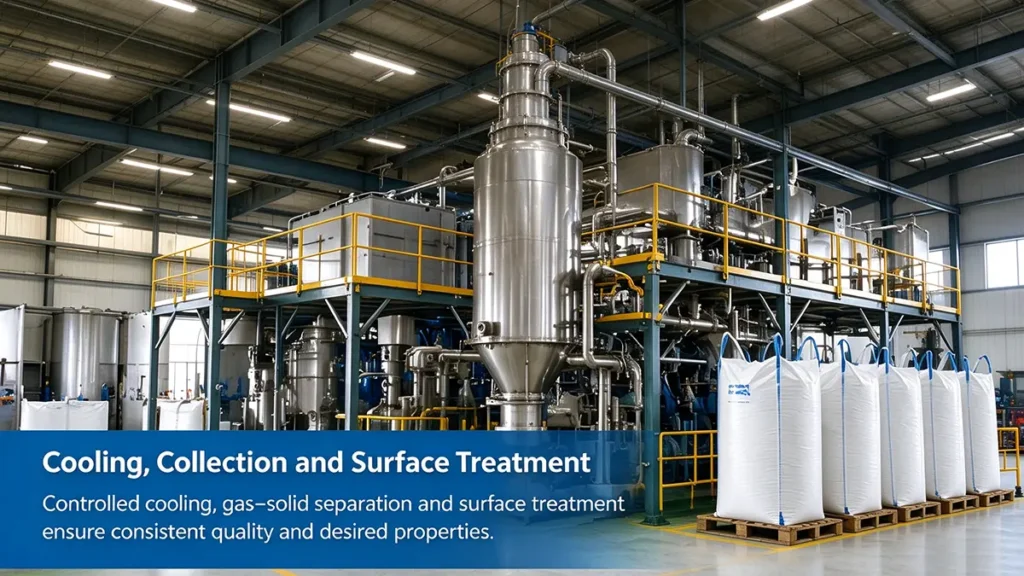
6. Step 4: Cooling, Collection and Residual Acid Control
After particle formation, the process stream contains silica suspended in gases that include hydrogen chloride. The silica must be recovered, and the remaining gases must be handled through suitable treatment systems.
Cooling and gas–solid separation
The process stream is cooled under controlled conditions before the silica is collected. Depending on the facility, the separation system may incorporate cyclones, filtration equipment or other gas–solid separation technologies.
The objective is to recover the fine powder while maintaining suitable product quality and preventing uncontrolled release of particulate matter.
Since fumed silica consists of extremely fine particles, the collection system must be designed for fine-powder handling rather than relying solely on equipment intended for coarse solids.
Residual hydrogen chloride and acidity
Hydrogen chloride is a major byproduct of the reaction. Residual acid or chloride-related impurities must be controlled according to the product’s intended use and applicable specification.
Depending on the manufacturing route, finishing may include treatment with heated air, steam or other suitable methods to reduce residual acidity. The exact operation and its effectiveness depend on the plant design and product requirements.
Process-gas recovery and treatment
Hydrogen chloride-containing process gases require appropriate treatment. Depending on the facility, hydrogen chloride may be recovered as hydrochloric acid or integrated into another chemical process.
Environmental performance should be evaluated using plant-specific evidence, such as emissions data, recovery systems and operating permits. It should not be assumed that all manufacturers use the same recovery configuration or achieve identical recovery rates.
7. Step 5: Surface Treatment and Product Finishing
After the silica structure has formed, further processing may be used to obtain the desired commercial grade.
The distinction between hydrophilic and hydrophobic fumed silica is especially important at this stage.
Untreated fumed silica has surface silanol groups (Si–OH). These groups interact with water and can form hydrogen-bonding interactions with neighboring particles or other formulation components.
In suitable liquids, these interactions can contribute to a three-dimensional particle network. Under shear, the network may partially break down, reducing viscosity; after the shear is removed, the structure may recover over time.
This behavior is useful in many coating, adhesive, sealant and silicone formulations. The extent of thickening and thixotropic recovery depends on the grade, concentration, liquid chemistry and dispersion process.
Hydrophobic fumed silica is generally produced by chemically modifying the surface of the silica after the core particle structure has formed.
Surface-treatment agents, including selected silane or siloxane-based reagents, can react with available silanol groups or otherwise modify the surface. The treatment changes the interaction between the silica and its environment while retaining the fundamental silica-based aggregate structure.
Hydrophobic grades may be useful in moisture-sensitive formulations or systems where compatibility with less polar media is important. However, hydrophobicity alone does not guarantee compatibility with every nonpolar system, and the correct grade must be evaluated in the actual formulation.
Finishing, densification and packaging
Freshly produced fumed silica has a low bulk density and a fluffy powder structure. Depending on the product, mechanical finishing or densification may be used to improve storage, transportation, dosing and handling.
These operations should be distinguished from the flame reaction itself. Densification can affect powder-handling characteristics, but it does not necessarily change the underlying aggregate structure in the same way as changing the synthesis conditions.
The finished product is then tested against the applicable specification before packaging and shipment.
8. How Manufacturing Conditions Affect Fumed Silica Properties
| Factor | Potential influence | What buyers should verify |
|---|---|---|
| Flame and reaction conditions | Affect nucleation, particle growth and fusion | Product-grade specifications and consistency |
| Residence time and gas flow | Influence particle growth and aggregation | Relevant grade characteristics and application data |
| BET surface area | Indicates measured specific surface area | Test method, specified range and performance requirements |
| Aggregate morphology | Influences network formation and reinforcement behavior | Suitability for the formulation and processing conditions |
| Surface treatment | Changes wettability and surface interactions | Hydrophilic or hydrophobic grade requirements |
| Finishing and densification | Affect handling, feeding and bulk-density characteristics | Powder-handling and processing requirements |
Does a higher BET surface area always mean better performance?
No. A higher BET surface area does not automatically make one grade better than another.
A higher-surface-area grade may provide useful thickening or reinforcing performance in some formulations. However, it may also require more demanding dispersion conditions or change the processing behavior of the system.
The result depends on the interaction between surface area, surface chemistry, aggregate structure, formulation composition and mixing conditions. A grade that performs well in silicone rubber may not be the most appropriate choice for a particular coating or sealant.
For buyers comparing grades, BET should be treated as one selection parameter rather than a standalone indicator of overall quality.
9. Fumed Silica Quality Control and Specifications
| Parameter | What it measures or indicates | Why it matters |
|---|---|---|
| BET specific surface area | Specific surface area, typically reported in m²/g | Helps distinguish grades and assess surface-area requirements |
| Moisture or loss on drying | Mass loss under a defined test procedure | Relevant to moisture-sensitive formulations and handling |
| pH | Acid–base behavior under specified test conditions | Helps evaluate consistency where pH is specified |
| Tapped density | Powder density after a defined tapping procedure | Relevant to handling, storage and dosing |
| Residual chloride or acidity | Residual process-related species, where specified | Important for applicable purity and formulation requirements |
| Carbon content or surface-treatment indicators | May help characterize treated grades | Useful for verifying relevant properties of hydrophobic products |
How to interpret a TDS and CoA
- The exact product grade and whether it is hydrophilic or hydrophobic.
- The BET surface-area range and applicable test method.
- Moisture, residual acidity and other relevant quality requirements.
- Packaging, storage conditions and shelf life, where declared.
- Whether the material has been evaluated under conditions representative of the intended application.
10. Fumed Silica vs. Precipitated Silica
| Comparison | Fumed silica | Precipitated silica |
|---|---|---|
| Manufacturing route | Flame hydrolysis or related flame-based processes | Wet-chemical precipitation |
| Reaction environment | Gas phase at high temperature | Liquid phase |
| Particle formation | Nucleation, growth and fusion into aggregates | Precipitation followed by processing and finishing |
| Structure | Nanoscale primary particles fused into aggregates | Structure depends on precipitation and subsequent processing |
| Common functional roles | Rheology modification, anti-settling and reinforcement | Reinforcement, absorption, carrier functions and other grade-specific uses |
| Key selection considerations | BET, surface chemistry, structure and dispersion | BET, pore structure, moisture and application-specific properties |
11. Industrial Applications of Fumed Silica
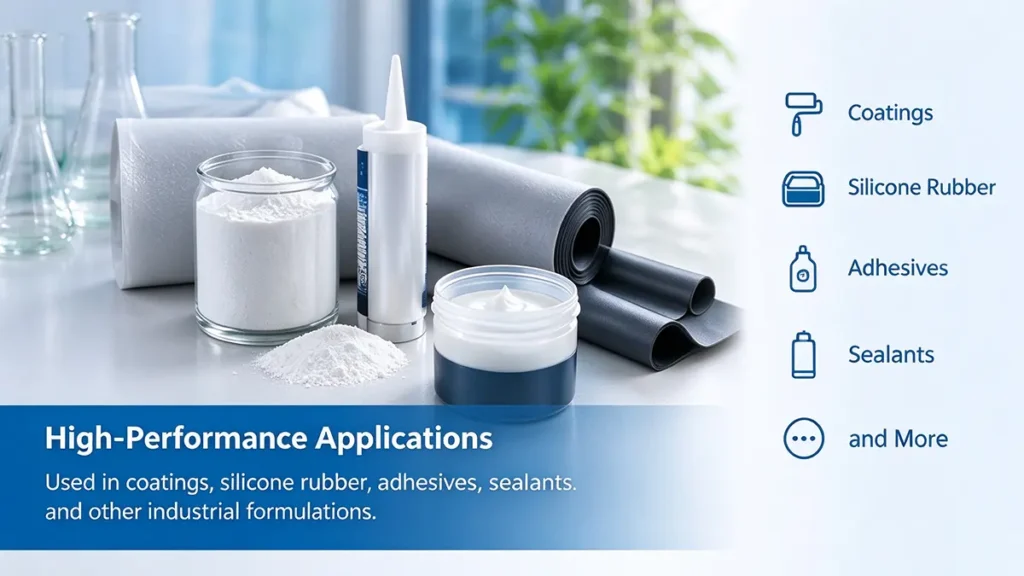
The relationship between manufacturing and product performance becomes clearer when fumed silica is considered in specific applications.
Paints and coatings
Fumed silica can modify rheology, help reduce the settling of dispersed solids and improve resistance to sagging on vertical surfaces.
A coating must remain sufficiently stable during storage while still allowing practical application through brushing, rolling or spraying. Grade selection and dispersion conditions affect the balance between storage stability, flow and application behavior.
Silicone rubber
Fumed silica is widely used as a reinforcing filler in silicone rubber. Its high surface area and interactions with the polymer can contribute to mechanical performance.
The actual reinforcement depends on silica grade, loading, polymer chemistry, compounding conditions and curing system. Tensile strength, tear strength and other properties should be confirmed through formulation-specific testing rather than inferred from BET alone.
Adhesives and sealants
In suitable adhesive and sealant systems, fumed silica can increase viscosity, provide thixotropic behavior, limit sagging and help suspend fillers.
The appropriate grade depends on polymer chemistry, moisture sensitivity, extrusion requirements and end-use conditions. Compatibility and dispersion should be evaluated within the complete formulation.
Greases and other specialty formulations
Fumed silica is also used in selected greases, polymer formulations and specialty products where rheology modification, stabilization or powder-flow improvement is required.
The same silica grade will not necessarily perform identically across these applications. Manufacturing characteristics establish the material’s potential, while formulation and processing determine how that potential is realized.
12. Conclusion
Fumed silica manufacturing is a controlled process involving raw-material preparation, flame hydrolysis, nanoscale particle formation, cooling, collection and, where required, surface treatment. These stages establish the primary particle characteristics, aggregate structure and surface chemistry that influence the finished product’s behavior.
For industrial buyers, choosing the right grade requires evaluating the complete specification rather than relying on a single number such as BET surface area. Application testing, appropriate technical documentation and consistent quality control remain essential to determining suitability.
Silico® provides an industrial organosilicon materials portfolio for customers evaluating silicone-related formulation requirements. When discussing fumed silica or related materials with the Silico® team, specifying the intended application, target properties, required surface characteristics and expected order volume can help establish a more focused technical assessment.
Frequently Asked Questions (FAQs)
Fumed silica production is commonly described as involving temperatures of approximately 1,000–1,800°C. Actual temperatures depend on the process design and measurement location, and local flame temperatures can differ from bulk gas temperatures.
Fumed silica production is commonly described as involving temperatures of approximately 1,000–1,800°C. Actual temperatures depend on the process design and measurement location, and local flame temperatures can differ from bulk gas temperatures.
Fumed silica forms from nanoscale primary particles, which provide a large surface area relative to their mass. Commercial grades are produced with different surface-area characteristics depending on the manufacturing process and intended application.
Hydrophilic fumed silica has surface silanol groups that interact with water and other compatible formulation components. Hydrophobic fumed silica is generally produced through post-treatment that modifies these surface interactions. The correct grade depends on the formulation chemistry and performance requirements.
No. Both are synthetic amorphous silica, but fumed silica is produced through a gas-phase flame process, whereas precipitated silica is produced through wet-chemical precipitation. Their structures and functional characteristics differ.
There is no single specification that determines suitability for all applications. BET surface area is important, but buyers should also consider surface chemistry, moisture, structure, dispersion conditions and the performance required in the final formulation.
Hydrophobicity is generally introduced through a subsequent surface-treatment process. The core flame reaction creates the silica structure, while post-treatment modifies the surface chemistry.
Buyers should provide the intended application, required hydrophilic or hydrophobic characteristics, target BET range if known, other technical requirements, estimated quantity and destination. Formulation and processing details can further improve the accuracy of grade selection.
Fumed Silica related products



Popular Recommendations
Get a Catalog & Best Price
- Quick and helpful reply within 24 hours;
- Tailored solutions provided for your project;
- One-stop purchasing service.
Need More Technical Information?
Silico® ORGANOSILICON
- Address: Daiyue Industrial Area, Taian, Shandong, China
- © Copyright 2022 Silico® . All Rights Reserved