
How Does Fumed Silica Improve Adhesives and Sealants?
Fumed silica is widely used in adhesives and sealants to control viscosity, thixotropy, anti-sag performance, anti-settling, extrusion behavior, and mechanical properties. Unlike conventional fillers used mainly to increase solids or modify cost, fumed silica can form a reversible particle network that changes how an adhesive or sealant flows under different shear conditions.
This makes fumed silica particularly useful when a formulation needs to flow during mixing and application but remain stable after application.
For manufacturers looking for consistent fumed silica quality for adhesive and sealant formulations, Silico® provides hydrophilic and hydrophobic fumed silica grades for applications where rheology control, reinforcement, dispersion, and formulation stability are important.
Table of Contents
- 1. What Is Fumed Silica?
- 2. How Does Fumed Silica Work in Adhesives and Sealants?
- 3. Key Benefits of Fumed Silica
- 4. Fumed Silica for Different Adhesive and Sealant Systems
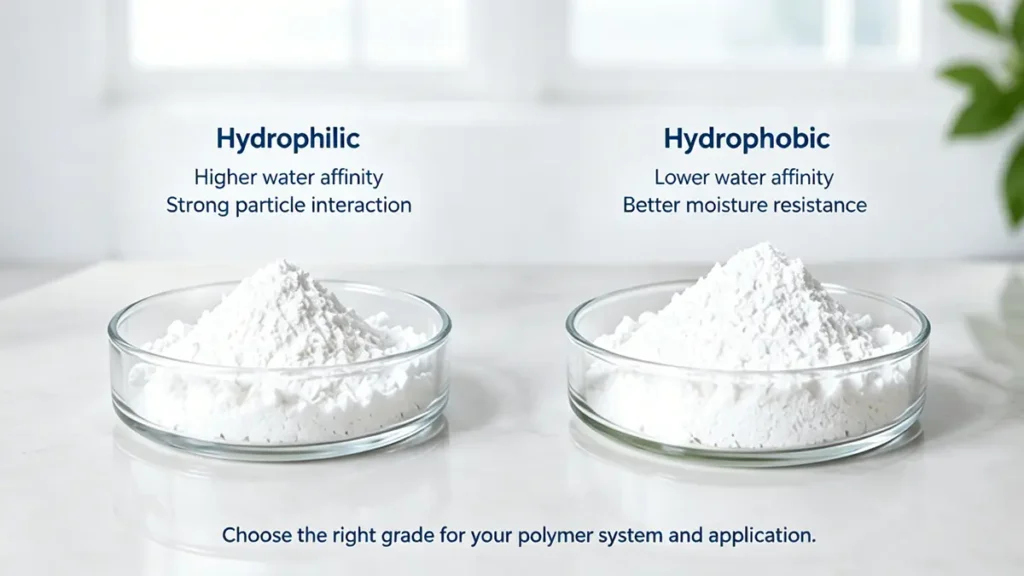
- 5. Hydrophilic vs. Hydrophobic Fumed Silica
- 6. How Much Fumed Silica Should Be Used?
- 7. What Determines Fumed Silica Performance?
- 8. Common Formulation Problems
- 9. How to Select the Right Fumed Silica
- 10. Why Fumed Silica Is More Than a Thickener
- Conclusion
1. What Is Fumed Silica?
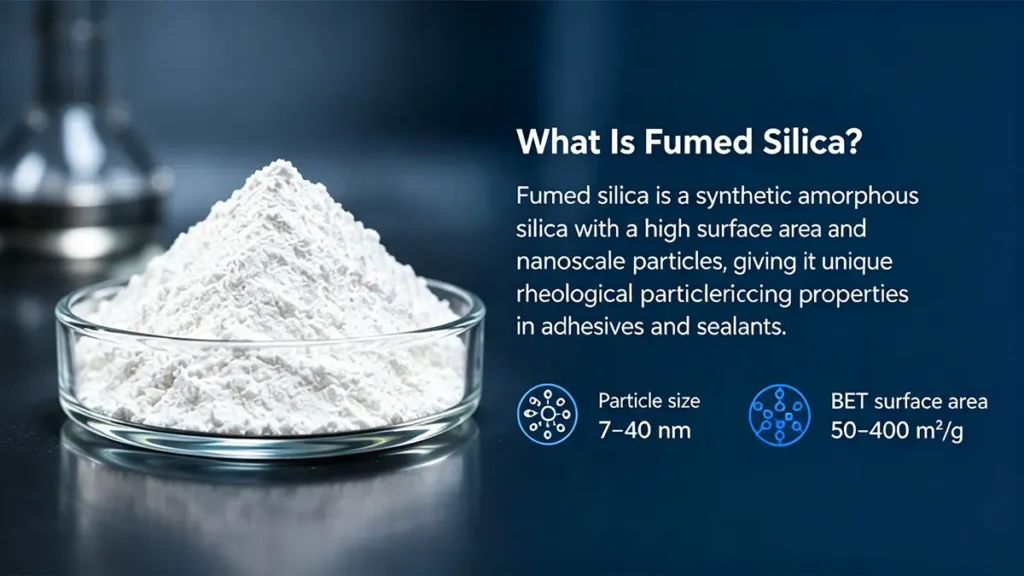
Fumed silica is a synthetic amorphous silica produced through a high-temperature vapor-phase process. It consists of nanoscale primary particles that form aggregates and larger agglomerates.
Typical commercial grades have:- Primary particle size: approximately 7–40 nm
- BET surface area: approximately 50–400 m²/g, depending on grade
- High surface-to-weight ratio
- Silanol-rich surfaces in untreated grades
- Modified surface chemistry in hydrophobic grades
These characteristics allow fumed silica to interact strongly with polymers and other formulation components.
In adhesives and sealants, performance depends not only on silica concentration but also on surface chemistry, BET surface area, structure, polymer compatibility, and dispersion quality.
2. How Does Fumed Silica Work in Adhesives and Sealants?
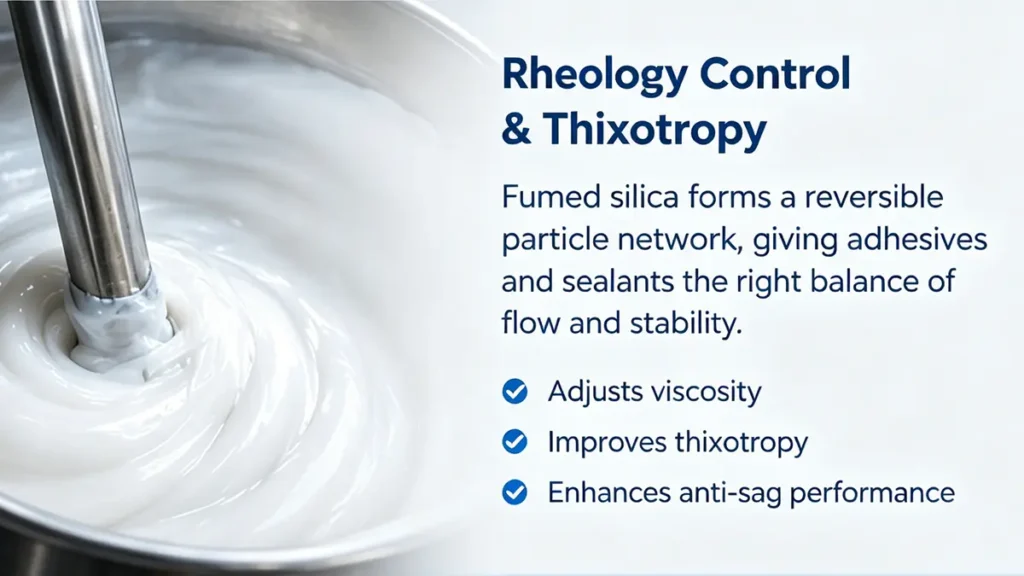
The main mechanism is the formation of a temporary three-dimensional particle network.
In suitable formulations, surface groups on fumed silica interact with neighboring particles and create a network throughout the liquid phase.
The basic mechanism is:
Fumed silica particles
↓
Particle interaction
↓
Three-dimensional network
↓
Higher low-shear viscosity and yield stress
↓
Improved anti-sag and anti-settling
When shear is applied during mixing, pumping or extrusion, this network is disrupted and viscosity decreases. After shear is removed, the structure can partially rebuild.
This produces the shear-thinning and thixotropic behavior required by many adhesives and sealants.
For example, a sealant applied to a vertical joint needs to pass through a nozzle relatively easily but should resist flowing downward after application.
3. Key Benefits of Fumed Silica
3.1 Rheology Control
Fumed silica is an efficient rheology modifier for many adhesive and sealant systems.
It can influence:- Low-shear viscosity
- High-shear flow
- Yield stress
- Thixotropy
- Extrusion behavior
- Bead stability
The objective is not simply to maximize viscosity, but to establish the right balance between easy processing and sufficient structural stability.
3.2 Thixotropy and Anti-Sag
A sealant with insufficient yield stress may flow under gravity after application, particularly on vertical surfaces.
Fumed silica can increase the internal structure of the formulation and improve resistance to sag.
This is particularly important for:- Construction sealants
- Silicone sealants
- Automotive adhesives
- Structural adhesives
- Panel bonding systems
The result is better control of the adhesive or sealant bead before curing.
3.3 Anti-Settling
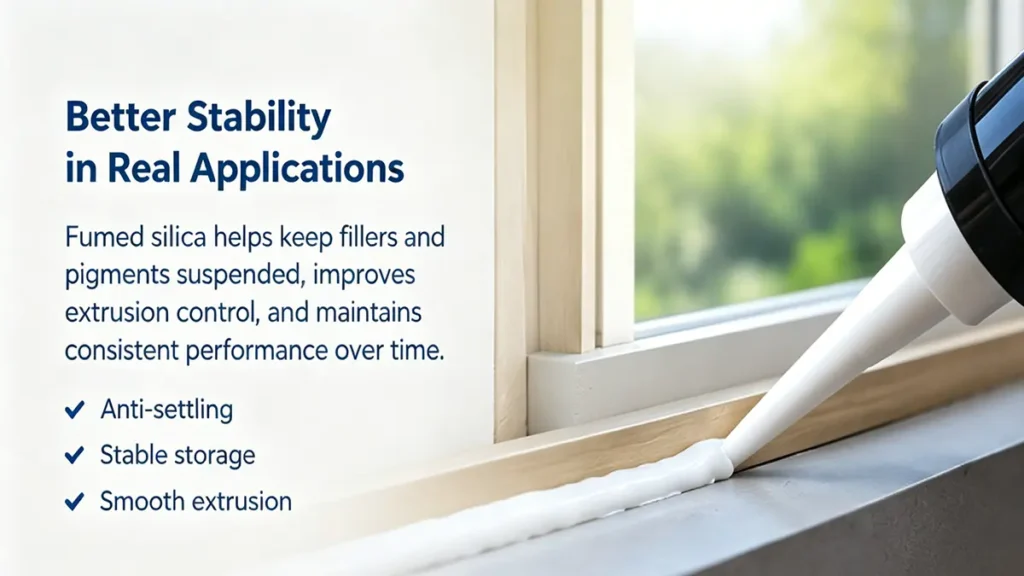
Many formulations contain fillers or pigments such as calcium carbonate, silica, titanium dioxide, and other mineral materials.
If the continuous phase does not have sufficient low-shear structure, these particles can settle during storage.
Fumed silica can increase yield stress and help maintain a more uniform formulation.
This is especially relevant to highly filled adhesive systems.
3.4 Extrusion and Application Control
A good sealant must balance two requirements:
During application: low enough viscosity for manageable extrusion.
After application: sufficient structure to resist sagging and deformation.
Therefore:
Higher viscosity does not automatically mean better performance.
The target is controlled rheology across the relevant shear-rate range.
3.5 Reinforcement
In selected polymer systems, fumed silica can also contribute to the mechanical properties of the cured material, including:
- Tensile strength
- Tear strength
- Modulus
- Cohesive strength
- Dimensional stability
The effect depends strongly on silica surface chemistry, dispersion and polymer–silica interaction.
4. Fumed Silica for Different Adhesive and Sealant Systems
Epoxy Adhesives
- Thixotropy
- Anti-sag
- Filler suspension
- Storage stability
- Application control
Both hydrophilic and hydrophobic grades can be considered depending on the formulation.
Importantly, initial viscosity is not the only criterion. Storage temperature and aging can change polymer–silica interactions and therefore alter rheological performance.
Polyurethane Adhesives
Fumed silica can increase viscosity and impart shear-thinning behavior in polyurethane systems.
Published research has evaluated fumed silica grades with BET surface areas ranging from approximately 90 to 380 m²/g in polyurethane adhesive formulations. In that particular system, intermediate grades around 130–200 m²/g provided favorable rheological performance.
This demonstrates an important formulation principle:
Higher BET surface area does not automatically mean better performance.
The optimum grade depends on the polymer system and target properties.
Silicone Sealants
- Rheology control
- Thixotropy
- Anti-sag
- Extrusion control
- Filler suspension
- Reinforcement
Hydrophobic fumed silica is often considered for moisture-sensitive systems because surface treatment changes its interaction with water and the surrounding polymer.
However, hydrophobic silica is not universally superior; the grade should be matched to the silicone polymer and curing chemistry.
MS Polymer / SMP / STP Sealants
- Anti-sag
- Thixotropy
- Extrusion control
- Reinforcement
- Storage stability
Surface chemistry and polymer compatibility are particularly important when selecting a grade.
Acrylic and Other Sealants
Fumed silica is also used in selected acrylic, polysulfide, butyl and other sealant formulations.
Reported application data show that loading levels can vary considerably between systems, from below 1 wt.% to several wt.% or higher depending on the polymer, silica grade and required rheology.
Therefore, published dosage ranges should be treated as formulation starting points rather than universal recommendations.
5. Hydrophilic vs. Hydrophobic Fumed Silica
| Property | Hydrophilic Fumed Silica | Hydrophobic Fumed Silica |
|---|---|---|
| Surface | Untreated, silanol-rich | Surface-treated |
| Water affinity | Higher | Lower |
| Surface interaction | Strong hydrogen bonding | Modified interaction |
| Moisture resistance | Generally lower | Generally higher |
| Typical applications | Epoxy, coatings, selected adhesives | Sealants, moisture-sensitive systems |
| Selection factor | Polymer compatibility | Surface treatment and compatibility |
Neither type is universally better.
The correct choice depends on:- Polymer polarity
- Moisture sensitivity
- Desired viscosity
- Thixotropy
- Dispersion
- Storage stability
- Curing chemistry
For a detailed comparison, see Hydrophilic vs Hydrophobic Fumed Silica: What Is the Difference?
6. How Much Fumed Silica Should Be Used?
There is no universal dosage for adhesives and sealants.
A practical starting range for many systems may be around 1–5 wt.%, while some silicone sealants and highly filled formulations can require higher levels.
The actual dosage depends on:- BET surface area
- Surface treatment
- Polymer chemistry
- Silica structure
- Filler loading
- Target yield stress
- Required thixotropy
- Mixing efficiency
- Application method
A better approach is to establish a dosage-performance curve rather than selecting an additive level from a generic specification.
For example, increasing silica loading may improve anti-sag performance but can also increase extrusion force and mixing difficulty.
7. What Determines Fumed Silica Performance?
BET Surface Area
BET surface area is one of the most useful parameters for comparing fumed silica grades.
Higher surface area generally provides more available surface for interaction at the same loading level.
However:
Higher BET ≠ automatically better performance.
A higher-surface-area grade may increase viscosity more strongly but can also require better dispersion and make processing more difficult.
Surface Chemistry
Surface treatment changes the interaction between silica, polymer, water and other formulation components.
This affects:- Rheology
- Thixotropy
- Dispersion
- Moisture sensitivity
- Storage stability
- Reinforcement
Dispersion
Even the correct fumed silica grade will not perform efficiently if it is poorly dispersed.
Poor dispersion can cause:- Unstable viscosity
- Localized thickening
- Inconsistent extrusion
- Poor batch-to-batch reproducibility
- Reduced formulation efficiency
Mixing equipment and processing conditions therefore need to be considered together with grade selection.
8. Common Formulation Problems
Viscosity Is Too High
- Excessive silica loading
- BET surface area too high
- Poor dispersion
- Strong silica–polymer interaction
- Incompatible surface chemistry
Possible solutions include optimizing the dosage, selecting another grade, improving dispersion or adjusting surface treatment.
Sealant Sags After Application
For best performance:
- Add fumed silica slowly during mixing
- Use high-shear dispersion equipment
- Avoid moisture contamination
- Optimize mixing time and shear force
Proper dispersion is essential for maximizing anti-settling efficiency and coating transparency.
Silicone Sealants
- Insufficient yield stress
- Inadequate silica network
- Incorrect surface chemistry
- Poor dispersion
- Excessive plasticizer
Increasing silica concentration may help, but a more efficient grade can sometimes provide the required anti-sag performance with less impact on extrusion.
Fillers Settle During Storage
This usually indicates insufficient low-shear structure.
Potential solutions include:- Optimizing fumed silica loading
- Selecting a more rheologically efficient grade
- Improving dispersion
- Adjusting the overall rheology system
Viscosity Changes During Storage
- Polymer–silica interactions
- Moisture exposure
- Chemical reactions
- Particle network changes
- Temperature history
Therefore, both initial and aged rheology should be evaluated during formulation development.
9. How to Select the Right Fumed Silica
Step 1: Identify the Polymer
- Epoxy
- Silicone
- Polyurethane
- Acrylic
- MS Polymer
- Polysulfide
- Butyl
- Solvent-based or water-based polymers
Step 2: Define the Main Function
- Thixotropy
- Anti-sag
- Anti-settling
- Reinforcement
- Extrusion control
- Storage stability
Step 3: Evaluate Surface Chemistry
Determine whether hydrophilic or hydrophobic surface characteristics are more compatible with the formulation.
Step 4: Compare BET Surface Area
Select the surface area based on the required rheological response rather than automatically choosing the highest value.
Step 5: Evaluate Dispersion
Confirm that the silica can be effectively dispersed using the available mixing process.
Step 6: Test the Complete Formulation
- Low- and high-shear viscosity
- Yield stress
- Thixotropic recovery
- Sag/slump
- Extrusion force
- Storage stability
- Mechanical properties after curing
For commercial adhesive and sealant development, initial viscosity alone is not sufficient.
10. Why Fumed Silica Is More Than a Thickener
Calling fumed silica simply a “thickener” does not fully describe its role.
In a properly designed formulation, it can simultaneously influence:
Rheology → viscosity and shear response
Structure → yield stress and thixotropic recovery
Stability → anti-settling and storage behavior
Application → extrusion and bead control
Cured properties → reinforcement and cohesive strength
The actual result depends on the interaction between the silica grade and the complete formulation.
This is why two fumed silica grades with similar chemical composition can produce significantly different results in the same adhesive or sealant.
Conclusion
Fumed silica improves adhesives and sealants primarily by controlling rheology, thixotropy, yield stress and suspension stability. It allows a formulation to flow during mixing and application while maintaining sufficient structure to resist sagging and filler settling afterward.
Depending on the polymer system and grade, fumed silica can also contribute to reinforcement, tensile strength, tear resistance and long-term formulation stability.
The most important selection factors are:
Surface chemistry + BET surface area + structure + dosage + polymer compatibility + dispersion
For this reason, fumed silica should not be selected based on price or BET surface area alone. The appropriate grade should be matched to the polymer chemistry, processing method, required rheological profile and final application.
For manufacturers evaluating fumed silica for adhesives and sealants, Silico® offers hydrophilic and hydrophobic fumed silica grades designed for different rheology, reinforcement, dispersion and formulation requirements. Grade selection and formulation testing remain essential for achieving the required balance of viscosity, thixotropy, anti-sag performance and processability.
Frequently Asked Questions (FAQs)
Fumed silica primarily controls rheology. It can increase low-shear viscosity, provide thixotropy and yield stress, improve anti-sag performance, reduce filler settling and, in selected systems, reinforce the cured adhesive.
Fumed silica is commonly used for thixotropy, anti-sag, extrusion control, anti-settling and reinforcement. It helps maintain a stable sealant bead before curing.
Not universally. The appropriate grade depends on polymer polarity, moisture sensitivity, required rheology and curing chemistry.
Many systems can start around 1–5 wt.%, but the actual level varies considerably by polymer chemistry, silica grade and target rheology. Silicone sealants and highly filled systems may require higher concentrations.
No. Higher BET surface area can produce stronger particle interactions and greater viscosity, but may also increase dispersion difficulty. The optimum surface area depends on the formulation and application.
Conventional fillers are often used for cost control, density, dimensional stability or bulk properties. Fumed silica has a much higher surface-area-to-weight ratio and can create a particle network that strongly affects rheology, thixotropy, suspension and reinforcement.
Fumed Silica related products



Popular Recommendations
Get a Catalog & Best Price
- Quick and helpful reply within 24 hours;
- Tailored solutions provided for your project;
- One-stop purchasing service.
Need More Technical Information?
Silico® ORGANOSILICON
- Address: Daiyue Industrial Area, Taian, Shandong, China
- © Copyright 2022 Silico® . All Rights Reserved