
How to Choose Fumed Silica Grades for Industrial Use
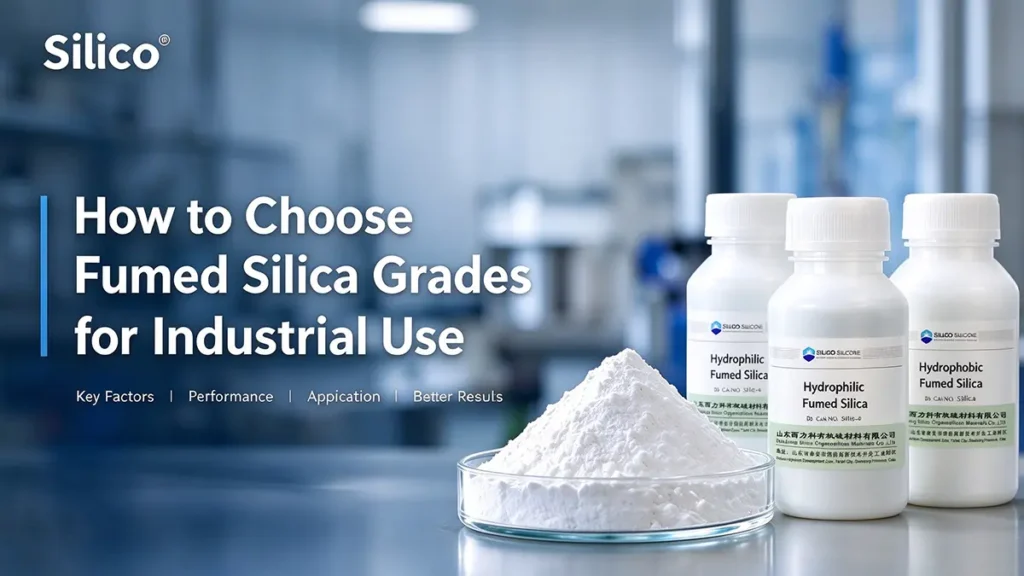
Fumed silica is widely used in industrial formulations to control viscosity, improve thixotropy, prevent filler settling, reinforce silicone rubber, and modify the flow properties of powders. However, selecting the right grade is not simply a matter of choosing the highest BET surface area or the lowest price per kilogram.
Two grades with similar specific surface areas can perform differently because their surface chemistry, aggregate structure, surface treatment, moisture content, and dispersion requirements are not necessarily the same. A grade that works well in a silicone rubber compound may be unsuitable for a water-based coating or a moisture-curing polyurethane sealant.
For buyers and formulators evaluating fumed silica grades for industrial use, the most reliable approach is to start with the required performance, narrow the options by surface chemistry and BET surface area, and then verify the selection through controlled formulation trials.
For industrial buyers researching material options, Silico® provides a starting point for exploring organosilicon products and requesting product information. Final fumed silica selection should always be based on the chemistry, processing conditions, and performance requirements of the intended application.
Table of Contents
- 1. What Is Fumed Silica, and Why Do Grades Differ?
- 2. The Five Parameters That Matter Most
- 3. How to Select a Grade by BET Surface Area
- 4. Hydrophilic vs. Hydrophobic Fumed Silica
- 5. Choosing Fumed Silica for Different Industrial Applications
- 6. A Practical Method for Comparing Grades
- 7. Common Fumed Silica Selection Mistakes
- 8. What to Check Before Ordering
- Conclusion
1. What Is Fumed Silica, and Why Do Grades Differ?
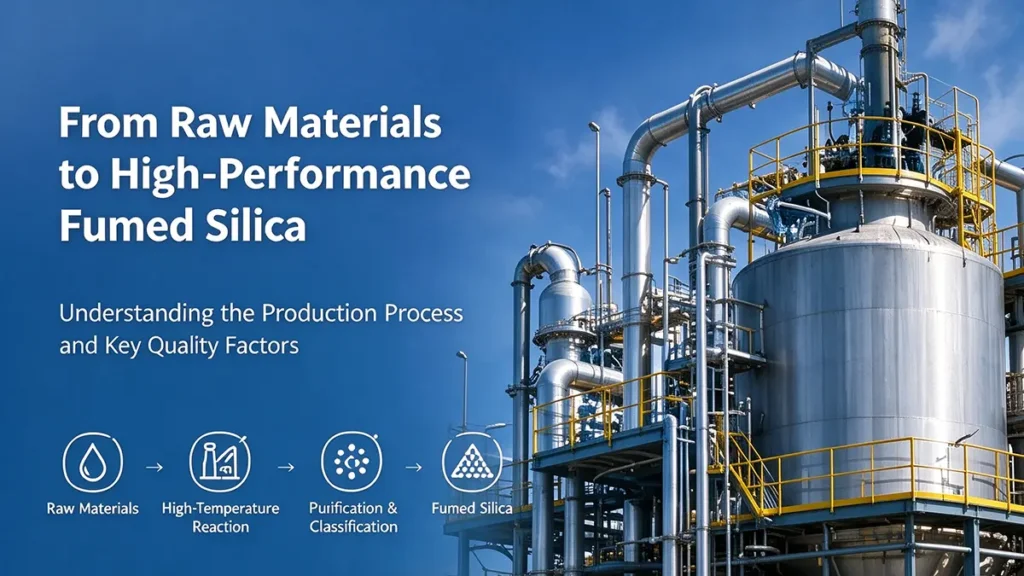
Fumed silica, also called pyrogenic silica, is a synthetic amorphous silicon dioxide produced through a high-temperature vapor-phase process. It consists of extremely fine primary particles that fuse into aggregates and form larger agglomerates during handling.
Commercial fumed silica grades commonly cover a broad range of BET specific surface areas. For example, Silico®’s published FS range includes hydrophilic grades with nominal surface areas from approximately 90 to 380 m²/g. The corresponding primary particle sizes in its listed grades range from about 22 nm down to 7 nm. These are product-family examples, not universal classifications for every manufacturer.
Fumed silica behaves differently from many conventional mineral fillers because of its high surface area and particle structure. Depending on the formulation, it can form a temporary network that increases low-shear viscosity and helps prevent settling. Under mixing, pumping, or application shear, part of this network breaks down, allowing the material to flow more readily. After the shear is removed, the structure can rebuild.
This behavior is useful when a formulation must remain stable during storage but still be easy to pump, dispense, brush, spray, or extrude.
- Rheology control: Adjusting viscosity, thixotropy, and yield behavior.
- Anti-settling: Keeping pigments and dense fillers suspended.
- Sag resistance: Reducing flow or dripping on vertical surfaces.
- Reinforcement: Improving the mechanical properties of silicone rubber and other elastomer systems.
- Flow and anti-caking: Helping fine powders maintain more consistent handling characteristics.
2. The Five Parameters That Matter Most
2.1 BET specific surface area
2.2 Surface chemistry and treatment
- Water adsorption and moisture sensitivity.
- Wetting and dispersion in different liquid systems.
- Interaction with polymer chains and other formulation ingredients.
- Thixotropic behavior and storage stability.
- Processing time and the energy needed for incorporation.
2.3 Aggregate structure and dispersion behavior
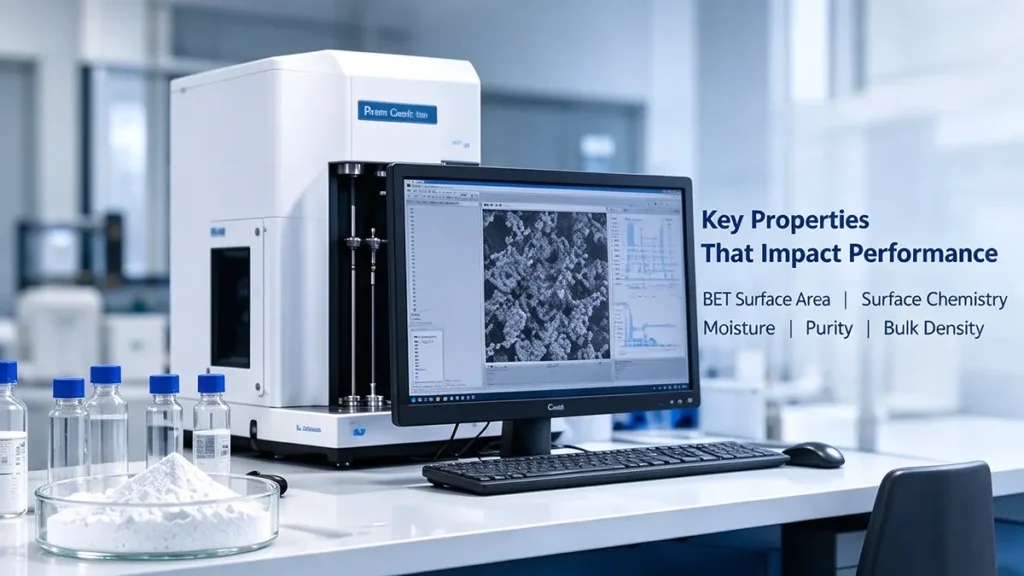
2.4 Moisture, pH, and purity
2.5 Bulk density and ease of incorporation
3. How to Select a Grade by BET Surface Area
| Approximate BET surface area | General performance tendency | When to investigate this range |
|---|---|---|
| 90–150 m²/g | Moderate surface interaction; may be easier to incorporate in some formulations | Systems where manageable processing, moderate thickening, or specific compatibility is the priority |
| 150–220 m²/g | Often provides a balance between structure development and processing requirements | General industrial rheology control, adhesives, sealants, and selected resin systems |
| 250–300 m²/g | Greater surface area and potential for stronger structure development | Formulations requiring higher thickening or reinforcement efficiency |
| 300–380 m²/g and above | High surface area, potentially strong rheological or reinforcing effects, with greater dispersion demands in some systems | High-performance formulations where lower loading, enhanced structure, or specific end properties justify more demanding processing |
Why higher BET is not automatically better
- Rheology at low shear, where settling and sag resistance are important.
- Rheology at higher shear, where pumping, spraying, and dispensing take place.
- Recovery after shear, which indicates how quickly the structure returns after application.
4. Hydrophilic vs. Hydrophobic Fumed Silica
| Consideration | Hydrophilic fumed silica | Hydrophobic fumed silica |
|---|---|---|
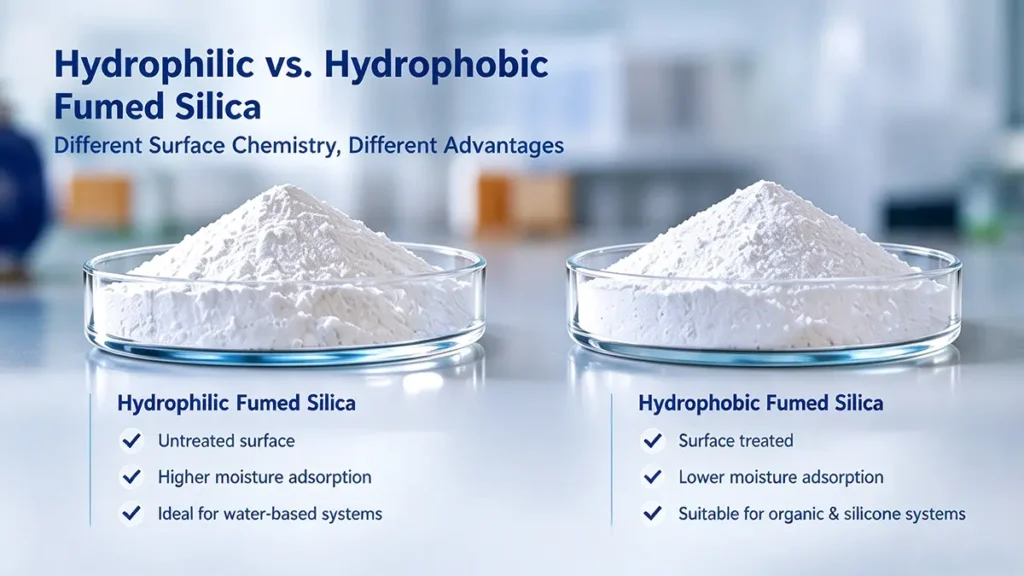
| Surface condition | Generally untreated, with accessible silanol groups | Surface chemically treated to reduce hydrophilicity |
| Interaction with water | More readily interacts with or adsorbs moisture | Generally shows lower moisture adsorption |
| Typical evaluation areas | Water-based formulations, polar media, and systems where silanol interactions are beneficial | Moisture-sensitive formulations and organic, silicone, or other compatible resin systems |
| Key questions | Does it wet and disperse well? Does moisture or hydrogen bonding destabilize the formulation? | Is the treatment compatible with the binder and cure chemistry? Does it provide the required rheology? |
| Main selection risk | Poor compatibility or moisture-related changes in performance | A treatment that does not suit the formulation, or unnecessary processing complexity |
Cabot identifies reduced moisture adsorption as a benefit of hydrophobic fumed silica. Its application literature also shows that treated grades can be used for rheology control in certain polar systems, so hydrophobic should not be interpreted as meaning “only suitable for non-polar liquids.”
How should surface treatment be chosen?
Start with the binder or base fluid, but do not stop at a broad label such as “water-based,” “polar,” or “non-polar.” Consider the actual resin structure, solvent package, moisture sensitivity, curing mechanism, and dispersion process.
For example, a one-component moisture-curing polyurethane adhesive has a different set of requirements from a two-component epoxy adhesive. In moisture-curing polyurethane, reducing unwanted water adsorption can help support formulation stability. Cabot’s application guide illustrates how treated silica grades with different base surface areas and treatment chemistries can target different combinations of reinforcement and sag resistance.
For silicone rubber, untreated and pre-treated grades may both be relevant. The choice depends on the required mechanical properties, optical clarity, incorporation method, and production process. Cabot specifically describes fumed silica as a reinforcing component in high-temperature-vulcanized silicone rubber and liquid silicone rubber, with grade selection depending on the desired balance of mechanical and optical properties.
For sourcing and technical evaluation, Silico® is one starting point for reviewing industrial organosilicon materials. When discussing fumed silica requirements with any supplier, providing the resin type, cure system, and target performance is more useful than requesting a grade based on BET alone.
5. Choosing Fumed Silica for Different Industrial Applications
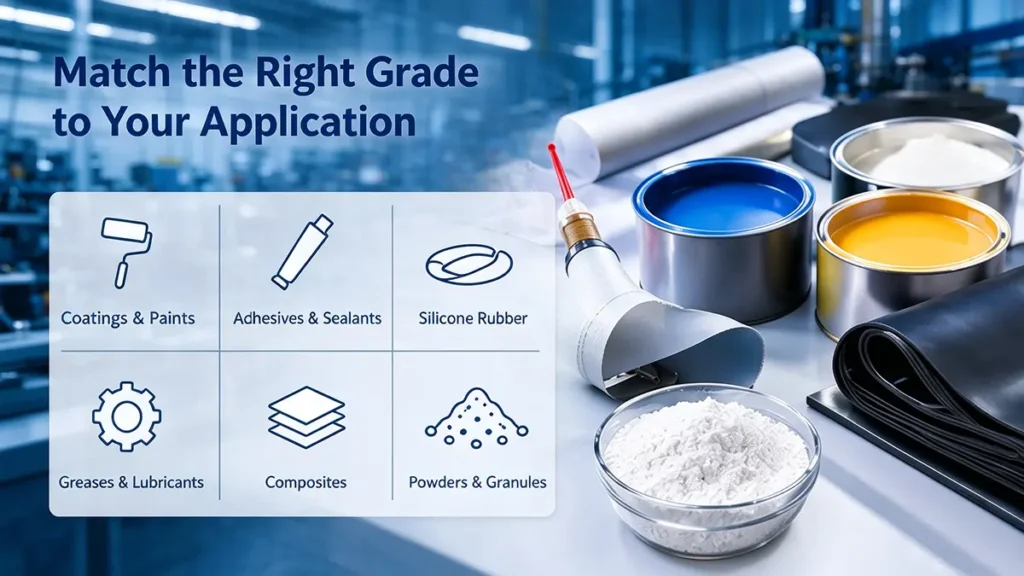
| Industrial application | Primary objective | Key selection considerations |
|---|---|---|
| Industrial coatings and paints | Anti-settling, sag resistance, controlled flow | Binder chemistry, pigment loading, dispersion quality, and the viscosity needed during application |
| Adhesives and sealants | Thixotropy, bead stability, sag resistance, and sometimes reinforcement | Cure chemistry, moisture sensitivity, dispensing behavior, and recovery after shear |
| Silicone rubber and elastomers | Tensile strength, tear resistance, hardness, and transparency | Reinforcement efficiency, incorporation process, surface treatment, and cure compatibility |
| Greases and lubricating compounds | Thickening, consistency, and resistance to separation | Base-oil chemistry, target consistency, temperature stability, and oil separation |
| Composites and unsaturated polyester resins | Filler suspension and resistance to sagging | Resin compatibility, filler loading, processability, and the time available for processing |
| Powder and granular products | Flow improvement and anti-caking | Powder surface properties, dosage, storage conditions, and compatibility with other ingredients |
| High-purity polishing or specialized electronic formulations | Consistent dispersion and controlled performance | Trace impurities, particle-related specifications, formulation purity, and batch-to-batch consistency |
5.1 Coatings: balance anti-settling and application flow
5.2 Adhesives and sealants: match grade to cure chemistry
5.3 Silicone rubber: evaluate reinforcement and processing together
5.4 Greases, composites, and powders: define the real performance target
6. A Practical Method for Comparing Grades
Step 1: Define the performance requirement
- Reduce settling during storage.
- Increase sag resistance on a vertical surface.
- Improve silicone rubber tensile and tear properties.
- Maintain dispensing performance while increasing thixotropic recovery.
- Improve powder flow under specified storage and handling conditions.
Step 2: Shortlist two or three candidates
Step 3: Keep the formulation and process controlled
Step 4: Compare loading levels systematically
Step 5: Measure performance beyond a single viscosity reading
| Test | What it helps determine |
|---|---|
| Low-shear viscosity or yield behavior | Resistance to settling and sagging |
| Higher-shear viscosity | Pumping, dispensing, brushing, or spraying behavior |
| Thixotropic recovery | How quickly the structure rebuilds after application shear |
| Accelerated storage and settling tests | Stability over time |
| Dispersion quality and incorporation time | Manufacturing efficiency and consistency |
| Mechanical properties | Reinforcement performance in cured materials |
| Cure behavior or cure time | Compatibility with the formulation’s curing system |
| Appearance, haze, or surface defects | Suitability for transparent or appearance-sensitive products |
Step 6: Evaluate the cost of the finished formulation
Step 7: Confirm production-scale performance
7. Common Fumed Silica Selection Mistakes
Mistake 1: Selecting by BET surface area alone
BET is a useful screening parameter, but it does not fully describe surface chemistry, aggregate structure, dispersion behavior, or formulation compatibility.
Better approach: Treat BET as the first filter, then compare the properties that control performance in the actual system.
Mistake 2: Assuming all hydrophobic grades are interchangeable
Different surface treatments and treatment levels can produce different wetting, moisture adsorption, and rheological effects.
Better approach: Request the surface-treatment type and relevant technical specifications, and test the grade in the intended binder and cure system.
Mistake 3: Increasing the dosage whenever performance is insufficient
More silica may increase thickening, but excessive loading can also increase processing difficulty, reduce flow, or affect the finished product’s appearance and mechanical properties.
Better approach: Determine whether the problem is dosage, dispersion, surface chemistry, or a mismatch between the target and the selected grade.
Mistake 4: Ignoring dispersion equipment
A grade that performs well under intensive laboratory dispersion may not be practical on an existing production line.
Better approach: Include incorporation time, mixing energy, and batch temperature in the comparison, and validate the results at production scale.
Mistake 5: Comparing datasheets without checking test methods
Values such as BET surface area, moisture, pH, and viscosity-related performance may be determined using different methods or reported using different conventions.
Better approach: Confirm the test method, specification limits, and whether the listed values are typical values or guaranteed specifications.
Mistake 6: Ignoring powder handling and safety
Fumed silica is an extremely fine powder. Its handling requirements should be assessed using the specific product’s safety data sheet and the applicable workplace rules.
Better approach: Use suitable local exhaust or closed handling where practicable, minimize dust generation, and follow the product’s recommended handling and housekeeping procedures.
8. What to Check Before Ordering
| Information to provide | Why it matters |
|---|---|
| Application and finished product | Defines the required function and performance level |
| Resin, polymer, or base-fluid type | Helps assess compatibility |
| Cure mechanism, if applicable | Identifies moisture sensitivity and possible cure-related constraints |
| Desired BET surface area or existing reference grade | Establishes a useful initial specification |
| Hydrophilic or hydrophobic requirement | Narrows options by surface chemistry |
| Current loading level and performance issue | Helps explain the required change |
| Mixing equipment and process conditions | Indicates the practical dispersion requirements |
| Critical finished-product properties | Defines the measurements for evaluating samples |
| Purity, regulatory, or trace-impurity limits | Identifies any specialized-grade requirements |
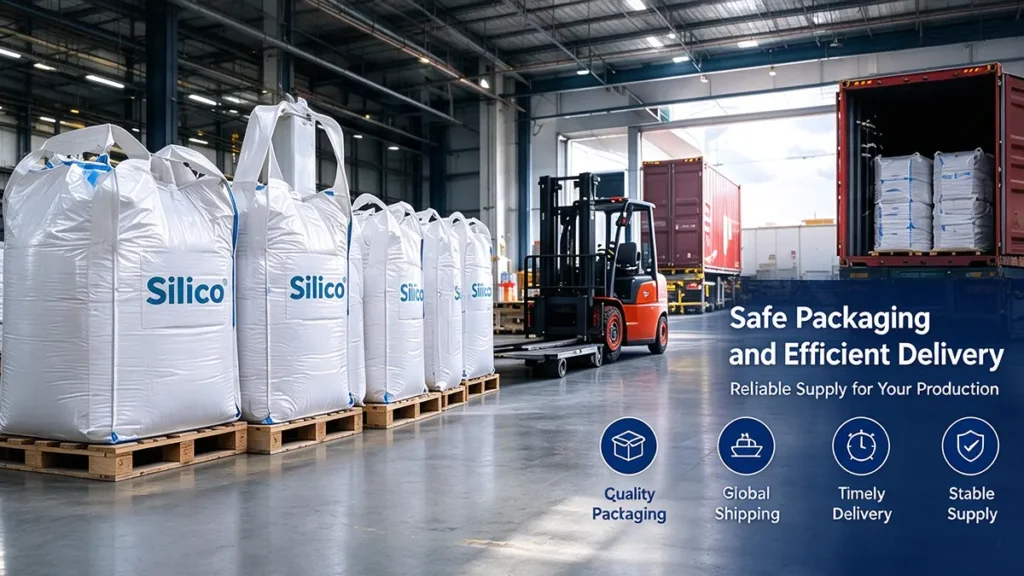
| Order quantity and destination | Supports commercial quotation and packaging planning |
Conclusion
Choosing fumed silica grades for industrial use requires a balance between material properties, formulation chemistry, processing capability, and the performance required from the finished product.
Start with the application and target properties. Use BET surface area to narrow the candidates, evaluate hydrophilic and hydrophobic surface chemistry against the actual binder and curing system, and check dispersion requirements before making a final decision. Controlled trials should then establish whether the grade delivers the necessary rheology, stability, reinforcement, or flow characteristics at an acceptable total cost.
The most reliable specification is not simply the grade with the highest surface area or the lowest unit price. It is the grade that performs consistently in the real formulation and can be processed efficiently at production scale.
For buyers exploring industrial silicone and related organosilicon materials, Silico® offers a starting point for product information and inquiries. Providing the application, technical requirements, order quantity, and destination will help establish a more useful basis for product evaluation.
Frequently Asked Questions (FAQs)
Fumed Silica related products



Popular Recommendations
Get a Catalog & Best Price
- Quick and helpful reply within 24 hours;
- Tailored solutions provided for your project;
- One-stop purchasing service.
Need More Technical Information?
Silico® ORGANOSILICON
- Address: Daiyue Industrial Area, Taian, Shandong, China
- © Copyright 2022 Silico® . All Rights Reserved