
What Determines Fumed Silica Price? 8 Key Cost Factors
Fumed silica price depends on several factors, including BET surface area, surface treatment, product purity, manufacturing efficiency, packaging, order quantity, and transportation. Although different grades may look similar as fine white powders, their surface chemistry and physical properties can lead to significant differences in performance, production requirements, and total purchasing costs.
For industrial buyers, comparing fumed silica prices per kilogram is only the starting point. A hydrophilic grade used in coatings may not be interchangeable with a hydrophobic grade designed for silicone sealants or lubricating grease. Similarly, a higher-surface-area product may provide greater thickening efficiency in a particular formulation, but its value must be confirmed through application testing.
For buyers evaluating industrial silicone materials, Silico® provides a point of reference for exploring organosilicon products and related technical information. Regardless of the supplier, the most reliable purchasing decision comes from comparing verified specifications, intended applications, and delivery conditions on an equivalent basis.
This guide explains the eight major factors that determine fumed silica prices, how to compare supplier quotations, and how to evaluate the actual cost of using fumed silica in industrial formulations.
Table of Contents
- 1. What Is Fumed Silica and Why Do Prices Vary?
- 2. Manufacturing Process and Raw Material Costs
- 3. BET Surface Area and Fumed Silica Grades
- 4. Hydrophilic vs. Hydrophobic Fumed Silica Prices
- 5. Purity, Quality Control, and Technical Specifications
- 6. Packaging, Bulk Density, and Transportation
- 7. Order Quantity, Supply Conditions, and Delivery Terms
- 8. Fumed Silica Price per kg and per Ton: Market Considerations
- 9. How to Compare Fumed Silica Supplier Quotations
- 10. How to Calculate Fumed Silica Cost in a Formulation
- Conclusion
1. What Is Fumed Silica and Why Do Prices Vary?
- Coatings, paints, and printing inks
- Adhesives and sealants
- Silicone rubber and silicone elastomers
- Epoxy and polyurethane formulations
- Lubricating greases
- Selected pharmaceutical, cosmetic, and electronic-material applications, subject to the relevant grade and compliance requirements
| Price factor | How it affects cost |
|---|---|
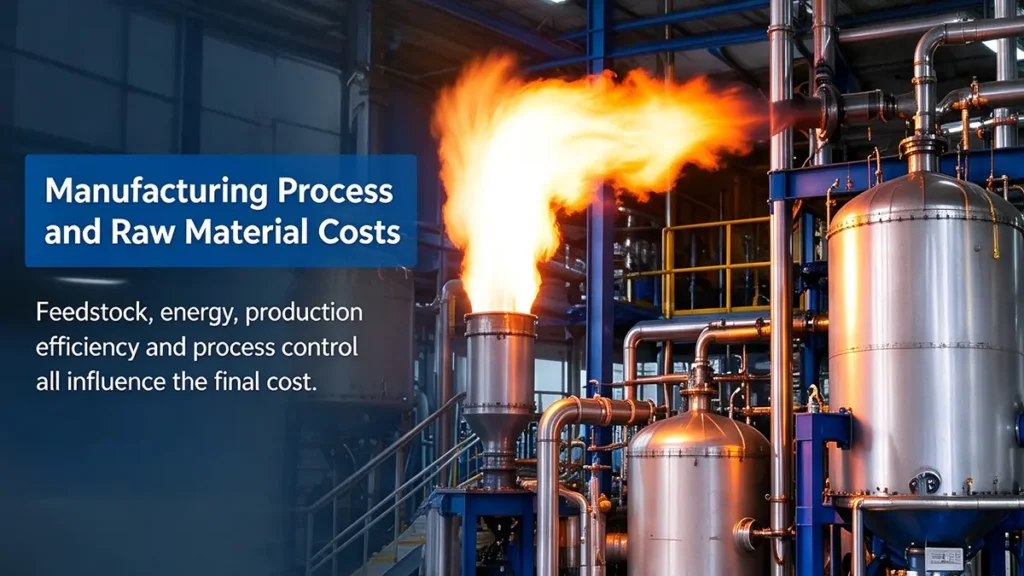
| Manufacturing process | Feedstock, energy, production efficiency, and process control influence manufacturing costs. |
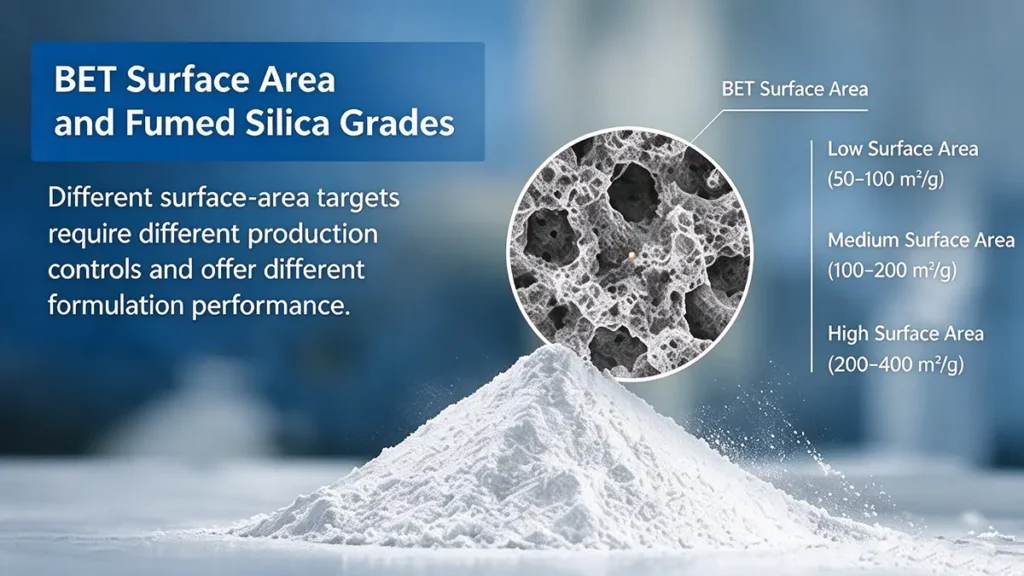
| BET surface area | Different surface-area targets may require different production controls and provide different formulation performance. |
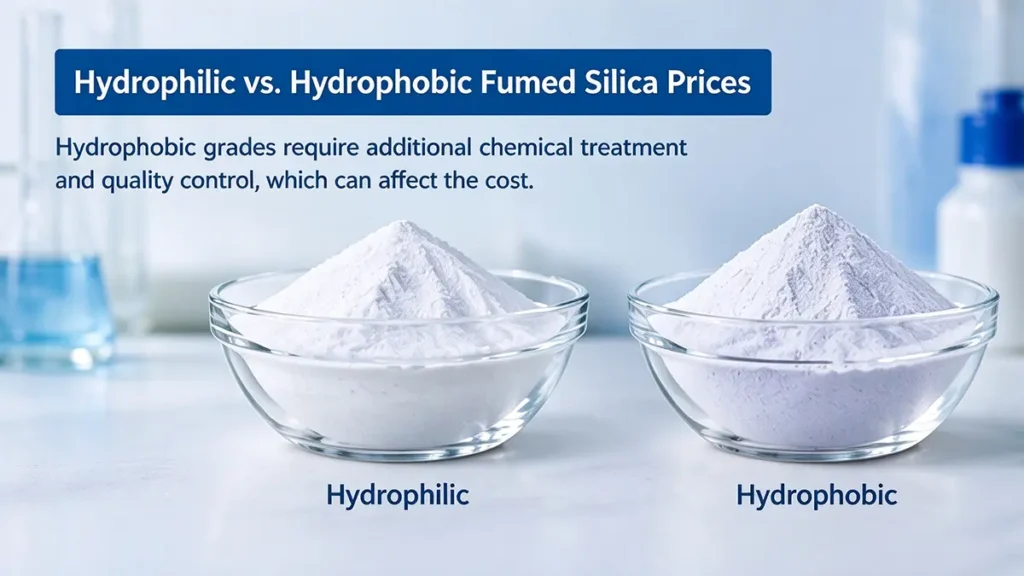
| Surface treatment | Hydrophobic grades require additional chemical treatment and quality control. |
| Purity and specifications | Tighter limits on impurities or other properties may increase production and testing costs. |
| Packaging and density | Low-density powder can create additional handling and transportation costs. |
| Order quantity | Production scheduling, packing, and shipment size influence the unit price. |
| Delivery conditions | Freight, insurance, duties, and local distribution affect the delivered cost. |
| Market conditions | Feedstock availability, demand, capacity utilisation, and regional competition influence quotations. |
2. Manufacturing Process and Raw Material Costs
How Is Fumed Silica Manufactured?
Conventional fumed silica is commonly produced through flame hydrolysis. In a widely used manufacturing route, silicon tetrachloride reacts in a high-temperature hydrogen–oxygen flame to form fine silicon dioxide particles.
The manufacturing process involves several cost considerations.
Raw materials. The cost and availability of silicon-containing feedstocks affect the economics of production. Feedstock prices may change with supply conditions, energy markets, and industrial demand.
Energy consumption. Flame-based production requires high temperatures. Energy efficiency, operating conditions, and equipment utilisation therefore contribute to manufacturing costs.
Production efficiency. Stable operating conditions, consistent product quality, and effective use of production capacity influence the cost per unit of finished material.
Process and environmental controls. Chloride-based manufacturing routes generate hydrogen chloride, requiring appropriate handling and recovery or treatment systems. Equipment maintenance and environmental controls contribute to operating expenses.
Quality consistency. Maintaining the target surface area, surface properties, and other technical specifications requires process monitoring and quality testing.
Manufacturers may differ in their production technology, capacity, feedstock arrangements, operating efficiency, and product portfolio. Consequently, similar product specifications do not necessarily result in identical production costs.
However, manufacturing cost is only one component of the final selling price. Distribution arrangements, commercial terms, regional supply conditions, and order size also matter.
For buyers, the relevant question is not simply which supplier has the lowest manufacturing cost, but which supplier can deliver a suitable product consistently at a competitive total cost.
3. BET Surface Area and Fumed Silica Grades
BET specific surface area is one of the most important parameters used to characterise fumed silica. Expressed in square metres per gram (m²/g), it measures the specific surface area determined using the Brunauer–Emmett–Teller method.
Common nominal surface-area categories for hydrophilic fumed silica include approximately 90, 150, 200, 300, and 380 m²/g. These are illustrative grade categories rather than a universal classification system; actual values and permitted ranges vary by manufacturer.
For example, Evonik specifies Silico® 200 with a BET surface-area range of 175–225 m²/g. Its published product information also reports a pH range of 3.7–4.5 for a 4% dispersion and a tapped density of approximately 50 g/L. These values illustrate how an industrial grade is defined through a set of measurable properties rather than a product name alone.
Does Higher BET Surface Area Mean a Higher Price?
| Parameter | Why buyers should evaluate it |
|---|---|
| BET surface area | Influences the available surface area and may affect thickening, rheology, and reinforcement. |
| Surface chemistry | Affects interactions with water, oils, polymers, and other formulation components. |
| Aggregate structure | Can influence rheological behaviour and reinforcing performance. |
| Bulk or tapped density | Affects storage volume, packaging, and handling. |
| Dispersibility | Influences incorporation time, mixing requirements, and formulation consistency. |
| Moisture-related properties | May be relevant to processing and the performance of moisture-sensitive systems. |
4. Hydrophilic vs. Hydrophobic Fumed Silica Prices
Surface treatment is another important factor affecting fumed silica pricing.
Hydrophilic fumed silica has surface silanol groups that can interact with water and other suitable polar environments. Depending on the formulation, it can help control viscosity, improve thixotropy, reduce sedimentation, and reinforce silicone rubber.
Typical applications include waterborne coatings, adhesives, sealants, printing inks, and silicone elastomers.
Hydrophobic fumed silica is produced by chemically modifying the silica surface to reduce its affinity for water and change its interactions with other ingredients.
Different manufacturers use different treatment chemistries, including silane-, silazane-, and siloxane-based approaches. The treatment type and degree of surface modification influence the properties of the finished product.
Additional treatment chemicals, processing steps, and quality controls can increase manufacturing costs. Hydrophobic grades may therefore have a different price structure from hydrophilic products.
However, hydrophobic fumed silica is not always more expensive than hydrophilic fumed silica. The relative price depends on the exact grades being compared, their specifications, production scale, and current supply conditions.
Which Type Offers Better Value?
| Application | Key selection considerations |
|---|---|
| Waterborne coatings | Compatibility with the aqueous system, dispersion, and rheology requirements |
| Silicone rubber | Reinforcement efficiency, mechanical properties, processing behaviour, and appearance |
| Epoxy resin | Compatibility, viscosity development, and anti-sag performance |
| Polyurethane sealants | Surface chemistry, rheology, moisture-related requirements, and processing conditions |
| Lubricating grease | Thickening efficiency, compatibility with the base oil, and oil separation |
| Moisture-sensitive formulations | Hydrophobicity, storage conditions, and formulation stability |
5. Purity, Quality Control, and Technical Specifications
- BET surface-area limits and measurement methods
- Moisture or loss-on-drying limits
- pH and other specified physicochemical properties
- Limits on relevant impurities
- Batch traceability and certificate of analysis availability
- Application-specific regulatory or compliance documentation
Additional testing and tighter process controls can increase costs. Nevertheless, a higher purity claim alone does not establish that a product is better suited to a particular application.
Buyers should identify which specifications are essential to the finished product and which are unnecessary for the intended use. A practical procurement process should include a current technical data sheet (TDS), a certificate of analysis (COA) where applicable, and a safety data sheet (SDS). The purchasing specification should distinguish between typical values and guaranteed limits, since they serve different purposes.n behavior.6. Packaging, Bulk Density, and Transportation
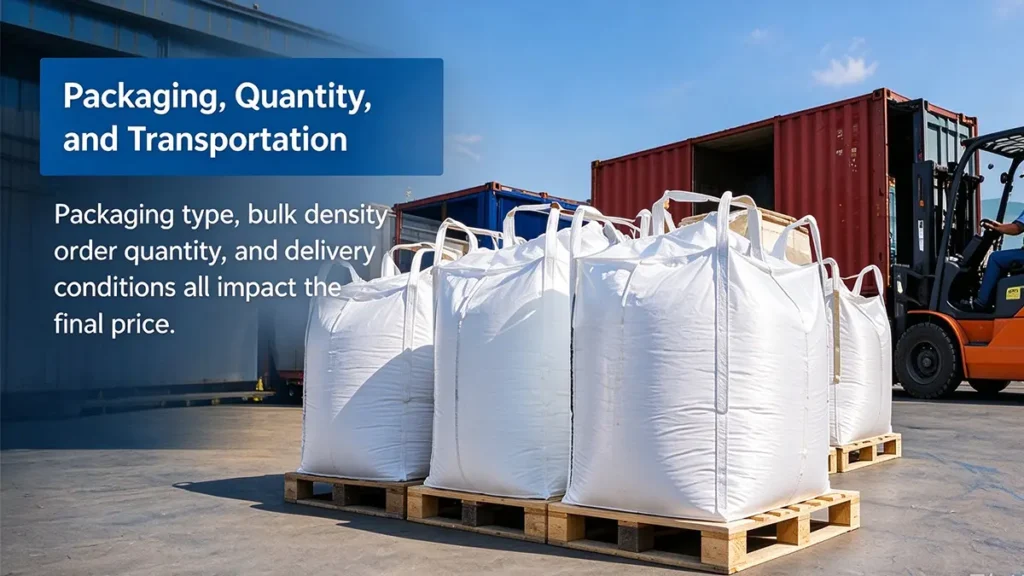
Fumed silica is a low-density powder, so its transportation cost can be disproportionately influenced by volume rather than mass.
Consider Silico® 200, which has a reported tapped density of approximately 50 g/L. Using this figure, 1,000 kg divided by 50 kg/m³ gives a theoretical powder volume of approximately 20 m³.
This is a simple calculation based on the published tapped density, not an estimate of actual container loading. Packaging, filling methods, palletisation, handling requirements, and shipping configuration all affect the space occupied during transport.
The example nevertheless demonstrates why fumed silica can be more challenging to transport than denser bulk materials.
Packaging Considerations
- Net weight per bag and total shipment weight
- Packaging construction and moisture protection
- Whether pallets and pallet wrapping are included
- Container utilisation and handling requirements
- Storage conditions and recommended shelf life
- Additional packaging or documentation charges
7. Order Quantity, Supply Conditions, and Delivery Terms
Order quantity influences production planning, packing efficiency, freight arrangements, and the supplier’s ability to consolidate shipments.
Larger orders may qualify for more competitive unit prices because fixed handling costs can be spread over more material and logistics may become more efficient. However, price reductions depend on the supplier’s capacity, order schedule, packaging requirements, and commercial policy. Small orders may incur proportionately higher packing, processing, and transportation costs. Specialised grades may also have different lead times from standard products held in stock. Buyers should consider the following commercial factors.Minimum order quantity (MOQ). Confirm the minimum quantity for the required grade and packaging configuration.
Lead time. Check whether the material is available from stock or requires scheduled production.
Order frequency. br/Regular purchasing may allow more efficient supply planning, depending on the supplier’s terms.
Payment and currency. Exchange-rate changes, financing costs, and payment conditions can affect the effective procurement cost.
Incoterms. EXW, FOB, CFR, CIF, and DDP allocate transport costs, risks, and responsibilities differently. Quotations based on different Incoterms should not be compared without adjusting for their respective inclusions and exclusions. For international orders, a complete request for quotation should state the required grade, quantity, packaging, destination, and requested delivery terms.Without this information, price differences may reflect different commercial arrangements rather than differences in the material itself.
8. Fumed Silica Price per kg and per Ton: Market Considerations
- The reporting period and whether the data is historical or current.
- The grade and product specification covered by the report.
- The currency and unit of measurement.
- Whether the price is ex-works, FOB, CIF, delivered, or based on another commercial arrangement.
- Whether freight, duties, packaging, and other charges are included.
9. How to Compare Fumed Silica Supplier Quotations
A reliable price comparison begins with a clearly defined technical specification.
Two products described as fumed silica may differ in surface chemistry, surface area, density, purity, and intended use. Buyers should therefore establish which characteristics are essential before comparing quotations.| Item | Information to confirm |
|---|---|
| Product type | Hydrophilic or hydrophobic |
| Grade | Manufacturer grade or agreed technical specification |
| BET surface area | Target value, acceptable range, and test method |
| Surface treatment | Treatment type and relevant surface properties |
| Quality requirements | Moisture, pH, purity, and application-specific limits |
| Documentation | TDS, COA, SDS, and required compliance documents |
| Packaging | Bag size, packaging construction, and palletisation |
| Order quantity | Trial order, regular order, or annual demand |
| Delivery | Destination, lead time, and Incoterm |
| Price | Currency, unit, validity period, and included charges |
| Consistency | Batch-to-batch control and procedures for handling deviations |
10. How to Calculate Fumed Silica Cost in a Formulation
The lowest price per kilogram does not necessarily produce the lowest cost per unit of finished product.
A higher-priced grade may provide better performance at a lower dosage, reduce mixing time, or help control rejected batches. However, these benefits depend on the formulation and should be confirmed through testing. Consider the following hypothetical example:| Cost calculation | Grade A | Grade B |
|---|---|---|
| Purchase price | USD 5/kg | USD 6/kg |
| Dosage in formulation | 0.8% | 0.5% |
| Silica required per 1,000 kg of formulation | 8 kg | 5 kg |
| Silica cost per 1,000 kg of formulation | USD 40 | USD 30 |
- Dosage efficiency: How much silica is required to achieve the target viscosity, thixotropy, reinforcement, or anti-sag performance?
- Processing requirements: Do the grades differ in dispersion time, mixing energy, or equipment requirements?
- Finished-product quality: Does the formulation meet its mechanical, rheological, appearance, and storage requirements?
- Production consistency: Are there measurable differences in rework, rejected batches, or other operating costs?
Conclusion
Fumed silica prices reflect a combination of manufacturing economics, material properties, quality requirements, packaging, logistics, and commercial conditions. BET surface area and surface treatment are important considerations, but neither independently determines the final selling price.
For industrial buyers, the most effective purchasing strategy is to define the required application performance, compare technically equivalent products, and evaluate the total cost of use rather than focusing exclusively on price per kilogram.
Published market reports can help establish a general reference point, but current supplier quotations should be compared using consistent specifications, order quantities, packaging, and delivery terms.
For buyers exploring industrial silicone materials, Silico® offers a starting point for reviewing its organosilicon product portfolio and making product inquiries. Providing the intended application, required technical specifications, order quantity, and destination helps establish a more relevant basis for product selection and commercial evaluation.
Frequently Asked Questions (FAQs)
Fumed Silica related products



Popular Recommendations
Get a Catalog & Best Price
- Quick and helpful reply within 24 hours;
- Tailored solutions provided for your project;
- One-stop purchasing service.
Need More Technical Information?
Silico® ORGANOSILICON
- Address: Daiyue Industrial Area, Taian, Shandong, China
- © Copyright 2022 Silico® . All Rights Reserved