2026-05-06


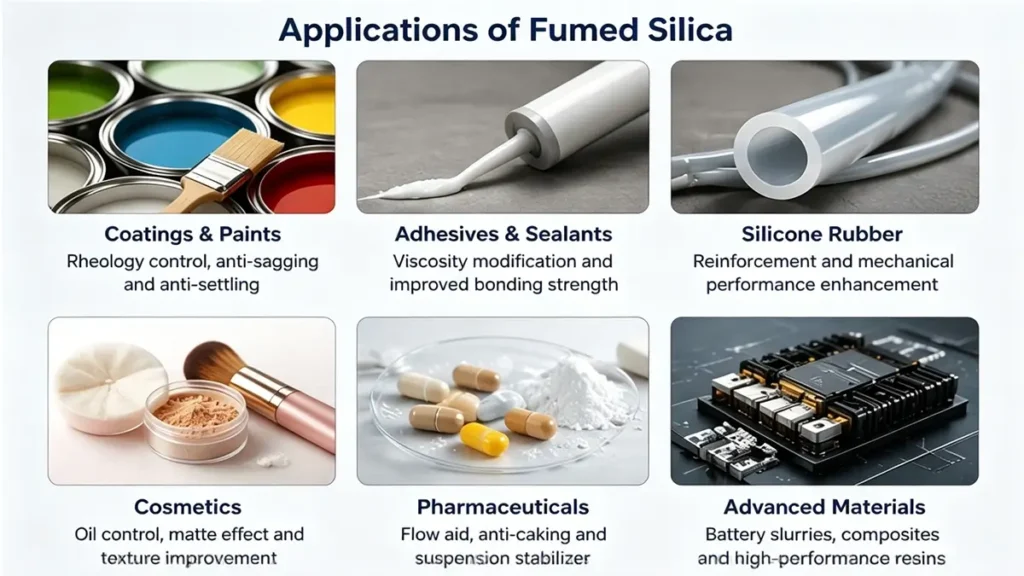
Fumed silica (pyrogenic silica) is a high-performance nano-scale silicon dioxide (SiO₂) functional additive widely used in modern industrial formulations. It plays a critical role in rheology control, viscosity modification, anti-settling performance, anti-sagging behavior, thixotropy adjustment, and polymer reinforcement across coatings, adhesives, silicone rubber, cosmetics, pharmaceuticals, and advanced composite materials.
In real-world formulation engineering, one of the most important decisions is selecting between hydrophilic fumed silica vs hydrophobic fumed silica. This choice directly affects dispersion stability, system compatibility, processing behavior, and final product performance.
For many industrial manufacturers and formulators, consistent material quality is essential. That is why advanced material providers such as Silico® are often referenced for delivering reliable fumed silica solutions tailored to different application systems.
SiCl4+2H2+O2→SiO2+4HCl
The resulting structure consists of nano-scale primary particles (≈7–40 nm) forming branched aggregates with extremely high specific surface area (typically 150–400 m²/g).
Because of its unique nanostructure, fumed silica is widely used as a rheology modifier, anti-caking agent, reinforcing filler, and anti-sedimentation additive in both polar and non-polar systems.
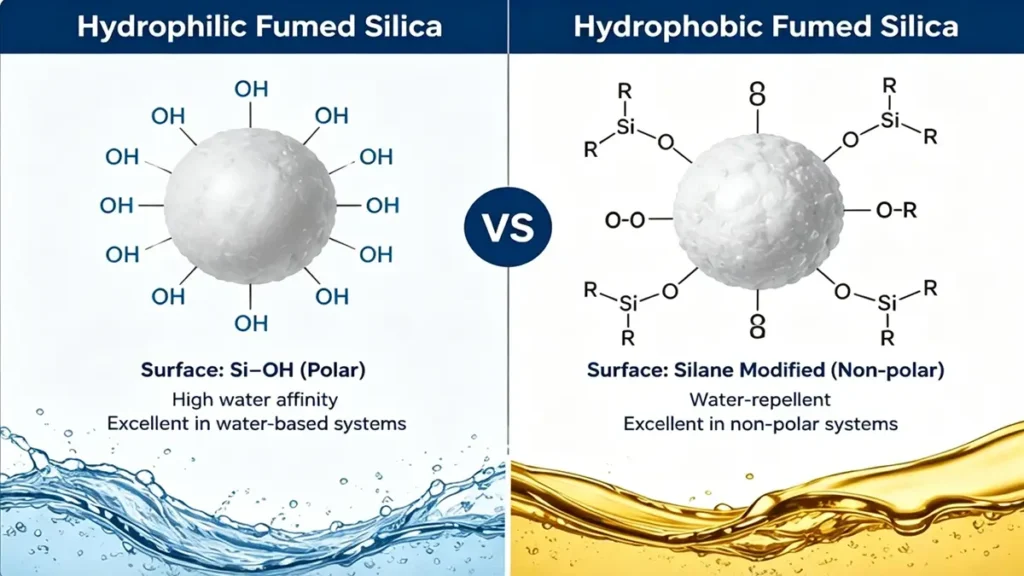
The surface of untreated fumed silica is rich in silanol groups:
These hydroxyl groups form strong hydrogen bonding networks with water and polar solvents, which is the core mechanism behind its thickening performance in aqueous systems.
Si–OH⋯HO–Si
This hydrogen bonding creates a three-dimensional network structure that increases viscosity and improves suspension stability.
However, this polar surface also limits compatibility in oil-based, resin-based, and silicone-based systems.
Hydrophilic fumed silica is the untreated form of SiO₂, retaining active silanol (Si–OH) groups. It is highly polar and strongly interacts with water molecules.
In aqueous systems, hydrophilic silica forms a viscoelastic network:
Si-OH+H2O→hydrogen-bonded gel structureThis makes it highly effective in water-based fumed silica thickening systems.
Hydrophobic fumed silica is produced by surface modification of hydrophilic silica using silane reagents (e.g., HMDS, DDS), replacing silanol groups with organic functional groups.
Si-OH+(CH3)3Si–Cl→Si–O–Si(CH3)3+HCl
This modification reduces surface polarity and significantly improves compatibility with non-polar systems.
Hydrophobic grades are essential in moisture-sensitive and high-durability industrial systems.
In many formulation environments, engineered material solutions such as Silico® fumed silica grades are used to ensure consistent dispersion behavior and stable rheology performance.
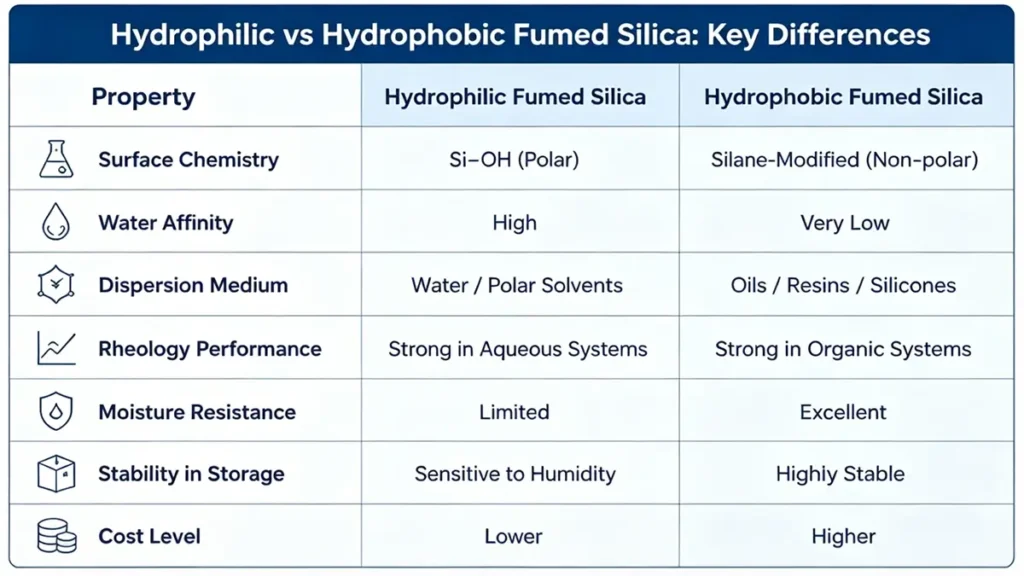
| Property | Hydrophilic Fumed Silica | Hydrophobic Fumed Silica |
|---|---|---|
| Surface chemistry | Si–OH (polar) | Silane-modified (non-polar) |
| Water affinity | High | Very low |
| Dispersion medium | Water, alcohols | Oils, resins, silicones |
| Thickening mechanism | Hydrogen bonding network | Steric + physical network |
| Moisture resistance | Limited | Excellent |
| Storage stability | Sensitive to humidity | Highly stable |
| Typical cost | Lower | Higher |
Hydrophobic silica significantly improves mechanical strength, elasticity, and long-term bonding stability.
Fumed silica is a key reinforcing filler:
Incorrect selection of fumed silica is a frequent cause of formulation failure:
❌ Using hydrophilic silica in oil systems → poor dispersion and aggregation
❌ Using hydrophobic silica in water systems → wetting failure and flocculation
❌ Over-dosing silica → gelation and processing difficulty
❌ Ignoring humidity exposure → viscosity drift and instability
Proper selection, dispersion energy, and system compatibility are critical for achieving stable rheology performance in industrial formulations.
The fundamental difference between hydrophilic and hydrophobic fumed silica lies in surface chemistry, which determines compatibility, dispersion behavior, and long-term formulation stability.
For formulators in coatings, silicone rubber, adhesives, cosmetics, and advanced materials industries, selecting the correct grade is essential for ensuring product consistency and performance reliability.
As global demand for high-performance materials continues to grow, reliable and application-specific material solutions such as Silico® fumed silica technologies play an increasingly important role in enabling stable, scalable, and efficient industrial formulations.
Hydrophilic fumed silica contains Si–OH groups and is suitable for water-based systems, while hydrophobic fumed silica is surface-treated for compatibility with oils, resins, and silicone systems, offering better moisture resistance and stability.
Hydrophilic fumed silica is ideal for water-based coatings, adhesives, cosmetics, and pharmaceutical suspensions where strong hydrogen bonding and high thickening efficiency are required.
Hydrophobic fumed silica has a non-polar surface, which improves dispersion in silicone rubber, epoxy resins, and solvent-based systems, ensuring better anti-sagging and long-term rheology stability.
Yes. Both hydrophilic and hydrophobic fumed silica act as rheology modifiers, forming a 3D network structure that enhances viscosity control, anti-sedimentation, and thixotropic behavior in industrial formulations.
The key factor is system polarity: use hydrophilic fumed silica for polar, water-based systems, and hydrophobic fumed silica for non-polar systems like oils, silicones, and resins to ensure optimal performance and stability.