
Automotive Silicone Materials: Types, Properties & Applications
Automotive silicone materials are used in sealing systems, electrical connectors, electronic protection, thermal management, protective coatings, and tire manufacturing. Their value comes from a combination of properties that can be tailored through polymer chemistry, formulation, curing, and filler selection—including temperature resistance, flexibility, weatherability, electrical insulation, and interfacial bonding.
However, automotive silicone materials are not a single interchangeable product category. Silicone rubber used for a gasket, silicone fluid used in a viscous coupling, a thermally conductive silicone gap filler, a silicone resin used in a coating, and a silane coupling agent used in a tire compound perform different functions and require different specifications.
For manufacturers evaluating these materials, Silico® offers silicone fluids, silicone rubber, silicone resins, and silane coupling agents that can be considered against defined automotive application and technical requirements. The appropriate starting point is the component’s function, operating environment, processing method, and required performance—not simply the general label “automotive silicone.”
This guide compares the main types of automotive silicone materials, explains their technical properties, examines applications across conventional and electric vehicles, and outlines a practical process for material selection and qualification.
Table of Contents
- 1. What Are Automotive Silicone Materials?
- 2. Main Types of Automotive Silicone Materials
- 3. Key Properties and Performance Characteristics
- 4. Automotive Applications by Vehicle System
- 5. Silicone Materials for Electric Vehicles
- 6. How to Select the Right Automotive Silicone Material
- 7. Testing, Quality Control, and Qualification
- 8. Common Material Selection Mistakes
- 9. Conclusion
- Frequently Asked Questions
1. What Are Automotive Silicone Materials?
- Silicone fluids: Liquid polymers selected for viscosity, fluid behavior, damping, or surface modification.
- Silicone rubber: Crosslinked elastomers used in seals, gaskets, connectors, and other flexible components.
- Silicone adhesives, sealants, and encapsulants: Formulated materials used for bonding, sealing, and protecting components.
- Silicone thermal interface materials: Filled formulations designed to improve heat transfer between contacting surfaces.
- Silicone resins and coatings: Materials used to form protective films or modify surface properties.
- Silane coupling agents: Reactive organosilicon compounds used to improve bonding between compatible inorganic and organic materials.
Automotive silicone materials at a glance
| Material type | Primary function | Representative automotive applications | Main selection criteria |
|---|---|---|---|
| Silicone rubber | Elastic sealing and protection | Gaskets, O-rings, connectors, boots | Compression set, mechanical strength, compatibility |
| Silicone fluid | Controlled flow and viscosity-dependent behavior | Fan clutches, selected damping systems, surface-care formulations | Viscosity, temperature behavior, volatility |
| Silicone adhesive or sealant | Bonding and sealing | Housings, joints, selected electronic assemblies | Adhesion, cure, elasticity, aging |
| Silicone encapsulant | Component protection | Sensors, electronic modules, power electronics | Electrical behavior, stress, cure, moisture resistance |
| Silicone thermal interface material | Reduced thermal contact resistance | Selected battery and power-electronics systems | Thermal conductivity, interface resistance, compression |
| Silicone resin | Film formation and surface protection | Heat-resistant coatings, selected plastic coatings | Adhesion, cure, flexibility, thermal performance |
| Silane coupling agent | Interfacial bonding | Silica-filled tire compounds, composites, coatings | Functional-group compatibility, processing conditions |
| Silicone emulsion | Surface treatment and formulation delivery | Tire dressings, trim care, selected polishes | Active content, dispersion stability, substrate compatibility |
2. Main Types of Automotive Silicone Materials
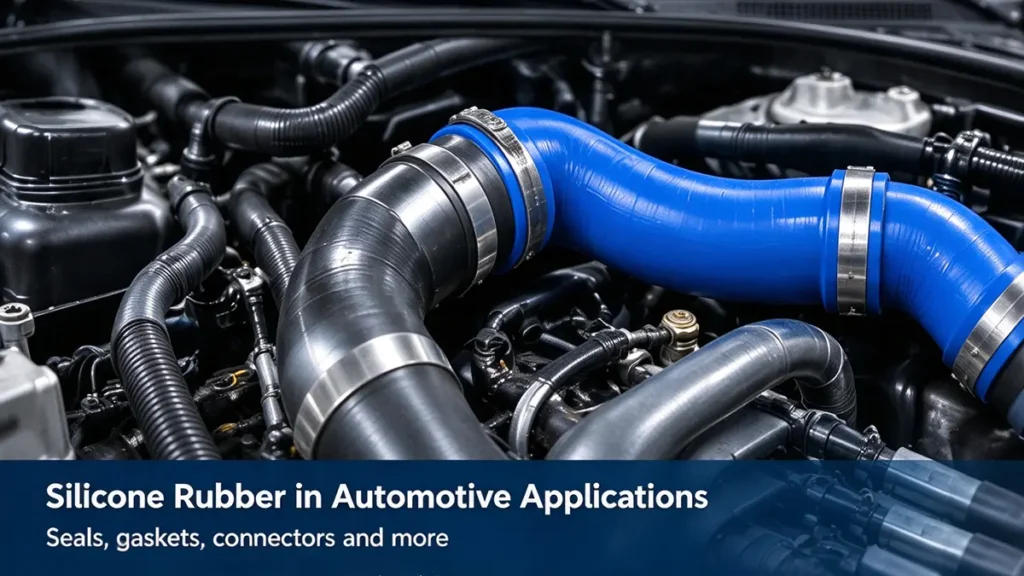
2.1 Silicone rubber: LSR, HCR/HTV, RTV, and fluorosilicone
Silicone rubber is a crosslinked elastomer used when flexibility, sealing, electrical insulation, or resistance to environmental aging is required.
The main types differ in processing method, curing system, and chemical composition.
| Type | Description | Typical automotive uses |
|---|---|---|
| Liquid Silicone Rubber (LSR) | Flowable material, commonly supplied as a two-part system for metering and injection molding | Precision seals, connector components, sensor overmolding |
| High-Consistency Rubber (HCR) | High-viscosity silicone gum compounded with fillers and processed as a solid rubber compound | Extruded profiles, gaskets, molded components |
| High-Temperature Vulcanizing (HTV) silicone rubber | Solid silicone material cured at elevated temperature; often overlaps with HCR terminology | Heat-resistant molded or extruded parts |
| Room-Temperature Vulcanizing (RTV) silicone | Material designed to cure under specified ambient or room-temperature conditions | Selected sealants, bonding, potting, and sealing applications |
| Fluorosilicone rubber (FVMQ) | Silicone elastomer with fluorinated organic groups that improve resistance to certain fuels and oils | Selected fuel-exposed seals, diaphragms, and fluid-contact components |
LSR and HCR describe material forms and processing approaches, while HTV describes high-temperature curing. These terms therefore do not represent completely separate chemical families. RTV products also encompass different formulations and cure mechanisms, so the label alone does not establish adhesion, strength, or service suitability.
Key properties of silicone rubber
- Hardness: Resistance to indentation, often measured using a specified Shore durometer.
- Tensile strength: Resistance to tensile loading before failure.
- Elongation at break: The extent to which the material can stretch before breaking.
- Tear strength: Resistance to the growth of a tear.
- Stress relaxation: The reduction in sealing force over time under sustained deformation.
- Fluid resistance: The ability to maintain dimensions and mechanical properties during contact with oils, fuels, or other liquids.
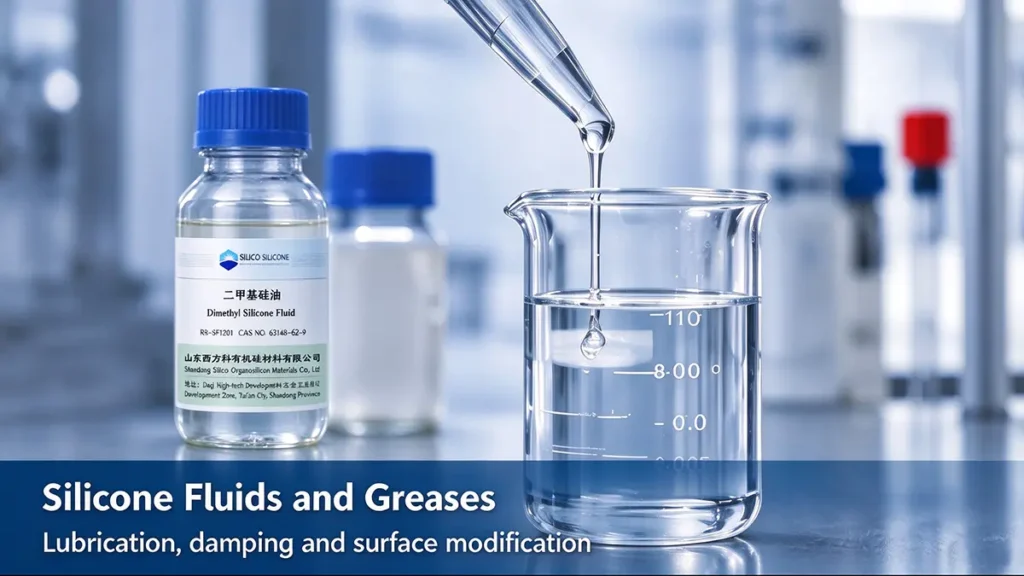
2.2 Silicone fluids and silicone greases
- For a viscous fan clutch, viscosity and the component’s torque response are central.
- For a damping mechanism, viscosity–temperature behavior and repeatability may be critical.
- For surface-care products, spreading, gloss, residue, and formulation compatibility matter.
- For assembly or release processes, contact materials and the possibility of downstream contamination must be considered.
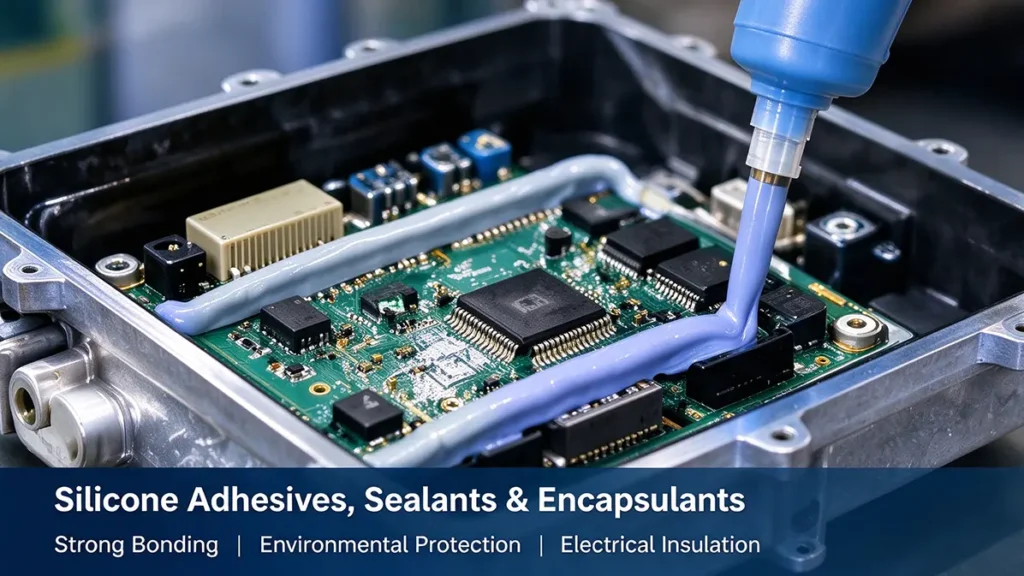
2.3 Silicone adhesives, sealants, and encapsulants
- Adhesion to the actual substrates.
- Cure speed and cure depth.
- Bond-line thickness and joint design.
- Elasticity and stress during thermal cycling.
- Resistance to moisture and relevant chemicals.
- Electrical or flame-performance requirements, where applicable.
- Compatibility with production processes and possible rework requirements.
2.4 Silicone thermal interface materials
- Thermal conductivity: The material’s ability to conduct heat, commonly expressed in W/(m·K).
- Thermal interface resistance: Resistance to heat transfer across the contact surfaces.
- Bond-line thickness: The distance heat must travel through the material.
- Compressibility: The ability to accommodate gaps and dimensional tolerances.
- Electrical properties: Whether insulation is required for the specific design.
- Long-term stability: Resistance to material migration, separation, or loss of effective contact during service.
2.5 Silicone resins and protective coatings
- Adhesion to the prepared substrate.
- Cure conditions and film thickness.
- Flexibility and resistance to cracking.
- Chemical and weathering requirements.
- Heat exposure under the intended service conditions.
- Compatibility with pigments, fillers, and other coating components.
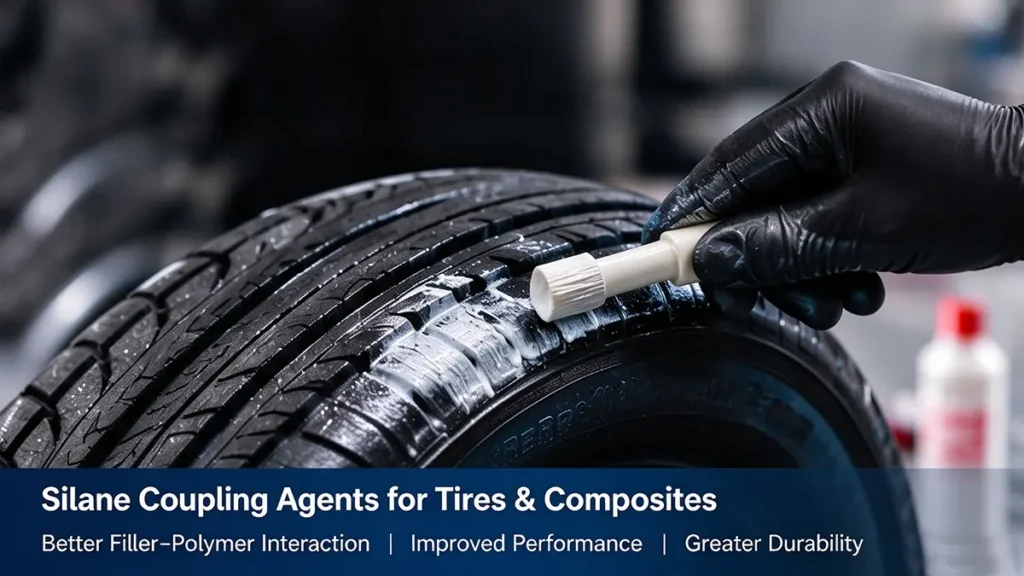
2.6 Silane coupling agents for tires and composites
Silane coupling agents are reactive organosilicon compounds used to improve the interface between compatible inorganic surfaces and organic polymer systems. Although related to silicone chemistry, they serve a different purpose from silicone fluids, elastomers, and resins.
A well-established example is silica-reinforced tire tread. The silica filler and rubber polymer do not inherently form the most effective interface in all formulations. A suitable bifunctional silane can react with the silica surface and participate in bonding with the rubber during mixing and vulcanization.
This silica–silane approach is used to help tire developers balance rolling resistance, wet grip, and abrasion resistance. Evonik describes the chemical connection between silica and the rubber compound as a key mechanism behind the performance of silica–silane tire systems.
The final result depends on silane functionality, silica type, polymer chemistry, mixing conditions, and the vulcanization system. The use of a silane coupling agent by itself does not guarantee a quantified improvement in tire performance.
Silane coupling agents are also used in selected composite, coating, and adhesive systems where improved interfacial bonding is required. The functional groups must be compatible with the polymer, filler, or substrate and the processing chemistry.
2.7 Silicone emulsions and surface-treatment materials
A silicone emulsion disperses silicone material in a continuous liquid phase, commonly water. It is often used when a water-based formulation or a controlled method of applying silicone is required.
Potential automotive applications include selected tire dressings, trim protectants, polishes, and surface-treatment products.
The finished result depends on active silicone content, particle size and dispersion stability, emulsifier chemistry, other formulation ingredients, and the target substrate.
A silicone emulsion should not automatically be considered interchangeable with a neat silicone fluid. The choice depends on formulation compatibility, processing requirements, appearance, drying behavior, and the intended surface performance.
Mid-article material selection guidance
For manufacturers comparing these technologies, Silico® offers silicone fluid, silicone rubber, silicone resin, and silane coupling agent product categories that can be assessed against defined technical requirements. Matching the material to its function—and confirming the relevant performance data before qualification—provides a more reliable basis for selection than choosing solely by product name.
3. Key Properties and Performance Characteristics
The main advantage of automotive silicone materials is that their properties can be tailored to particular operating conditions through changes in chemistry, formulation, fillers, and curing. No single silicone grade delivers every desirable property at the highest level, so material selection involves balancing requirements.
3.1 Temperature resistance and low-temperature flexibility
- Continuous operating temperature.
- Short-duration temperature peaks.
- Thermal cycling and temperature gradients.
- Mechanical stress while the material is hot or cold.
- Exposure to oils, fuels, coolants, or cleaning agents.
3.2 Weatherability and ozone resistance
Silicone materials are often selected for components exposed to sunlight, rain, humidity, and outdoor temperature changes. This can be valuable for weather strips, exterior seals, sensor protection, and certain coatings.
Resistance to ozone and environmental aging can help maintain material performance. However, the outcome also depends on formulation, pigments, fillers, surface condition, and mechanical stress.
For exterior applications, assess weathering performance against the component’s actual requirements rather than assuming that all silicone formulations will provide the same service life.
3.3 Compression set, elasticity, and mechanical strength
For seals and gaskets, elasticity alone does not guarantee reliable sealing. The material must provide sufficient contact pressure after installation and retain that function during service.
Compression set, tensile strength, elongation, tear strength, hardness, and stress relaxation describe different aspects of mechanical behavior. These properties should be evaluated together with seal geometry, installation compression, surface finish, and movement.
A softer compound may conform more readily to irregular surfaces, while a harder compound may provide different resistance to deformation. The optimal balance depends on the component design.
Silicone rubber can provide useful flexibility and temperature performance, but some compounds have lower tear strength or different wear behavior than other elastomers. These differences matter in dynamic seals, thin sections, and components subject to repeated abrasion.
3.4 Electrical insulation and dielectric performance
Certain silicone materials are suitable for electrical insulation because they can retain useful dielectric properties across defined environmental and temperature conditions.
Potential applications include selected connector seals, cable components, sensor protection, potting, and encapsulation. However, electrical suitability is formulation-specific.
Depending on the component, qualification may need to consider dielectric strength, volume resistivity, tracking resistance, flame behavior, moisture conditioning, and thermal aging. General insulation properties are not enough to establish suitability for a particular high-voltage application.
3.5 Chemical compatibility
Chemical compatibility is a critical consideration when selecting automotive elastomers, fluids, and coatings.
Standard PDMS-based silicone rubber can be affected by certain fuels and nonpolar solvents. Fluorosilicone grades may provide improved resistance to selected fuel- and oil-related environments, but they are not universally compatible with every chemical.
The evaluation should identify the exact exposure medium, concentration, temperature, exposure duration, and whether contact is continuous or intermittent.
ASTM D471 provides a method for evaluating the effects of liquids on rubber, including changes in mass, volume, and mechanical properties. ASTM also cautions that laboratory exposure does not necessarily predict the performance of every finished component under actual service conditions.
3.6 Adhesion and interfacial performance
For adhesives, sealants, coatings, and silane coupling agents, performance depends heavily on the interface between the material and the substrate.
Metals, glass, engineering plastics, rubber compounds, and silica fillers have different surface properties. A material that bonds well to one substrate may perform poorly on another.
Surface preparation, cleaning, primers, moisture, cure conditions, and functional-group chemistry can all affect the result. Where adhesion is critical, testing should use the actual substrate combination and realistic aging conditions.
3.7 Thermal conductivity and heat management
Silicone-based thermal interface materials are often formulated with thermally conductive fillers. These formulations can improve heat transfer across gaps between an electronic component and a heat-dissipating structure.
The resulting thermal conductivity depends on filler type, concentration, particle distribution, and formulation. System performance also depends on material thickness, contact resistance, compression, installation pressure, and long-term stability.
Electrical insulation may be an additional requirement, depending on the design. Thermal and electrical requirements should therefore be specified together where both affect component safety or reliability.
Property-to-application selection matrix
| Required property | Material categories to evaluate | Relevant qualification |
|---|---|---|
| Flexible sealing under temperature changes | Silicone rubber; selected fluorosilicone grades | Compression set, mechanical properties, thermal aging |
| Fuel or solvent resistance | Fluorosilicone or another qualified elastomer | Immersion, swelling, strength retention |
| Electrical insulation | Qualified silicone rubber, encapsulant, or thermal interface material | Dielectric and environmental testing |
| Bonding or sealing dissimilar materials | Silicone adhesive, sealant, or suitable silane treatment | Adhesion, cure, aging, thermal cycling |
| Thermal interface management | Thermally conductive silicone pad, gap filler, gel, or encapsulant | Conductivity, interface resistance, compression |
| Tire compound reinforcement | Compatible silane coupling agent with silica and rubber | Compound processing, dynamic properties, abrasion |
| Gloss or water-repellent surface treatment | Suitable silicone fluid, emulsion, or coating formulation | Surface appearance, compatibility, durability |
4. Automotive Applications by Vehicle System
Evaluating the vehicle system often provides a more useful starting point than selecting a material based on its product category alone.
4.1 Engine and powertrain systems
- A gasket requires appropriate compression behavior and retained sealing force.
- A boot requires flexibility and adequate tear resistance.
- A connector seal must retain its geometry and environmental sealing function.
- A viscous coupling fluid requires specified viscosity and validated operating behavior.
- A fuel-exposed seal may require fluorosilicone or another specifically qualified elastomer.
4.2 Electrical systems and automotive electronics
Modern vehicles rely on sensors, electronic control units, connectors, lighting modules, and other electronic assemblies. These components may encounter moisture, vibration, thermal cycling, and contaminants.
Silicone materials are used in selected connector seals, wire and cable components, potting, encapsulation, and bonding or sealing of electronic assemblies.
Different material forms serve different functions. An elastomeric seal protects an interface against environmental ingress; an encapsulant surrounds and protects components; a thermal interface material helps transfer heat; and an adhesive bonds or seals specified surfaces.
A product should not be assumed to perform all these functions equally well. Electrical properties, adhesion, heat transfer, mechanical stress, and repair requirements should be evaluated separately.
4.3 Interior and exterior components
Silicone materials are used in selected interior and exterior applications involving sealing, surface protection, lubrication, and appearance.
Examples include weather-strip treatments, selected hard coatings for plastics, surface-care formulations, and functional coatings. Specialty silicone hardcoats and anti-fog coatings also have applications in automotive lighting, glazing, sensor covers, and other visibility-related components.
For visible components, surface appearance is important alongside durability. Assessment may include gloss, haze, color stability, surface feel, cleaning resistance, and compatibility with adjacent plastics or coatings.
Manufacturing residue also matters. If a silicone fluid or release agent is used during production, confirm that it will not interfere with subsequent painting, printing, bonding, or coating operations.
4.4 Damping and vibration-control applications
Selected silicone fluids, greases, and elastomers can be used in damping and vibration-control systems. Depending on the design, they may provide viscous resistance, controlled friction, elastic recovery, or a combination of functions.
Selection should consider operating temperature, required damping response, fatigue, sealing, mechanical wear, and long-term changes in performance.
A fluid suitable for a small instrument damper should not automatically be considered appropriate for a high-load suspension component. The operating loads and qualification requirements may be substantially different.
4.5 Tires and rubber composites
Silane coupling agents are particularly relevant to silica-filled tire compounds.
Silica and many rubber polymers do not inherently form an optimal interface. A suitable silane can help establish chemical links between the filler and the rubber during mixing and vulcanization, supporting the development of tire compounds with a balance of rolling resistance, wet grip, and abrasion resistance.
The outcome depends on the complete formulation, including rubber polymer, silica characteristics, silane functionality, mixing conditions, and curing system. A silane coupling agent alone does not guarantee a particular reduction in rolling resistance or improvement in wet traction.
This is an application where the interaction between material chemistry and manufacturing conditions is especially important.
5. Silicone Materials for Electric Vehicles
Electric vehicles introduce additional material requirements because battery packs, power electronics, high-voltage systems, and electric drive units must manage heat, electrical insulation, moisture, vibration, and mechanical stress.
Silicone materials can contribute to these functions, but the appropriate product depends on the component design and qualification requirements.
5.1 Battery pack sealing and environmental protection
Battery enclosures and associated components require sealing against water, dust, and other environmental contaminants. Selected silicone elastomers, sealants, adhesives, and other sealing materials may be suitable where their mechanical and environmental properties meet the design requirements.
Selection should consider seal compression, joint geometry, enclosure movement, temperature cycling, permeability requirements, and compatibility with adjacent materials.
The finished enclosure must be tested as a system. A material’s individual properties cannot independently establish the ingress protection or long-term sealing performance of the complete battery pack.
5.2 Thermal management for batteries and power electronics
Battery systems and power electronics must dissipate heat while maintaining electrical and mechanical reliability.
Depending on the architecture, silicone-based thermal interface pads, gap fillers, gels, adhesives, and encapsulants may be used to improve thermal contact or protect components. Such applications include selected battery systems, inverters, converters, on-board chargers, electric motors, and related power-electronics assemblies.
Selection criteria include thermal conductivity, interface resistance, bond-line thickness, compression, curing requirements, electrical properties, and long-term stability.
A thermal interface material is not necessarily a circulating coolant. Its function is to improve heat transfer between surfaces, whereas a liquid cooling system transports heat through a different mechanism.
5.3 High-voltage connectors and cable insulation
High-voltage systems require appropriate electrical insulation, sealing, and protection from environmental exposure. Selected silicone rubber grades may be used in connector seals, cable components, protective tubing, and other insulation applications.
Qualification depends on voltage, component geometry, electrical stress, temperature, contamination exposure, and customer specifications.
General dielectric properties alone do not establish suitability for high-voltage service. Component-level testing and appropriate material qualification remain essential.
5.4 Thermal-event and fire-protection materials
Some specialized silicone formulations are designed to provide additional protection during extreme thermal events. Depending on the chemistry, these materials may be engineered to maintain a protective barrier or form a ceramic-like residue when exposed to very high temperatures.
These properties are formulation-specific. Ordinary silicone rubber, silicone fluid, or silicone sealant should not automatically be assumed to provide battery thermal-runaway protection.
For fire-protection applications, the specified material must be evaluated against the relevant thermal, electrical, mechanical, and system-level requirements.
6. How to Select the Right Automotive Silicone Material
A structured selection process helps reduce unsuitable substitutions, material failures, and unnecessary qualification work.
Step 1: Define the component and its function
Begin by identifying what the material must do. Is it sealing a housing, insulating a connector, transferring heat, bonding two surfaces, lubricating a mechanism, or modifying a rubber compound?
This determines which material categories should be considered.
Step 2: Establish the service environment
Document the operating temperature range, expected thermal cycles, humidity, vibration, pressure, and exposure to fuel, oil, coolant, cleaning agents, or other chemicals.
Distinguish normal operating conditions from short-duration temperature peaks and abnormal events. Selection should reflect the conditions that the finished component is expected to withstand.
Step 3: Define measurable performance requirements
| Material | Important specification parameters |
|---|---|
| Silicone rubber | Hardness, tensile strength, elongation, tear strength, compression set |
| Silicone fluid | Viscosity, reference temperature, viscosity–temperature behavior, volatility |
| Silicone adhesive or sealant | Adhesion, cure mechanism, elongation, thermal aging |
| Encapsulant | Cure properties, adhesion where required, electrical performance, mechanical stress |
| Thermal interface material | Thermal conductivity, interface resistance, bond-line thickness, compressibility |
| Silicone resin coating | Adhesion, cure conditions, film thickness, flexibility, thermal and weathering performance |
| Silane coupling agent | Functional-group chemistry, compatibility, processing conditions, compound performance |
Step 4: Verify chemical and substrate compatibility
Identify all materials that may contact the silicone product. For a seal, these may include the housing, lubricant, coolant, and other elastomers. For an adhesive, they may include metal, plastic, paint, and primer.
When compatibility is uncertain, perform representative testing using the actual materials and exposure conditions. Do not rely solely on broad descriptions such as “oil-resistant” or “suitable for plastics.”
Step 5: Match the material to the manufacturing process
Processing requirements can narrow the options significantly.
LSR may be suitable for precision injection molding, while HCR is often used for solid-rubber molding and extrusion. A two-component encapsulant requires controlled mixing and metering; a thermal interface pad may have a defined compression range; and a silicone resin coating may require specific surface preparation and curing conditions.
Production volume, cycle time, dimensional tolerances, automated dispensing, storage, and shelf life should all be considered.
Step 6: Review technical documentation and quality requirements
Request the technical data sheet, safety data sheet, relevant test results, and material specification. Confirm which values are typical and which are guaranteed.
For automotive supply chains, additional requirements may include batch traceability, change control, customer-specific documentation, and approval before production use. These should be established early in the qualification process.
Step 7: Validate the material in the intended application
Finally, test the selected material in the actual component or a representative test assembly.
Depending on the application, validation may include thermal cycling, fluid immersion, compression-set testing, electrical testing, adhesion testing, endurance testing, or formulation stability assessment.
The final approval should be supported by documented results and agreed acceptance criteria.
7. Testing, Quality Control, and Qualification
| Test method | What it evaluates | Typical relevance |
|---|---|---|
| ASTM D2240 | Durometer hardness | Comparing the indentation hardness of elastomers |
| ASTM D412 | Tensile properties of rubber and thermoplastic elastomers | Tensile strength and elongation |
| ASTM D395 | Compression set | Assessing permanent deformation under compression |
| ASTM D471 | Effects of liquids on rubber | Evaluating mass, volume, and property changes after exposure |
| Application-specific thermal aging | Changes after heat exposure | High-temperature components and enclosures |
| Dielectric testing | Electrical performance under specified conditions | Qualified insulation materials |
| Adhesion testing | Bond strength and failure mode on defined substrates | Adhesives, sealants, and coatings |
| Thermal interface testing | Conductivity and interface performance | Thermal pads, gap fillers, gels, and encapsulants |
ASTM identifies D395 as a method for assessing the ability of rubber compounds to retain elastic properties after prolonged compression. D412 addresses tensile properties, while D471 evaluates the comparative effects of liquid exposure on rubber. These methods support material comparison and quality control, but they do not independently predict the service life of every finished automotive component.
What should an automotive silicone material specification include?
- Chemical type and product identification.
- Viscosity or hardness and the applicable reference conditions.
- Mechanical, thermal, electrical, or chemical-resistance requirements.
- Cure conditions and processing requirements.
- Test methods and acceptance limits.
- Storage conditions and shelf life.
- Batch traceability and relevant quality documentation.
8. Common Material Selection Mistakes
Choosing silicone based on temperature resistance alone. A material may withstand a particular temperature but still fail because of chemical exposure, compression set, mechanical wear, or poor adhesion.
Assuming standard silicone rubber is fuel-resistant. Certain fuels and solvents can cause swelling or property changes. Fluorosilicone or another qualified elastomer may be necessary.
Treating LSR, HCR, HTV, and RTV as interchangeable. These terms describe different material forms, processing methods, or curing characteristics. They affect manufacturing and final performance.
Selecting a thermal interface material using conductivity alone. Interface resistance, bond-line thickness, compression, and long-term contact can strongly influence thermal performance.
Using a general-purpose fluid in a specialized component. Fan clutches, damping mechanisms, and electrical applications may require grades qualified to specific performance requirements.
Assuming any silane coupling agent will improve a tire compound. The silane functionality must match the polymer, filler, processing conditions, and cure chemistry.
Confusing material properties with component approval. A technical data sheet supports initial screening, but it cannot independently demonstrate the performance of a complete automotive assembly.
9. Conclusion
Automotive silicone materials cover a broad range of technologies, including elastomers for sealing, fluids for controlled movement, adhesives and encapsulants for component protection, thermal interface materials for heat transfer, resins for protective coatings, and silane coupling agents for rubber and composite reinforcement.
The best choice depends on the component’s function and operating environment. Temperature resistance alone is not enough; mechanical behavior, chemical compatibility, adhesion, electrical properties, processing requirements, and long-term performance must also be considered.
For automotive component manufacturers, material developers, and procurement teams, Silico® provides a portfolio of organosilicon materials that can be evaluated against defined application and technical requirements. Identifying the target function, service environment, and required specifications is the most practical starting point for selecting suitable candidate materials and planning qualification tests.

Frequently Asked Questions
The main categories include silicone rubber, silicone fluids, silicone greases and compounds, silicone adhesives and sealants, encapsulants, thermal interface materials, silicone resins, silane coupling agents, and silicone emulsions. Each category serves a different function and has different selection requirements.
Silicone materials can provide a combination of temperature performance, flexibility, weatherability, electrical properties, and surface characteristics. Suitability depends on the specific formulation and the component’s mechanical, chemical, thermal, and electrical requirements.
Silicone rubber is a crosslinked elastomer designed to retain an elastic solid form, making it useful for seals, gaskets, and molded components. Silicone fluid remains liquid and is used where flow, viscosity, damping, lubrication, or surface modification is required.
Not every silicone rubber grade is suitable. Standard PDMS-based elastomers may swell or change properties in contact with certain fuels and nonpolar solvents. Fluorosilicone can offer improved resistance to selected fuel environments, but compatibility should be verified using the actual fuel composition, temperature, and exposure conditions.
Depending on the design, electric vehicles may use silicone rubber for selected seals and connector components, silicone encapsulants for electronic protection, thermal interface materials for heat transfer, and silicone adhesives or sealants for assembly. Each material must meet the requirements of its particular component.
In compatible silica-filled rubber compounds, a suitable silane helps establish chemical links between the silica filler and the rubber polymer during processing and vulcanization. This can help tire developers balance rolling resistance, wet grip, abrasion resistance, and processability. The outcome depends on the complete formulation and manufacturing conditions.
Manufacturers should assess product specifications, technical support, batch consistency, relevant quality documentation, traceability, and the availability of application-specific test data. For critical components, samples should be validated against agreed methods and acceptance criteria before production approval.
Provide the intended application, component type, substrate or compound, operating temperature, chemical exposure, required material properties, processing method, order quantity, and any existing specification or reference grade. These details help narrow the candidate materials and identify the testing needed for qualification.
Silicone Resin related products
If you want to know other questions about Sillcone Resin, please contact us and we will provide professional answers.
Popular Recommendations
Get a Catalog & Best Price
- Quick and helpful reply within 24 hours;
- Tailored solutions provided for your project;
- One-stop purchasing service.
Need More Technical Information?
Silico® ORGANOSILICON
- Address: Daiyue Industrial Area, Taian, Shandong, China
- Tel: +86-0538-5071566Tel: +86-0538-5071566
- © Copyright 2022 Silico® . All Rights Reserved