
What Is Food Grade Silicone Oil? PDMS, Properties and Uses
PDMS is widely used because its Si–O–Si molecular backbone provides low surface tension, chemical stability, hydrophobicity, lubricity, and good thermal stability.
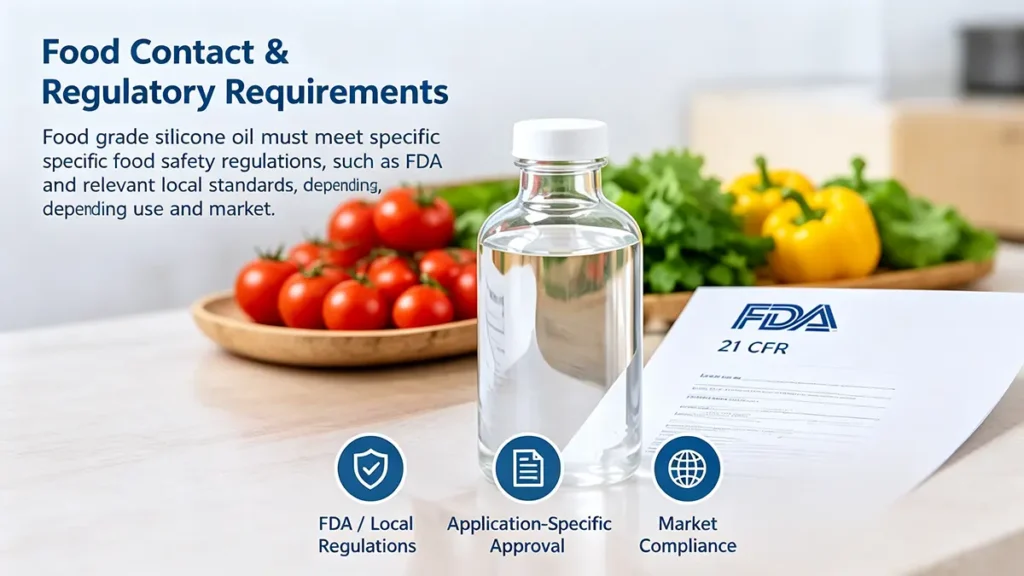
However, “food grade” should not be interpreted as unrestricted approval for every food-contact application. The suitability of a silicone oil depends on its exact specification, intended use, concentration, contact conditions, and applicable regulations. The FDA lists dimethylpolysiloxane under several specific food and food-contact regulations, including 21 CFR 173.340 and 21 CFR 178.3570.
Silico® Food Grade Silicone Oil is a PDMS-based silicone fluid available in controlled viscosity grades for selected food-processing, lubrication, mold-release, surface-treatment, and defoaming applications. Its 350 cSt food-grade PDMS grade is specified as a high-purity linear silicone fluid for food processing and incidental food-contact applications.
Table of Contents
- 1. What Is Food Grade Silicone Oil?
- 2. What Is Industrial Silicone Oil?
- 3. Food Grade vs. Industrial Silicone Oil
- 4. Purity and Quality Control
- 5. Application Differences
- 6. Silicone Oil Viscosity and Grade Selection
- 7. Food Contact and Regulatory Requirements
- 8. Documentation for Commercial Purchasing
- 9. Can Industrial Silicone Oil Be Used in Food Processing?
- 10. How to Choose the Right Silicone Oil
- Conclusion
1. What Is Food Grade Silicone Oil?
- Food-processing equipment lubrication
- Mold release
- Defoaming and foam control
- Surface treatment
- Processing aids
- Packaging equipment
- Selected food-contact applications
PDMS is also known as dimethylpolysiloxane, dimethyl silicone, or dimethyl silicone fluid. The FDA identifies dimethylpolysiloxane as a substance used for technical effects including lubrication, release, and surface-active functions, with multiple specific regulations applying to different uses.
Food grade silicone oil is available in different viscosity grades because viscosity directly affects flow, spreading, film formation, lubrication, and release performance.
2. What Is PDMS?
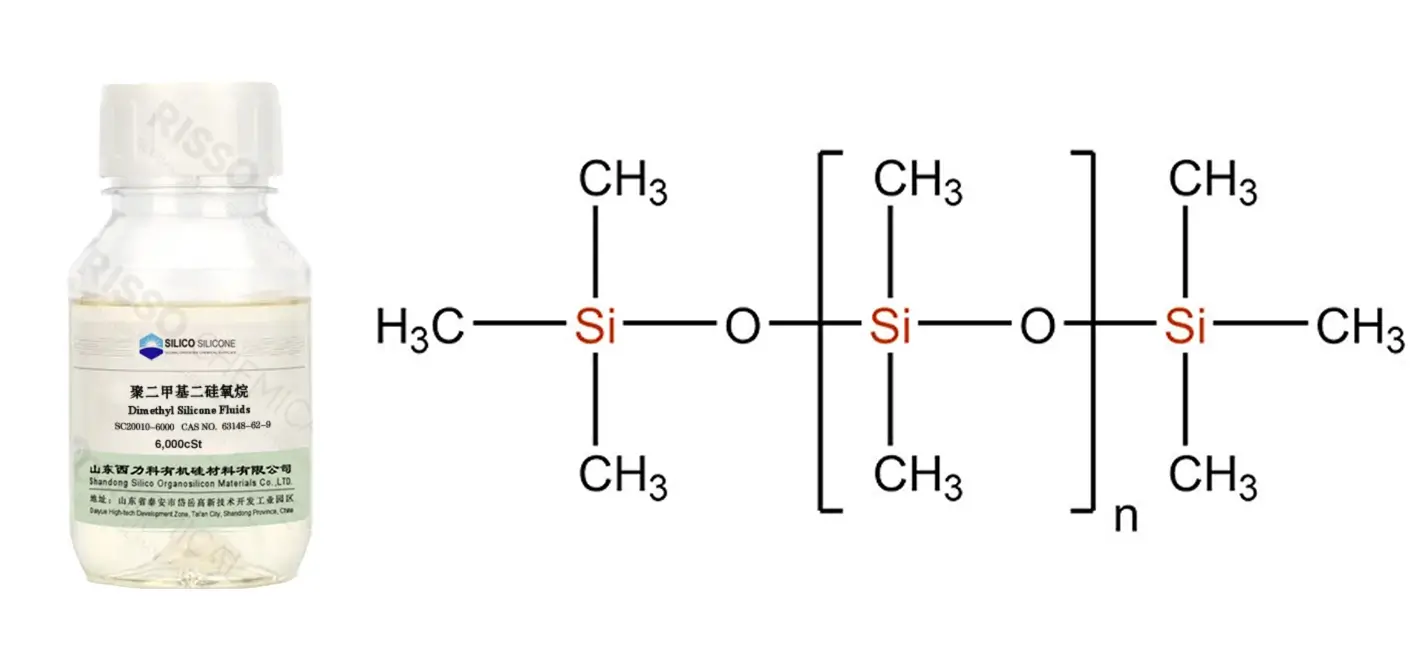
Its basic repeating structure can be represented as:
–[Si(CH₃)₂–O]ₙ–
The polymer contains a silicon-oxygen backbone with methyl groups attached to the silicon atoms.
This structure gives PDMS several properties that distinguish it from conventional mineral and hydrocarbon oils.
| PDMS characteristic | Practical effect |
|---|---|
| Si–O–Si backbone | Good thermal and chemical stability |
| Low surface tension | Rapid spreading and wetting |
| Hydrophobic methyl groups | Water repellency |
| Controlled molecular weight | Different viscosity grades |
| Low volatility at suitable viscosities | Good film retention |
| Chemical inertness | Broad material compatibility |
3. How Does PDMS Structure Affect Performance?
3.1 Product Purity
3.2 Methyl Groups
- Water repellency
- Surface slip
- Release performance
- Rapid spreading
3.3 Polymer Chain Length
Low-viscosity PDMS flows and spreads easily, while higher-viscosity grades provide greater film retention and a more persistent surface layer.
For this reason, viscosity is an important engineering parameter when selecting food grade silicone oil.
4. Key Properties of Food Grade Silicone Oil
4.1 Low Surface Tension
This property is useful for:
- Mold release
- Surface treatment
- Lubrication
- Foam control
In defoaming applications, the ability of PDMS to spread over a foam film contributes to bubble destabilization.
4.2 Thermal Stability
This makes it suitable for selected food-processing equipment exposed to heating, cooling, and temperature cycling.
Actual operating limits depend on viscosity, exposure time, oxygen availability, equipment design, and application conditions.
4.3 Chemical Stability
Material compatibility should still be verified for specific plastics, elastomers, coatings, cleaning chemicals, and process conditions.
4.4 Hydrophobicity
4.5 Lubricity
- Conveyors
- Guides
- Seals
- Moving components
- Packaging machinery
The required viscosity depends on the equipment and operating conditions.
4.6 Low Odor and Color

5. Food Grade Silicone Oil Viscosity
| Viscosity | General characteristics | Typical consideration |
|---|---|---|
| 100 cSt | Fast flow and spreading | Light lubrication, surface treatment |
| 200 cSt | Good flow with improved film | Lubrication, release |
| 350 cSt | Balance of flow and film retention | Lubrication, release |
| 500 cSt | Moderate viscosity | Lubrication, surface treatment |
| 750 cSt | Higher film retention | Release, equipment applications |
| 1,000 cSt | More persistent film | Release, lubrication |
| 1,500 cSt | Higher viscosity and retention | Specialized applications |
Why Does Viscosity Matter?
- Easier pumping
- Faster spreading
- Better penetration
- Thinner films
- Better film retention
- Longer-lasting lubrication
- More persistent release films
- Greater resistance to flow
Therefore, higher viscosity is not automatically better. The correct grade depends on the application method, equipment, temperature, required film thickness, and contact conditions.

6. What Is Food Grade Silicone Oil Used For?
- Equipment lubrication
- Mold release
- Defoaming and foam control
- Surface treatment
- Processing aids
- Packaging equipment
- Selected food-contact applications
The exact permitted use depends on the product grade and applicable regulations.
The FDA lists dimethylpolysiloxane for specific technical effects and references multiple sections of 21 CFR covering different applications.
7. Food Processing Applications
Silicone oil can be used in selected applications where a thin, stable, low-surface-energy film is beneficial.
Conveyor Systems
Baking Equipment
Bottling and Filling Equipment
Appropriately specified silicone fluids can be used for selected lubrication points where incidental food contact is possible.
Packaging Machinery
8. Lubrication Applications
- Bearings
- Chains
- Guides
- Conveyors
- Valves
- Seals
- Sliding surfaces
Where incidental food contact is possible, the lubricant must meet the requirements applicable to that specific use.
For example, 21 CFR 178.3570 addresses lubricants with incidental food contact. The FDA’s food-contact inventory also advises users to consult the cited regulation to determine whether a substance is authorized for the intended use.
Therefore:
PDMS chemistry alone does not automatically make a silicone oil suitable as a food-processing lubricant.
The exact product grade and application should be verified.
9. Mold Release Applications
A properly selected silicone fluid can reduce adhesion between food products and molds or processing surfaces.
Viscosity affects how easily the material spreads and how long the release film remains on the surface.
Low-viscosity grades generally spread more easily, while higher-viscosity grades can provide greater film retention.
10. PDMS for Defoaming and Foam Control
- Mixing
- Fermentation
- Pumping
- Heating
- Beverage processing
- Food processing
PDMS is effective in foam-control applications because of its low surface tension and ability to spread across the air-liquid interface.
When distributed over a foam film, silicone fluid can reduce film stability and promote bubble collapse.
The FDA specifically lists dimethylpolysiloxane in connection with antifoaming applications under 21 CFR 173.340, subject to the conditions of that regulation.
For food-processing defoaming, the important questions include:
- Is the product specified for defoaming?
- What dosage is permitted?
- What food category is involved?
- Which regulation applies?
- Is a neat PDMS fluid or an emulsion required?
11. Food Contact and Regulatory Requirements
Food Grade Does Not Mean Unlimited Food Contact
There is no single rule that makes every silicone oil suitable for every food application.
The FDA lists dimethylpolysiloxane under multiple regulations, including:
- 21 CFR 173.340
- 21 CFR 175.105
- 21 CFR 175.300
- 21 CFR 176.170
- 21 CFR 176.180
- 21 CFR 176.200
- 21 CFR 176.210
- 21 CFR 177.1200
- 21 CFR 178.3570
These regulations cover different food, food-contact, and processing applications.
Therefore, a more practical compliance approach is:
Product → Grade → Intended Use → Concentration → Contact Conditions → Applicable Regulation
This is more precise than simply asking whether a product is “FDA approved.”
12. How to Choose the Right Food Grade Silicone Oil
Step 1: Define the Application
- Lubrication
- Mold release
- Defoaming
- Surface treatment
- Processing aid
- Packaging equipment
Step 2: Determine Contact Conditions
- Direct or incidental food contact
- Temperature
- Contact time
- Application rate
- Food type
- Equipment surface
Step 3: Select Viscosity
- Flow
- Spreading
- Film thickness
- Lubrication
- Release performance
- Film retention
Step 4: Check Material Compatibility
- Stainless steel
- Aluminum
- Plastics
- Rubber
- Elastomers
- Coatings
- Seals
Step 5: Verify Documentation
Review the supplier’s technical and regulatory documents before commercial use.
13. What Documents Should You Request?
Technical Data Sheet — TDS
- Chemical identity
- Viscosity
- Appearance
- Specific gravity
- Recommended applications
- Storage conditions
Certificate of Analysis — CoA
A CoA provides actual test results for a specific production batch.
Safety Data Sheet — SDS
The SDS covers handling, storage, hazards, transport, and emergency information.
Food-Contact or Regulatory Documentation
- Food-contact compliance statements
- NSF documentation
- Declaration of Compliance
- Application-specific testing
- Regulatory references
The exact documentation should correspond to the intended application rather than relying only on a general “food grade” statement.
14. Food Grade Silicone Oil vs. Industrial Silicone Oil
| Factor | Food Grade Silicone Oil | Industrial Silicone Oil |
|---|---|---|
| Typical chemistry | PDMS | PDMS or other silicone fluids |
| Main purpose | Specified food-related applications | General industrial applications |
| Purity control | Food/application-specific | Industrial specification |
| Viscosity | Application-dependent | Application-dependent |
| Lubrication | Food-processing equipment | Industrial machinery |
| Mold release | Food-related processes | Plastics, rubber, composites, etc. |
| Defoaming | Selected food applications | Industrial processes |
| Food-contact suitability | Must be confirmed | Not automatically suitable |
| Documentation | TDS, SDS, CoA, compliance documents | TDS, SDS, CoA |
The important distinction is that food grade is related to product specification, intended application, manufacturing controls, and regulatory requirements—not simply the presence of PDMS.
Conclusion
Food grade silicone oil is primarily a high-purity PDMS silicone fluid specified for particular food-processing and food-related applications.
Its main technical advantages include:- Low surface tension
- Good thermal stability
- Chemical stability
- Hydrophobicity
- Lubricity
- Release performance
- Controlled viscosity
- Low odor and color
The most common applications include equipment lubrication, mold release, surface treatment, processing aids, and foam control.
When selecting a food grade silicone oil, viscosity is only one part of the decision. The more important evaluation is:
Chemical composition + viscosity + application + contact conditions + dosage + regulatory requirements + supporting documentation.
For manufacturers, distributors, and food-processing equipment suppliers, Silico® Food Grade Silicone Oil provides PDMS-based silicone fluid options for selected food-processing, lubrication, mold-release, surface-treatment, and defoaming applications. Selecting the appropriate viscosity and compliance documentation according to the actual process helps ensure that the material matches the technical and regulatory requirements of the application.
Frequently Asked Questions
Food grade silicone oil is typically a high-purity PDMS silicone fluid specified for food-processing, lubrication, mold-release, defoaming, or other regulated food-related applications.
Yes. Most conventional food grade silicone oils are based on polydimethylsiloxane (PDMS), also known as dimethylpolysiloxane.
Common applications include food-processing equipment lubrication, mold release, surface treatment, processing aids, packaging equipment, and selected defoaming applications.
Commercial food-grade PDMS is available in multiple viscosity grades, including examples such as 350 cSt and 1,000 cSt. Availability depends on the supplier and application.
A 350 cSt PDMS grade can be suitable for selected food-processing lubrication applications when
A 1,000 cSt PDMS fluid can provide good film retention and can be used for selected release and surface-treatment applications. The suitability depends on the specific product and process.
Not automatically. Suitability depends on the exact product, intended use, concentration, contact conditions, and applicable regulation. FDA regulations for PDMS are application-specific.
No. A better approach is to identify the exact product grade and verify the regulation applicable to the intended use.
Silicone Fluid related products
If you want to know other questions about Sillcone Fluid, please contact us and we will provide professional answers.
Popular Recommendations
Get a Catalog & Best Price
- Quick and helpful reply within 24 hours;
- Tailored solutions provided for your project;
- One-stop purchasing service.
Need More Technical Information?
Silico® ORGANOSILICON
- Address: Daiyue Industrial Area, Taian, Shandong, China
- © Copyright 2022 Silico® . All Rights Reserved