
350 cSt vs 1,000 cSt Silicone Oil: Which Grade Should You Choose?
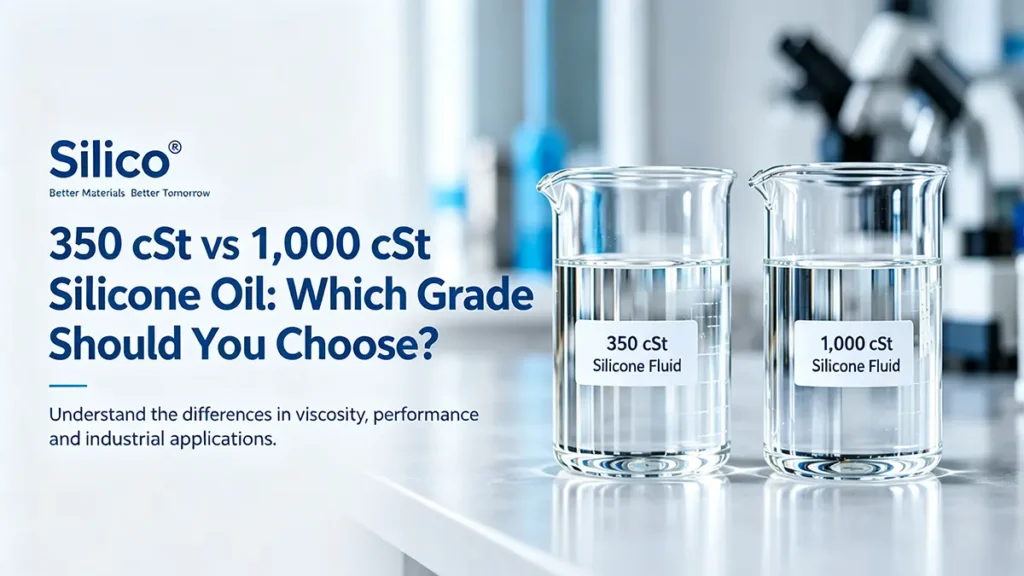
350 cSt and 1,000 cSt silicone fluids are widely used PDMS viscosity grades for lubrication, damping, mold release, surface treatment, electrical insulation, and other industrial applications. The main difference is viscosity, but the practical effects extend to flow, film retention, pumping, mixing, and temperature-dependent performance.
At 25°C, 1,000 cSt has approximately 2.86 times the kinematic viscosity of 350 cSt. This does not mean that it flows exactly 2.86 times more slowly. Actual fluid movement depends on temperature, pressure, equipment geometry, pump characteristics, and application conditions.
In simple terms, 350 cSt offers easier flow and processing, while 1,000 cSt provides greater resistance to flow and generally stronger film retention and damping characteristics.
For industrial users comparing PDMS viscosity grades, Silico® supplies standard silicone fluids in both 350 cSt and 1,000 cSt grades for applications including lubrication, damping, mold release, heat transfer, surface treatment, and electrical applications.
Table of Contents
- 1. What Are 350 cSt and 1,000 cSt Silicone Fluids?
- 2. 350 cSt vs 1,000 cSt: Key Differences
- 3. How Viscosity Affects Performance
- 4. Which Grade Should You Choose?
- 5. 350 cSt vs 1,000 cSt for Mold Release
- 6. 350 cSt vs 1,000 cSt for Heat Transfer
- 7. Temperature and Silicone Fluid Viscosity
- 8. What Happens When You Change from 350 cSt to 1,000 cSt?
- 9. Can 350 cSt and 1,000 cSt Silicone Fluid Be Blended?
- 10. What Should Buyers Compare?
- 11. Frequently Asked Questions
- 12. Conclusion
1. What Are 350 cSt and 1,000 cSt Silicone Fluids??
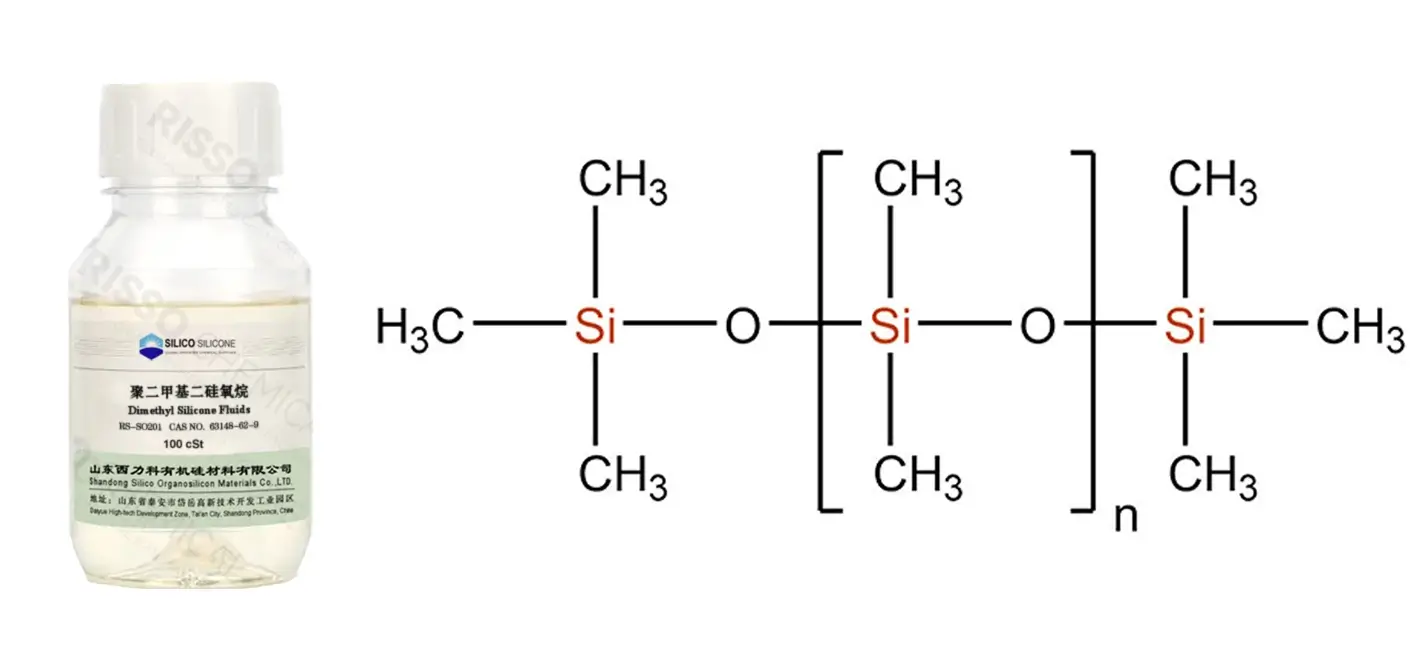
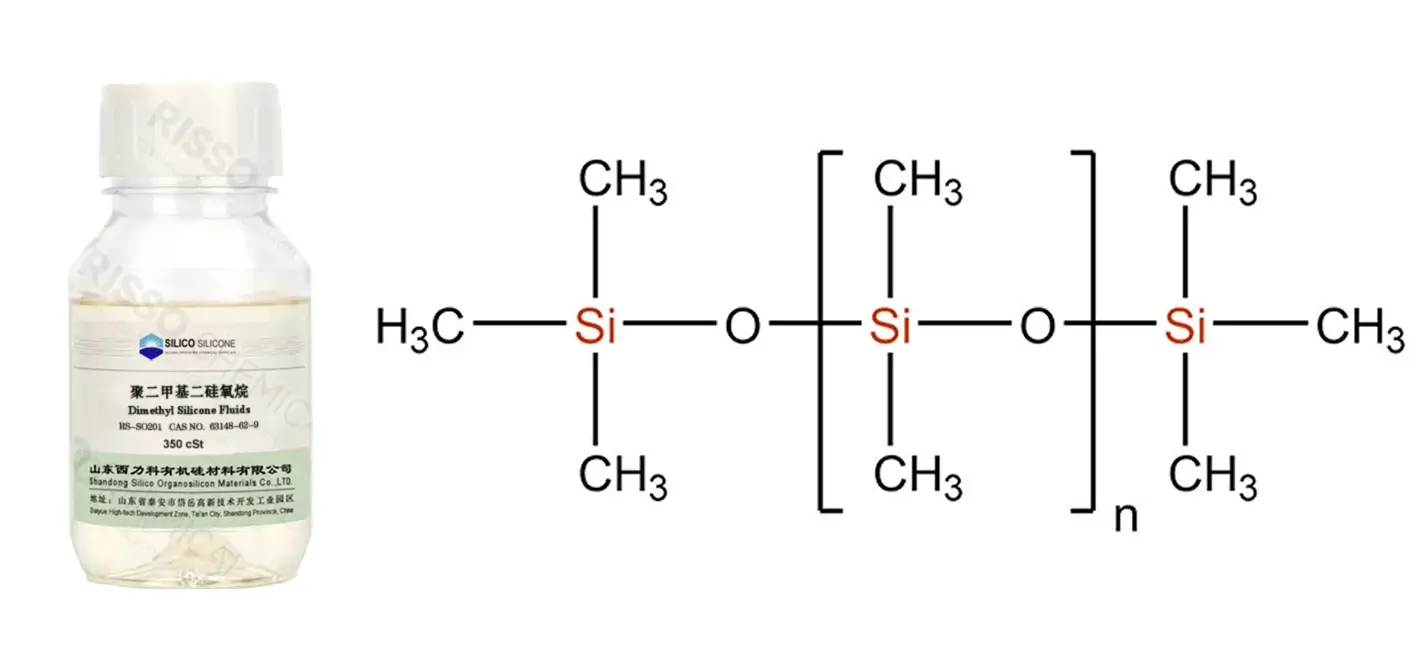
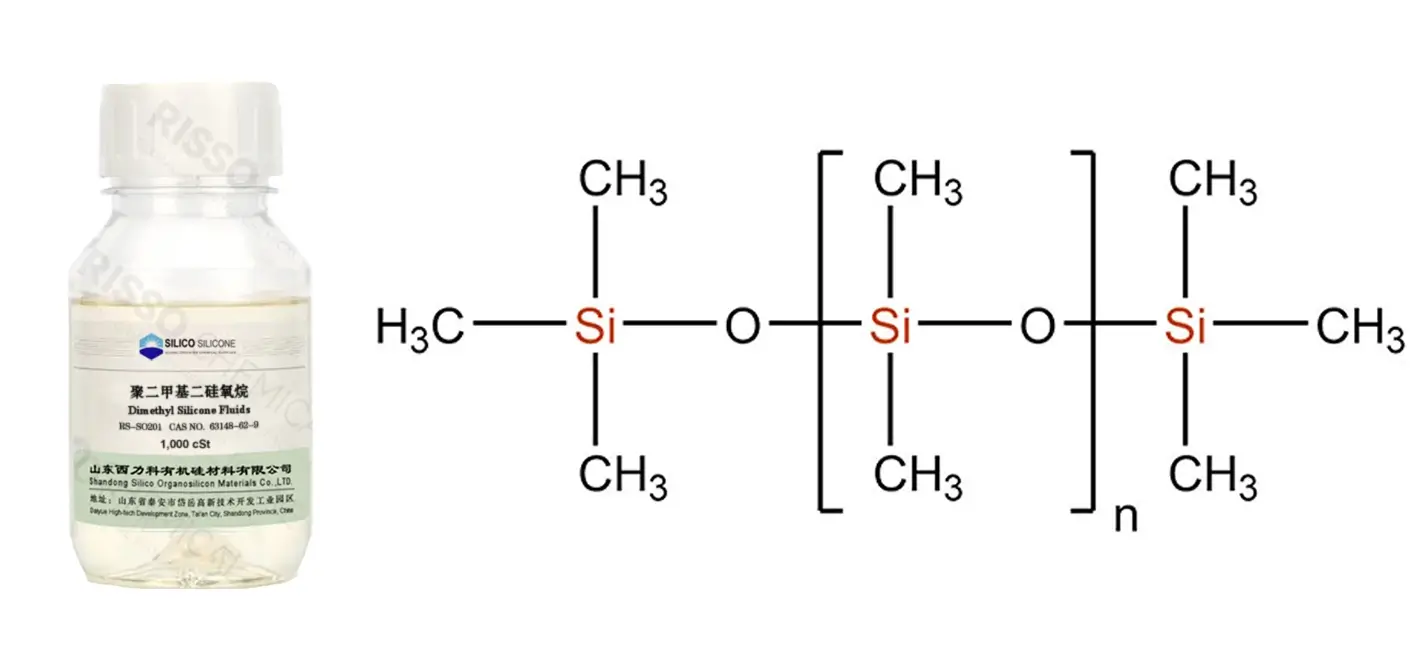
350 cSt and 1,000 cSt generally refer to PDMS (polydimethylsiloxane) fluids with different kinematic viscosities.
The unit cSt, or centistokes, is a measure of kinematic viscosity:
1 cSt = 1 mm²/s
Therefore:
- 350 cSt = 350 mm²/s
- 1,000 cSt = 1,000 mm²/s
Commercial PDMS viscosity grades are commonly specified at 25°C, although the actual test temperature and test method should always be confirmed in the supplier’s technical data sheet.
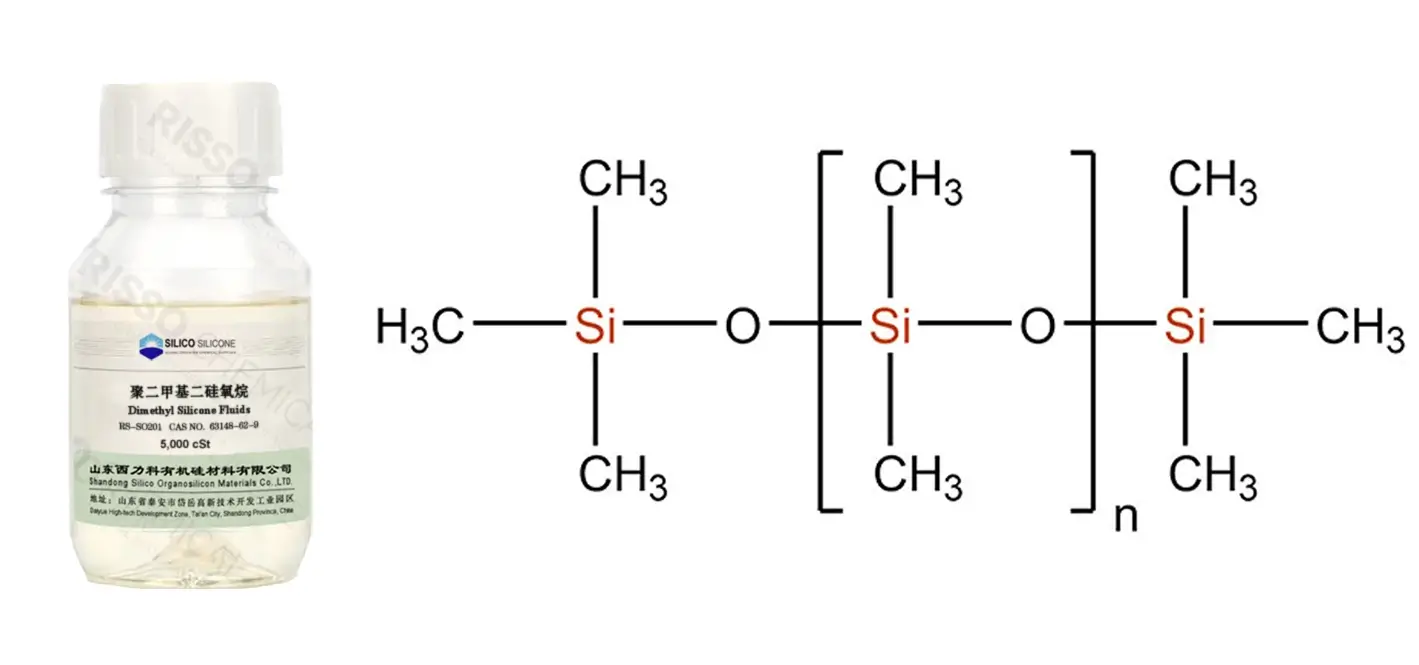
Silico®’s standard PDMS range includes 350 cSt, 500 cSt and 1,000 cSt grades, among other viscosities. These products are based on linear PDMS and are used in applications such as damping, lubrication, heat transfer and dielectric systems.
350 cSt is a medium-viscosity PDMS grade that provides a useful balance between flowability and film retention.
Typical characteristics include:
- Relatively easy pumping
- Good spreading
- Moderate flow resistance
- Good lubrication
- Moderate film retention
- Easier mixing and metering
- Suitable for general industrial formulations
A commercial 350 cSt PDMS product from Silico®, for example, is specified at 350 cSt and is supplied for applications including processing, lubrication and surface-treatment formulations.
1,000 cSt has substantially higher viscosity and greater resistance to flow.
Typical characteristics include:
- Higher film retention
- Lower fluid migration
- More persistent lubrication
- Higher damping contribution
- Greater fluid body
- Higher pumping resistance
- More demanding mixing and metering
Dow lists 1,000 cSt PDMS for applications including mechanical fluids, lubricants, mold release agents, electrical insulating fluids and specialty polishes.
Silico®’s 1,000 cSt PDMS is specified at approximately 1,000 cSt at 25°C and is positioned for lubrication, damping, mold release, antifoaming and specialty industrial applications.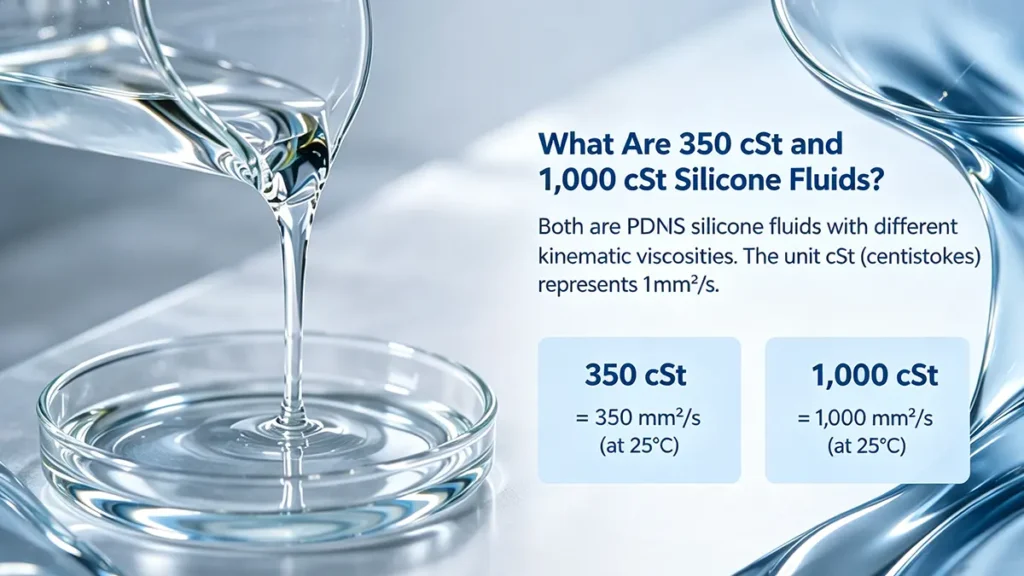
2. 350 cSt vs 1,000 cSt: Key Differences
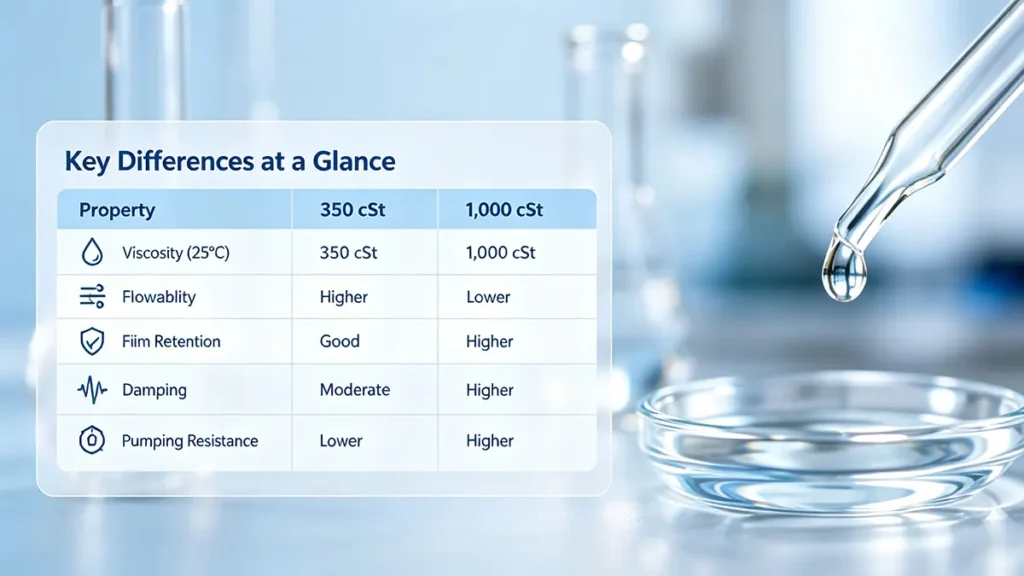
| Property | 350 cSt | 1,000 cSt |
|---|---|---|
| Kinematic viscosity @ 25°C | 350 cSt | 1,000 cSt |
| Relative viscosity | 1× | 2.86× |
| Flowability | Higher | Lower |
| Flow resistance | Lower | Higher |
| Pumping | Easier | More demanding |
| Spreading | Faster | Slower |
| Film retention | Good | Higher |
| Lubrication persistence | Good | Higher |
| Damping contribution | Moderate | Higher |
| Mixing | Easier | More demanding |
| Metering | Easier | More demanding |
| Fluid migration | Higher | Lower |
The two grades provide different rheological behavior.
A formulation that works well with 350 cSt may perform poorly after switching to 1,000 cSt if the pump, nozzle, mixing system or application rate is not adjusted.
3. How Viscosity Affects Performance
Flow and Pumping
At the same temperature and under comparable conditions, 1,000 cSt PDMS has significantly higher resistance to flow than 350 cSt.
This can affect:
- Transfer from drums or IBCs
- Pump selection
- Pipe pressure drop
- Filling speed
- Metering
- Nozzle flow
- Automated dispensing
- Mixing time
For a system designed around 350 cSt, switching directly to 1,000 cSt may reduce flow rate or increase required pumping pressure.
This is particularly important in automated production equipment.
Higher viscosity does not mean that 1,000 cSt cannot be pumped. It means that the equipment must be designed or adjusted for the higher viscosity.
Film Formation and Retention
A 350 cSt fluid generally spreads more easily and can produce a relatively uniform film.
A 1,000 cSt fluid moves more slowly and tends to provide greater film persistence.
This distinction is relevant to:
- Mold release
- Rubber processing
- Plastic processing
- Surface treatment
- Industrial polishing
- Lubrication
- Protective coatings
For example, Dow’s formulation information demonstrates the use of different silicone-fluid viscosities to adjust formulation properties such as gloss and application behavior.
Therefore, viscosity should be considered as part of the formulation design, rather than simply as a specification to maximize.
Lubrication
350 cSt is generally suitable when:
- Easy distribution is important
- Low pumping resistance is preferred
- Accurate metering is required
- A relatively thin film is sufficient
- The lubricant needs to circulate easily
1,000 cSt may be preferred when:
- Longer film retention is required
- Lower migration is desirable
- A more persistent lubricating layer is needed
- Higher viscosity is beneficial to the formulation
However, higher viscosity does not automatically mean better lubrication.
Lubrication performance also depends on:- Load
- Sliding speed
- Contact pressure
- Surface roughness
- Clearance
- Temperature
- Material combination
- Application method
For precision mechanical systems, these parameters should be evaluated together with viscosity.
Damping and Vibration Control
Higher-viscosity PDMS is commonly used when greater resistance to fluid movement is required.
In a damping system:
350 cSt → lower fluid resistance
1,000 cSt → higher fluid resistance
Therefore, 1,000 cSt may be a better starting point when higher damping is required.
Typical applications include:
- Rotary dampers
- Instrument damping
- Precision mechanisms
- Vibration-control systems
- Mechanical dampers
- Shock-control components
Silicone-fluid technical data commonly identify PDMS grades as damping fluids, and Silico®’s standard PDMS range includes grades from 350 cSt through 1,000 cSt and higher for applications requiring different levels of viscosity and damping.
The final damping performance, however, depends on much more than fluid viscosity.
A proper design should consider:
Viscosity + orifice geometry + clearance + temperature + movement speed
4. Which Grade Should You Choose?
Choose 350 cSt when you need:
- Easier pumping
- Faster spreading
- Easier mixing
- Easier metering
- Moderate film retention
- General lubrication
- General mold release
- Moderate damping
Choose 1,000 cSt when you need:ed:
- Higher film retention
- Lower migration
- More persistent lubrication
- Greater damping
- Thicker fluid films
- Higher resistance to fluid movement
- More persistent surface coverage
Quick Selection Guide
| Requirement | Preferred Starting Grade |
|---|---|
| Easy pumping | 350 cSt |
| Fast spreading | 350 cSt |
| Automated metering | 350 cSt |
| General lubrication | 350 cSt |
| General mold release | 350 cSt |
| Higher film retention | 1,000 cSt |
| Persistent lubrication | 1,000 cSt |
| Higher damping | 1,000 cSt |
| Lower migration | 1,000 cSt |
| Thicker film | 1,000 cSt |
These are selection guidelines rather than fixed specifications. The actual choice should be validated under the intended process conditions.
5. 350 cSt vs 1,000 cSt for Mold Release
Both grades can be used in mold-release systems.
The main consideration is the balance between spreading and film persistence.350 cSt
Generally provides:
- Easier application
- Faster spreading
- More convenient metering
- Good thin-film coverage
1,000 cSt
- Greater film persistence
- Higher viscosity film
- Lower migration
- Longer-lasting surface coverage
- Mold temperature
- Mold material
- Polymer being processed
- Release-agent concentration
- Carrier system
- Application rate
- Required number of molding cycles
Therefore, selecting the highest viscosity is not necessarily the best way to improve mold release.
6. 350 cSt vs 1,000 cSt for Heat Transfer
Silicone fluids are used in certain heat-transfer systems because of their thermal stability and relatively stable viscosity over a broad temperature range.
However, higher viscosity does not automatically mean better heat transfer.
A heat-transfer system must consider:
- Operating temperature
- Flow rate
- Pump capacity
- Pressure drop
- Specific heat
- Thermal conductivity
- Heat-exchanger design
When circulation efficiency is important, 350 cSt may offer easier pumping than 1,000 cSt.
For a system operating at elevated temperature, the relevant value is the viscosity at operating temperature, not simply the viscosity printed on the product label.

7. Temperature and Silicone Fluid Viscosity
Temperature has a direct effect on PDMS viscosity.
As temperature increases → viscosity decreases.
As temperature decreases → viscosity increases.
This is important when comparing 350 cSt and 1,000 cSt.
A 1,000 cSt fluid measured at 25°C may become considerably easier to pump at an elevated operating temperature.
Conversely, at low temperature, its flow resistance can increase significantly.
Silico®’s standard PDMS data describe these materials as having a broad service-temperature range and relatively stable viscosity characteristics compared with many conventional organic fluids.
For equipment design, always evaluate the viscosity-temperature relationship rather than relying only on the nominal 25°C value.
8. What Happens When You Change from 350 cSt to 1,000 cSt?
A viscosity change from 350 cSt to 1,000 cSt can affect the entire process.
Before making the change, check:- Pump capacity
- Transfer pressure
- Pipe and hose diameter
- Nozzle size
- Metering accuracy
- Mixing time
- Application rate
- Operating temperature
- Film thickness
- Final product performance
For example, if a spray system was developed around 350 cSt, replacing it with 1,000 cSt may result in poor atomization or reduced spray coverage.
In contrast, if the original formulation suffers from excessive migration or insufficient film retention, moving toward 1,000 cSt may solve the problem.
This is why viscosity changes should be treated as a process change, not simply a raw-material substitution.
9. Can 350 cSt and 1,000 cSt Silicone Fluid Be Blended?
Compatible PDMS fluids can generally be blended to obtain an intermediate viscosity.
However, a 50:50 blend does not necessarily produce 675 cSt.
A simple arithmetic calculation:
(350 + 1,000) ÷ 2 = 675 cSt
should not be used as a production specification.
Viscosity does not necessarily vary linearly with blend ratio.
For production blending:- Define the target viscosity.
- Establish the blend ratio experimentally.
- Mix thoroughly.
- Allow the sample to equilibrate.
- Measure viscosity at the specified temperature.
- Verify other critical properties.
- Conduct application testing.
For tight viscosity specifications, purchasing the required commercial grade is generally more reliable than relying on in-house blending.
10. What Should Buyers Compare?
When purchasing 350 cSt or 1,000 cSt silicone fluid, viscosity should not be the only specification considered.
A useful technical comparison includes:| Parameter | Why It Matters |
|---|---|
| Kinematic viscosity | Defines the viscosity grade |
| Test temperature | Needed for meaningful comparison |
| Viscosity tolerance | Indicates batch consistency |
| Density | Important for formulation and dosing |
| Refractive index | Useful for identification |
| Volatile content | Important for residue and weight loss |
| Pour point | Relevant to low-temperature handling |
| Surface tension | Affects spreading and wetting |
| Purity | Important for sensitive applications |
| Grade/certification | Determines suitability for regulated uses |
For example, commercial 350 cSt and 1,000 cSt PDMS products are normally specified with viscosity and other physical properties under defined test conditions. Silico®’s 350 cSt and 1,000 cSt products illustrate why the full technical specification should be reviewed rather than comparing viscosity alone.
11. Frequently Asked Questions
Yes. At the same reference temperature, 1,000 cSt has approximately 2.86 times the kinematic viscosity of 350 cSt.
Not necessarily. 1,000 cSt provides higher resistance to flow and generally better film retention and damping, while 350 cSt is easier to pump, mix and spread.
Typical applications include lubrication, mold release, surface treatment, damping, heat-transfer systems and industrial formulations.
1,000 cSt PDMS is commonly used in lubrication, mold release, damping, electrical insulation, mechanical-fluid systems, polishing and specialty formulations.
1,000 cSt is generally the better starting point when higher fluid resistance and damping are required.
1,000 cSt generally provides greater film retention because its higher viscosity reduces fluid movement and migration.
350 cSt is generally easier to pump than 1,000 cSt under the same temperature and equipment conditions.
Yes. 1,000 cSt PDMS is used in mold-release formulations where a more persistent film is desirable.
Sometimes, but the change can reduce film retention and damping performance and may alter the overall formulation behavior.
Not automatically. The higher viscosity can increase pumping resistance and affect mixing, metering and application.
Yes. PDMS viscosity decreases as temperature increases and increases as temperature decreases.
The practical difference is flowability versus film persistence. 350 cSt is easier to process, while 1,000 cSt provides greater viscosity, film retention and damping.

12. Conclusion
- Easier pumping
- Faster spreading
- Easier mixing
- Accurate metering
- General lubrication
- General mold release
- Greater film retention
- Lower migration
- More persistent lubrication
- Higher damping
- Thicker fluid films
- Greater resistance to fluid movement
At 25°C, the nominal kinematic viscosity of 1,000 cSt is approximately 2.86 times that of 350 cSt. But this number should not be interpreted as a direct prediction of pump flow rate or application performance.
The better engineering approach is to evaluate viscosity at the actual operating temperature, pumping conditions, application method, required film thickness, load, movement speed and final performance.
For industrial applications requiring different PDMS viscosity grades, Silico® provides standard silicone fluids from low to high viscosity, including 350 cSt and 1,000 cSt grades, allowing users to select a viscosity according to the actual process and performance requirements.
Silicone Fluid related products
If you want to know other questions about Sillcone Fluid, please contact us and we will provide professional answers.
Popular Recommendations
Get a Catalog & Best Price
- Quick and helpful reply within 24 hours;
- Tailored solutions provided for your project;
- One-stop purchasing service.
Need More Technical Information?
Silico® ORGANOSILICON
- Address: Daiyue Industrial Area, Taian, Shandong, China
- © Copyright 2022 Silico® . All Rights Reserved