2026-02-02

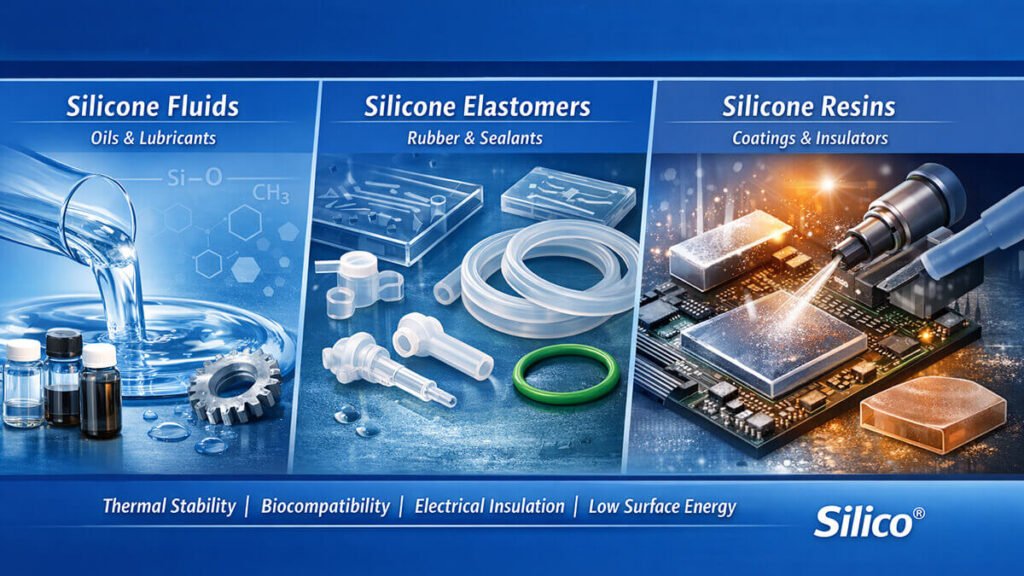
Polydimethylsiloxane (PDMS) is a widely used organosilicon polymer characterized by a silicon–oxygen (Si–O) backbone with methyl side groups. PDMS materials span an exceptionally broad product spectrum—from low-viscosity silicone fluids used in lubrication and mold release to highly crosslinked elastomers applied in sealing, damping, and microfluidic devices.
Key advantages of PDMS include:
Proven biocompatibility in many formulations
Because of these attributes, PDMS plays a critical role in industries such as microfluidics, biomedical engineering, electronics, lubrication, coatings, and specialty chemicals. High-purity PDMS materials, such as those developed by Silico®, are increasingly adopted in applications requiring performance consistency and regulatory compliance.
The fundamental repeating unit of PDMS is:
–[Si(CH₃)₂–O]–
Industrial production commonly starts from dichlorodimethylsilane via hydrolysis and condensation, or from cyclic siloxanes (e.g., D4) through anionic ring-opening polymerization. Molecular weight, chain architecture, and functionality are precisely controlled by:
By adjusting these parameters, manufacturers can produce linear silicone fluids, lightly crosslinked elastomers, or highly crosslinked silicone resins. Both academic and industrial literature provide extensive discussions on catalysts, polymerization conditions, and molecular control strategies.
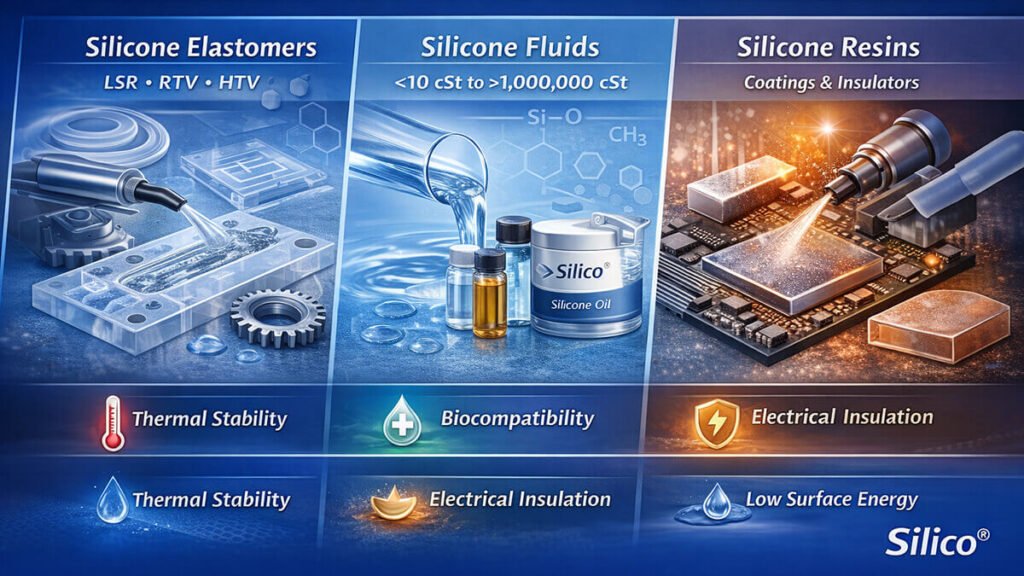
Silicone fluids are linear or lightly branched PDMS polymers with viscosities typically expressed in centistokes (cSt at 25°C), ranging from <10 cSt to >1,000,000 cSt. Typical applications include:
These materials are commonly used in high-temperature coatings, protective finishes, and electrical insulation systems.
Thermal Stability
PDMS maintains performance over a broad temperature range (typically –50°C to +200°C, with short-term tolerance above this), making it suitable for automotive, electronics, and industrial processes.
Mechanical and Viscoelastic Behavior
Crosslink density governs modulus and elastic recovery. Uncrosslinked PDMS behaves as a viscous fluid, while elastomers exhibit pronounced viscoelasticity and time-dependent deformation.
Electrical Properties
PDMS offers high dielectric strength and low dielectric loss, supporting its use in electronic encapsulation and insulation.
Surface Properties and Compatibility
PDMS is inherently hydrophobic with low surface energy. Oxygen plasma treatment can temporarily render the surface hydrophilic, but hydrophobic recovery typically occurs over time. PDMS swells significantly in many nonpolar organic solvents but shows minimal swelling in water and polar alcohols.
May generate extractables or cause discoloration
Silicone Fluids by Viscosity
From ultra-low viscosity fluids (<10 cSt) to ultra-high viscosity gums (>1,000,000 cSt). Selection should consider temperature dependence, volatility, and surface behavior.
Elastomer Categories
HTV/HCR: extrusion, calendaring, cable insulation
Medical-Grade PDMS
Materials intended for medical or food-contact applications must comply with ISO 10993 and FDA guidance, with careful control of catalyst residues and low-molecular-weight extractables.
Microfluidics and Lab-on-a-Chip Devices: Optical transparency, gas permeability, and ease of molding make PDMS a standard material.
Medical Devices (Non-Long-Term Implantable): Tubing, seals, and housings, subject to regulatory testing.
Electronics and Thermal Management: Electrical insulation and thermally conductive filled formulations.
Industrial Lubrication and Antifoaming: Widely used in chemical processing, food, and personal care.
High-Performance Coatings and Protection: Silicone resins for weather-resistant and insulating coatings.
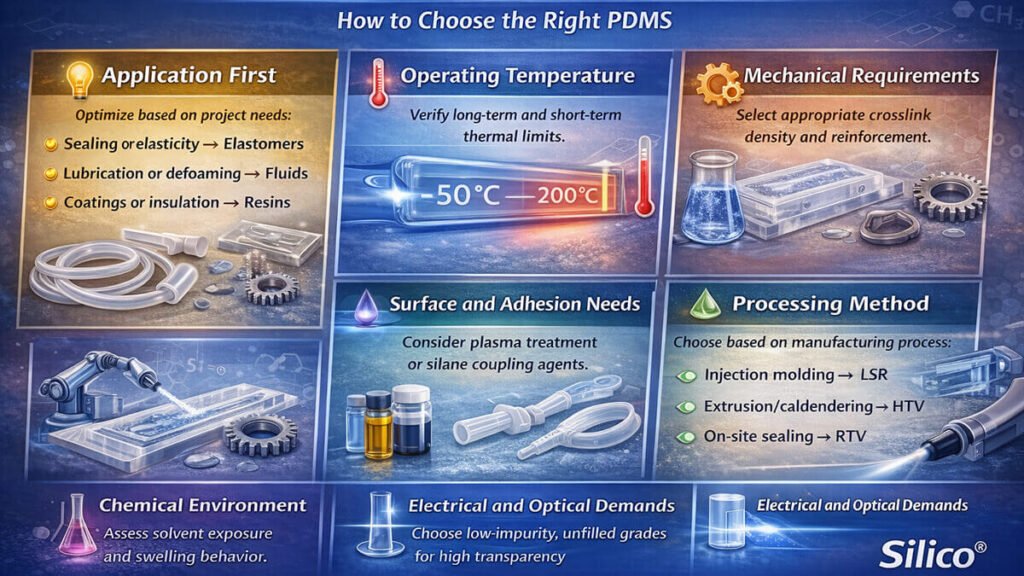
Operating Temperature
Verify long-term and short-term thermal limits.
Mechanical Requirements
Select appropriate crosslink density and reinforcement.
Surface and Adhesion Needs
Consider plasma treatment or silane coupling agents.
Biocompatibility
For medical or food contact, choose certified grades and addition-cure systems.
Processing Method
Injection molding → LSR
Extrusion/calendering → HTV
On-site sealing → RTV
Chemical Environment
Assess solvent exposure and swelling behavior.
Electrical and Optical Demands
Use low-impurity, unfilled grades for high transparency and low dielectric loss.
Hydrophobic Recovery: Long-term hydrophilicity requires chemical grafting or surface coatings.
PDMS materials demonstrate a strong safety record across industrial and consumer applications. However, medical and food-contact uses require full biocompatibility testing, extractables analysis, and regulatory documentation. Condensation-cure systems should be evaluated for by-product emissions. Environmental fate and lifecycle considerations are increasingly addressed in academic and regulatory studies.
PDMS remains a cornerstone material across engineering, medical, and industrial sectors due to its chemical stability, thermal resilience, and processing versatility. Successful material selection depends on clearly defined application requirements, compatibility testing, and close collaboration with qualified suppliers. Technical documentation from leading manufacturers and peer-reviewed literature should guide final decisions.
High-quality PDMS materials, such as those offered by Silico®, provide reliable performance supported by detailed technical data, making them suitable for demanding industrial and specialty applications.
Q1: Does PDMS swell in water?
A1: No significant swelling occurs in water or polar solvents, but PDMS swells considerably in many nonpolar organic solvents.
Q2: What is the difference between RTV and LSR?
A2: RTV cures at room temperature and is suitable for sealing and repairs, while LSR is designed for high-volume injection molding of precision parts.
Q3: How can PDMS surfaces remain hydrophilic long-term?
A3: Plasma treatment is temporary; long-term solutions require chemical grafting or hydrophilic coatings.
Confirm curing chemistry, degassing procedures, shelf life, and storage conditions with your supplier.