
Food Grade Silicone Fluid for Defoaming: How PDMS Controls Foam
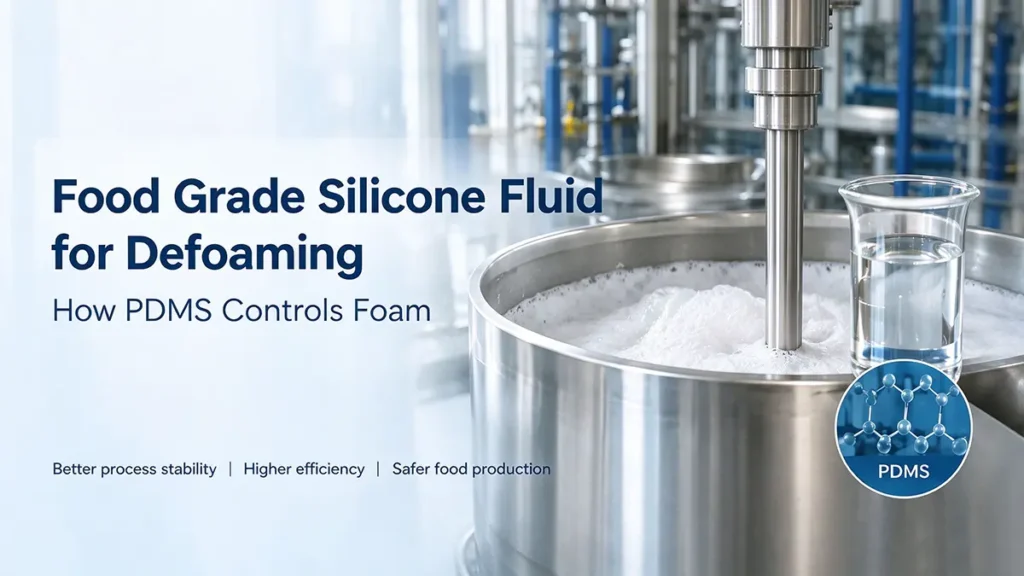
Foam is a routine process problem in food manufacturing. It can develop during mixing, pumping, circulation, heating, fermentation, filling, and other operations where air becomes dispersed in a liquid. Excessive foam can reduce effective tank capacity, interfere with level measurement, increase the risk of overflow, and make processing less stable.
Food grade silicone fluid, typically based on polydimethylsiloxane (PDMS), is widely used for foam control because of its low surface tension, hydrophobicity, chemical stability, and ability to destabilize foam films.
The important point is that silicone fluid does not simply “remove air.” Its antifoaming action is mainly an interfacial process: the silicone phase reaches the air-liquid interface, interacts with the thin liquid film around bubbles, and promotes film thinning and rupture.
Silico® Food Grade Silicone Fluid provides controlled-viscosity PDMS options for selected food-processing and foam-control applications. The appropriate grade, viscosity, formulation, and dosage should be determined from the actual process conditions and applicable food regulations.
Table of Contents
- 1. What Is Food Grade Silicone Fluid?
- 2. Why Does Foam Form in Food Processing?
- 3. Why Is PDMS Effective as a Defoamer?
- 4. How Does PDMS Control Foam?
- 5. The Role of Surface Tension
- 6. Spreading, Entry and Foam-Film Rupture
- 7. Does Silicone Fluid Viscosity Affect Defoaming?
- 8. PDMS Fluid vs. Silicone Antifoam Formulations
- 9. What Factors Affect Defoaming Performance?
- 10. Food Processing Applications
- 11. How Much Silicone Fluid Is Needed?
- 12. Food-Use and Regulatory Considerations
- 13. How to Select a PDMS Defoamer
- 14. Common Problems in Silicone Defoaming
- Conclusion
1. What Is Food Grade Silicone Fluid?
Food grade silicone fluid is a silicone-based fluid manufactured and controlled for defined food-related applications.
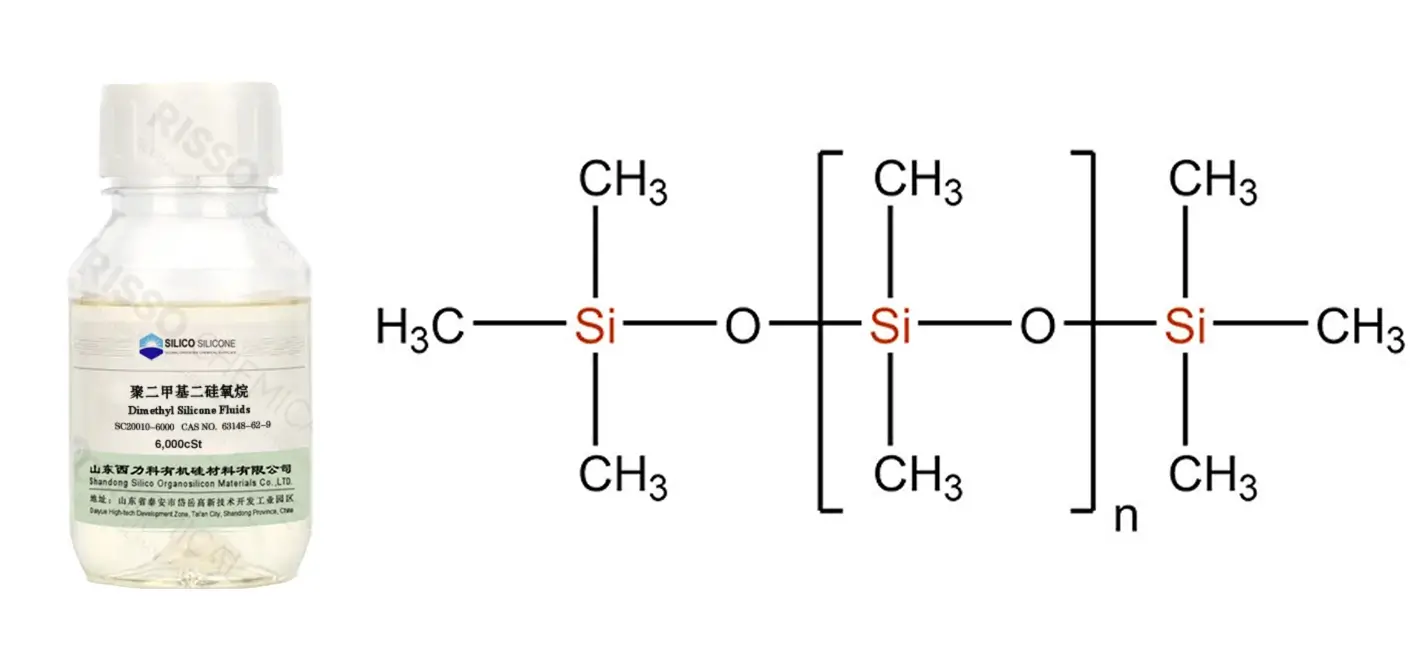
The most common material is polydimethylsiloxane (PDMS), with the repeating structure:
–[Si(CH₃)₂–O]ₙ–
PDMS is available in different molecular weights and viscosity grades. In food-processing applications, the required viscosity depends on how the silicone fluid is introduced, dispersed, metered, and maintained in the process.
Important properties include:- Low surface tension
- Hydrophobicity
- Chemical stability
- Thermal stability
- Low water solubility
- Lubricity
- Controlled viscosity
These properties make PDMS useful not only for defoaming, but also in selected release, lubrication, and processing applications.
However, food grade does not mean unrestricted use in every food application. The permitted use, concentration, formulation, and regulatory basis need to match the intended application.
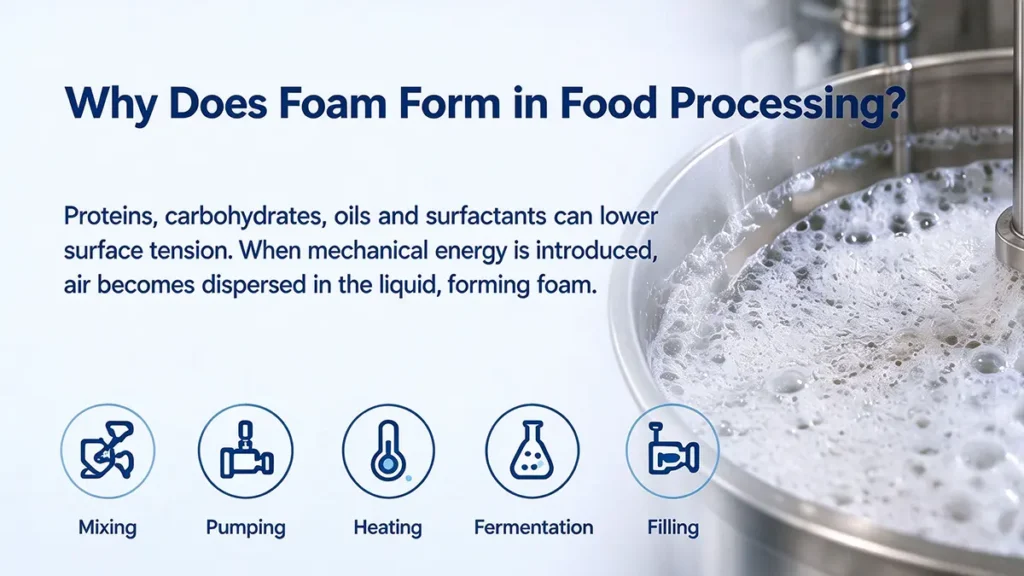
2. Why Does Foam Form in Food Processing?
Food-processing liquids often contain proteins, carbohydrates, oils, surfactants, emulsifiers, or other surface-active components.
When mechanical energy is introduced, air can become dispersed into the liquid.
Typical foam-generating operations include:- High-speed mixing
- Pumping and recirculation
- Agitation
- Heating
- Fermentation
- Filling and transfer
- Spraying
- Homogenization
The liquid surrounding each gas bubble forms a thin film. Surface-active substances can adsorb at the air-liquid interface and make this film more resistant to rupture.
This is why some food systems produce foam that disappears quickly, while others generate persistent foam.
Why excessive foam is a problem
- Reduce usable vessel volume
- Cause tank overflow
- Interfere with level sensors
- Reduce filling accuracy
- Increase cleaning requirements
- Complicate pumping and transfer
- Reduce process throughput
A defoamer therefore needs to act on the foam film, not simply reduce the amount of air introduced into the system.
3. Why Is PDMS Effective as a Defoamer?
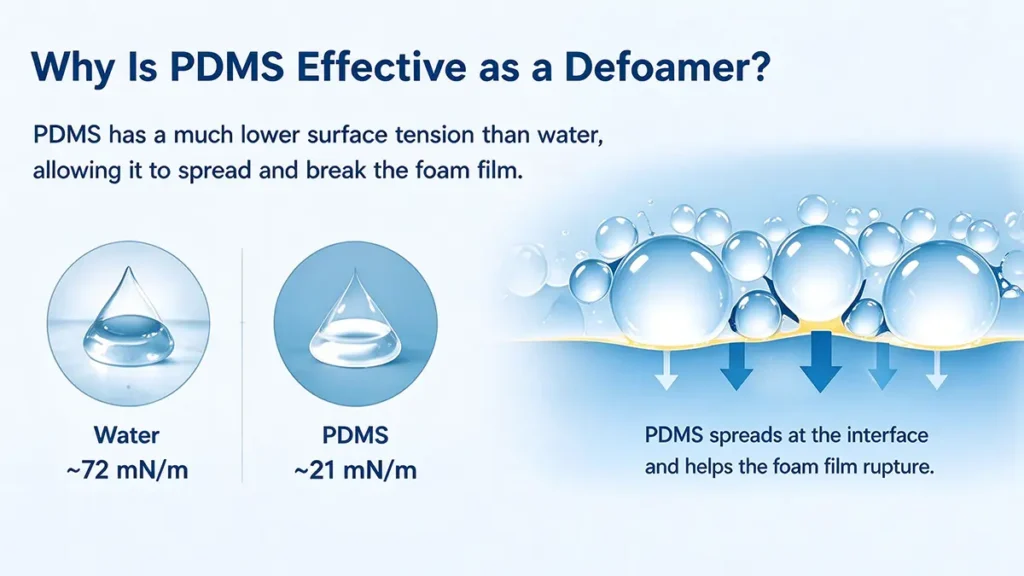
PDMS has a surface tension of approximately 21 mN/m at ambient temperature, substantially lower than water, which is around 72 mN/m.
This difference is one reason silicone fluids can spread effectively at suitable interfaces.
But surface tension alone does not explain the complete mechanism.
Research on PDMS-based antifoams shows that performance is also strongly influenced by the properties of the surfactant adsorption layer at the foam interface. Dense or highly condensed adsorption layers can significantly hinder antifoam spreading and reduce activity.
In practical food-processing systems, performance can therefore change significantly with:- Protein concentration
- Surfactant concentration
- Oils and fats
- Salts
- pH
- Temperature
- Agitation
- Foam-film thickness
- Silicone viscosity
- Antifoam formulation
This explains why a silicone fluid that performs well in one product may require a different grade or application method in another.
4. How Does PDMS Control Foam?
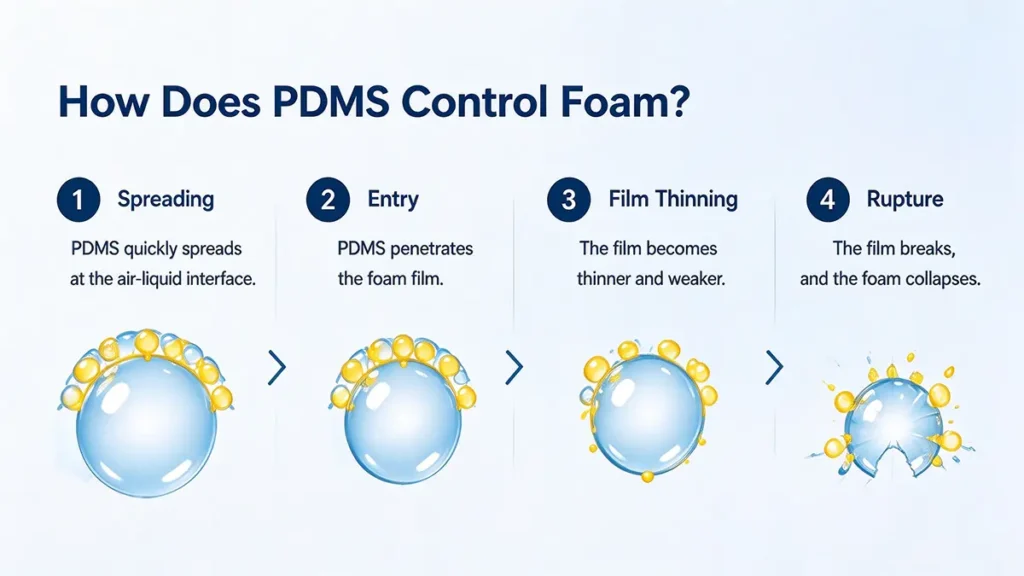
Stage 1: PDMS Reaches the Foam Interface
The silicone phase must first reach the air-liquid interface.
In an aqueous food system, PDMS generally remains as a separate hydrophobic phase rather than dissolving completely into the water.
The size and dispersion of the silicone phase influence how quickly it can reach the foam.
Stage 2: Silicone Enters or Spreads Across the Foam Film
When the silicone phase encounters a suitable foam film, interfacial forces can promote spreading and entry.
This changes the local structure of the film.
Stage 3: The Foam Film Becomes Unstable
The silicone phase disrupts the thin liquid film surrounding the gas bubble.
For oil-based antifoams, the literature commonly describes mechanisms such as bridging-stretching, where the antifoam oil forms an unstable bridge within the foam film and contributes to film rupture.
In PDMS-silica formulations, hydrophobic silica particles can further lower the barrier for antifoam entry and contribute to a bridging-dewetting mechanism.
Stage 4: The Bubble Collapses
Once the liquid film becomes sufficiently unstable, it ruptures.
The gas escapes and the bubble collapses.
The overall process can therefore be simplified as:
PDMS reaches interface → spreads/enters foam film → destabilizes film → film ruptures → bubble collapses
This is the central mechanism behind silicone-based foam control.
5. The Role of Surface Tension
Surface tension is one of the key physical properties of silicone fluids.
For comparison:| Liquid | Approximate surface tension |
|---|---|
| PDMS silicone fluid | ~21 mN/m |
| Water | ~72 mN/m |
The relatively low surface tension of PDMS allows it to spread readily under suitable interfacial conditions.
However, lower surface tension does not automatically mean better defoaming.
A useful defoamer needs an appropriate balance between:- Surface tension
- Spreading behavior
- Entry into the foam film
- Droplet size
- Viscosity
- Hydrophobicity
- Interfacial compatibility
The properties of the foam itself are equally important.
For example, a foam stabilized by a dense protein or surfactant layer may resist silicone spreading even when the silicone has favorable surface properties.
6. Spreading, Entry and Foam-Film Rupture
Spreading
The silicone phase spreads across the foam interface when the interfacial energy conditions are favorable.
Greater spreading can increase the area over which the antifoam interacts with the foam film.
Entry
The silicone phase must overcome the resistance of the interfacial layer and enter the foam film.
This is particularly important in concentrated surfactant systems.
Research has shown that the entry barrier is an important parameter affecting PDMS-based antifoam activity.
Film Rupture
Once the silicone phase has entered or interacted sufficiently with the film, it can form an unstable structure that promotes local thinning and rupture.
The result is bubble collapse.
This is why simply measuring surface tension is not enough to predict antifoaming performance.
7. Does Silicone Fluid Viscosity Affect Defoaming?
Yes.
Viscosity influences how a silicone fluid:- Flows
- Disperses
- Spreads
- Is metered
- Remains in the process
- Interacts with the foam
- 100 cSt
- 200 cSt
- 350 cSt
- 500 cSt
- 1,000 cSt
- 1,500 cSt
These grades should not be treated as interchangeable.
Lower-viscosity PDMS
Lower-viscosity silicone fluid can generally be easier to meter and disperse.
It may be useful where rapid distribution through the process liquid is required.
Higher-viscosity PDMS
Higher-viscosity material can provide different spreading, dispersion, and persistence characteristics.
It may be useful where greater persistence is required, but excessive viscosity can make pumping, dosing, and dispersion more difficult.
The key point
Higher viscosity does not automatically mean better defoaming.
The optimum grade depends on the foam system, dosing method, temperature, agitation, and required persistence.
8. PDMS Fluid vs. Silicone Antifoam Formulations
Neat PDMS
This is primarily silicone polymer fluid.
It can provide useful defoaming performance in selected systems, but dispersion and application conditions are important.
PDMS-Silica Antifoam
This formulation combines silicone fluid with hydrophobic solid particles, commonly silica.
The particles can contribute to antifoam activity through mechanisms involving entry, bridging, and dewetting.
Silicone Antifoam Emulsion
A silicone emulsion disperses silicone droplets in an aqueous carrier.
This can make dosing and distribution easier in some water-based food-processing systems.
The three product forms can therefore behave differently even when their primary silicone component is PDMS.
9. What Factors Affect Defoaming Performance?
9.1 Foam Composition
9.2 Temperature
9.3 Agitation
9.4 Silicone Droplet Size
9.5 Viscosity
9.6 Dosage
Too little may not control the foam effectively.
Too much can increase cost, complicate formulation, and potentially create regulatory or quality issues.9.7 Foam Stability
A simple aqueous foam can respond very differently from a highly stabilized protein or surfactant foam.
For this reason, laboratory screening followed by a controlled production trial is usually more reliable than selecting a defoamer from viscosity alone.
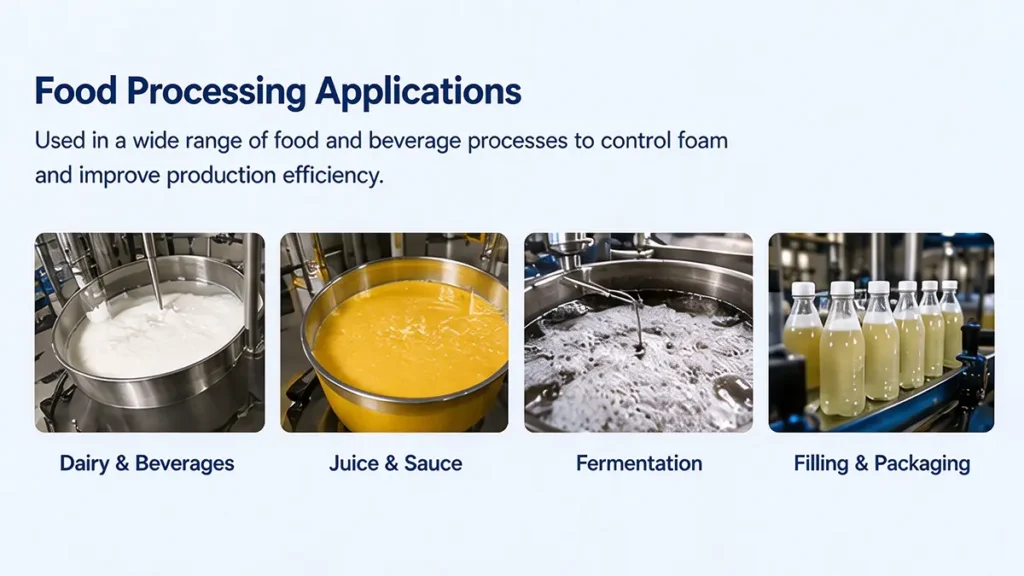
10. Food Processing Applications
Beverages
Dairy Processing
Oils and Fats
Fermentation
Liquid Food Processing
Sauces, syrups, liquid ingredients, and other formulated food systems may develop foam during mixing and transfer.
The appropriate silicone product depends on the composition of the process liquid and the applicable regulatory conditions.
11. How Much Silicone Fluid Is Needed?
There is no universal silicone defoamer dosage
The required level depends on:- Foam severity
- Food composition
- Silicone viscosity
- Product form
- Process temperature
- Agitation intensity
- Initial and continuous dosing
- Residence time
- Required foam-control performance
Codex currently lists PDMS as INS 900a and specifies maximum levels by food category. Some categories show 10 mg/kg, while other categories have different limits or specific conditions of use.
Therefore, a statement such as “use 10 mg/kg of silicone oil”
The correct approach is:
Start with the applicable regulatory limit → conduct laboratory screening → determine the minimum effective dosage → validate under production conditions.
12. Food-Use and Regulatory Considerations
A silicone fluid intended for food processing should be evaluated against the regulations applicable to its intended use and market.
In the United States, FDA’s food-substance database lists dimethylpolysiloxane (CAS 9016-00-6) under multiple provisions, including 21 CFR 173.340 and several indirect food-additive regulations. FDA specifically advises users to consult the cited regulation to determine whether the substance is authorized for the intended use.
This means that:
“PDMS is FDA approved” is not a sufficient compliance statement by itself.
The specific product, formulation, concentration, application, and conditions of use need to be considered.
The same principle applies to Codex and other national regulations.
Documentation commonly requested by food manufacturers
- Technical Data Sheet (TDS)
- Safety Data Sheet (SDS)
- Certificate of Analysis (CoA)
- Product specification
- Regulatory statement
- Food-use declaration
- Migration or supporting test data where applicable
For direct food applications, the regulatory status of the exact product should be confirmed before commercial use.
13. How to Select a PDMS Defoamer
Step 1: Understand the Foam
- Where foam forms
- When it forms
- How stable it is
- Whether the foam is protein-, surfactant-, oil-, or process-related
Step 2: Analyze the Process Liquid
- Water content
- Proteins
- Surfactants
- Oils and fats
- Salts
- pH
- Temperature
Step 3: Select the Product Form
- Neat PDMS
- PDMS-silica antifoam
- Silicone antifoam emulsion
depending on the process and regulatory requirements.
Step 4: Select Viscosity
- Dosing equipment
- Dispersion
- Temperature
- Residence time
- Required persistence
Step 5: Establish Dosage
Use the minimum effective level that provides stable foam control while remaining within applicable regulatory limits.
Step 6: Validate in Production
Laboratory foam tests are useful for screening, but actual production conditions can change the result.
A production trial should evaluate:- Foam height
- Foam persistence
- Dosage
- Product quality
- Residual silicone where relevant
- Cleaning requirements
- Process stability
14. Common Problems in Silicone Defoaming
Foam Does Not Collapse Quickly
- Insufficient dosage
- Poor dispersion
- Highly stabilized foam
- Incorrect silicone viscosity
- Strong surfactant adsorption layer
Silicone Is Difficult to Meter
The viscosity may be too high for the existing dosing system.
A lower-viscosity grade or a different product form may be more suitable.
Foam Returns After Initial Control
The process may continuously generate new foam.
In this case, a single addition may not be sufficient. Continuous or staged dosing may need to be evaluated.
Good Laboratory Results but Poor Production Results
Production conditions can differ significantly from laboratory conditions.
Differences in:- Shear
- Temperature
- Residence time
- Foam composition
- Dosing location
- Mixing efficiency
can change antifoam performance.
Regulatory Documentation Does Not Match the Application
A silicone product may have suitable technical performance but insufficient documentation or an unsuitable regulatory basis for the intended use.
This is a compliance problem, not a defoaming-performance problem.
Conclusion
Food grade silicone fluid controls foam primarily through interfacial mechanisms, rather than by simply reducing the amount of air entering a process.
The basic sequence is:
PDMS reaches the foam interface → spreads or enters the foam film → destabilizes the film → promotes film rupture → bubbles collapse.
Its performance depends on several variables, including:- PDMS viscosity
- Surface tension
- Droplet dispersion
- Foam composition
- Surfactants and proteins
- Temperature
- Agitation
- Product formulation
- Dosage
- Regulatory requirements
Research on PDMS-based antifoams shows that the properties of the foam’s interfacial adsorption layer can strongly affect antifoam activity, which explains why performance cannot be predicted from silicone viscosity or surface tension alone.
For manufacturers and distributors evaluating food-grade PDMS for foam control, Silico® Food Grade Silicone Fluid offers controlled-viscosity options for selected food-processing applications. The most appropriate grade should be determined through process analysis, laboratory screening, production validation, and regulatory review rather than by viscosity alone.
The practical principle is simple:
Choose the silicone fluid according to the foam system, process conditions, product form, required dosage, and regulatory requirements together.
Frequently Asked Questions
Food grade silicone fluid is a silicone-based fluid manufactured and controlled for defined food-related applications. PDMS is the most common silicone polymer used in these fluids.
PDMS reaches the air-liquid interface, spreads or enters the foam film, destabilizes the film, and promotes film rupture and bubble collapse.
Its low surface tension, hydrophobicity, chemical stability, and interfacial behavior make PDMS effective in many foam-control systems. However, actual performance depends strongly on the foam composition and antifoam formulation.
Not necessarily. Viscosity affects dispersion, spreading, metering, and persistence. The appropriate viscosity depends on the process.
Silicone oil can refer to neat PDMS fluid, while a silicone antifoam may contain PDMS together with silica or other formulation components. Their performance can therefore be different.
No. Food-use suitability depends on the specific product, application, concentration, food category, and applicable regulations.
PDMS is listed by Codex as INS 900a, with antifoaming among its functional classes. Permitted levels and conditions vary by food category.
No. Codex lists 10 mg/kg for a number of food categories, but other categories have different provisions. The applicable maximum level must be checked for the specific food category and market.
Silicone Fluid related products
If you want to know other questions about Sillcone Fluid, please contact us and we will provide professional answers.
Popular Recommendations
Get a Catalog & Best Price
- Quick and helpful reply within 24 hours;
- Tailored solutions provided for your project;
- One-stop purchasing service.
Need More Technical Information?
Silico® ORGANOSILICON
- Address: Daiyue Industrial Area, Taian, Shandong, China
- © Copyright 2022 Silico® . All Rights Reserved