
Food Contact Silicone Oil: Requirements, Testing and Compliance
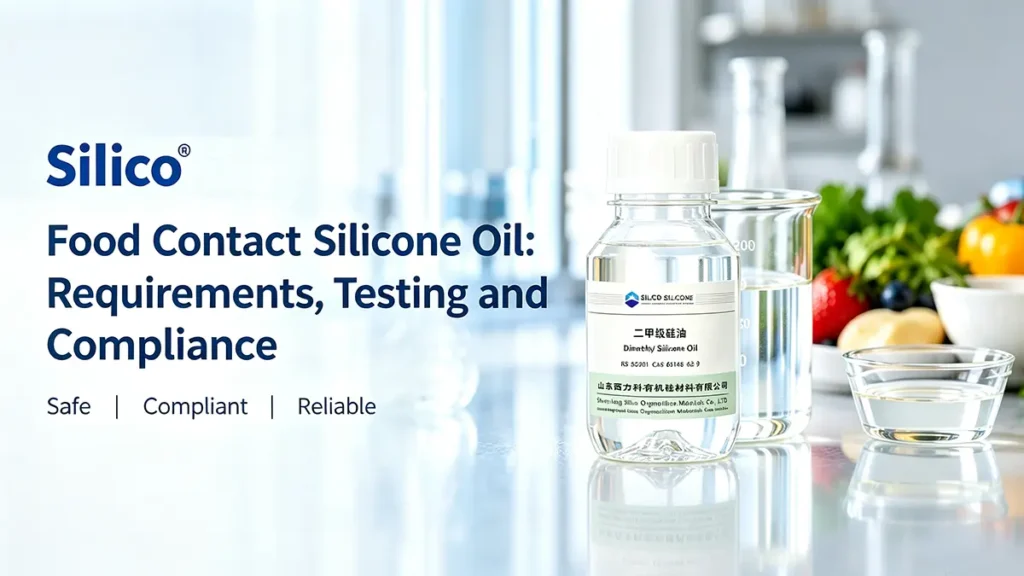
Food contact silicone oil is not simply a silicone fluid that has been manufactured at high purity. For food-contact use, the key question is whether the specific substance, formulation, and intended application are permitted under the regulations applicable to the target market.
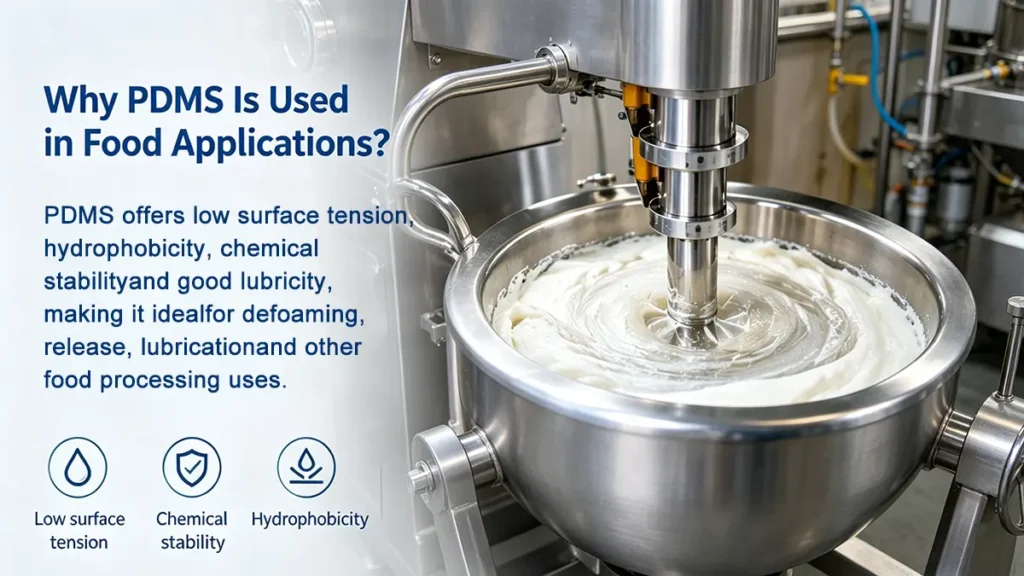
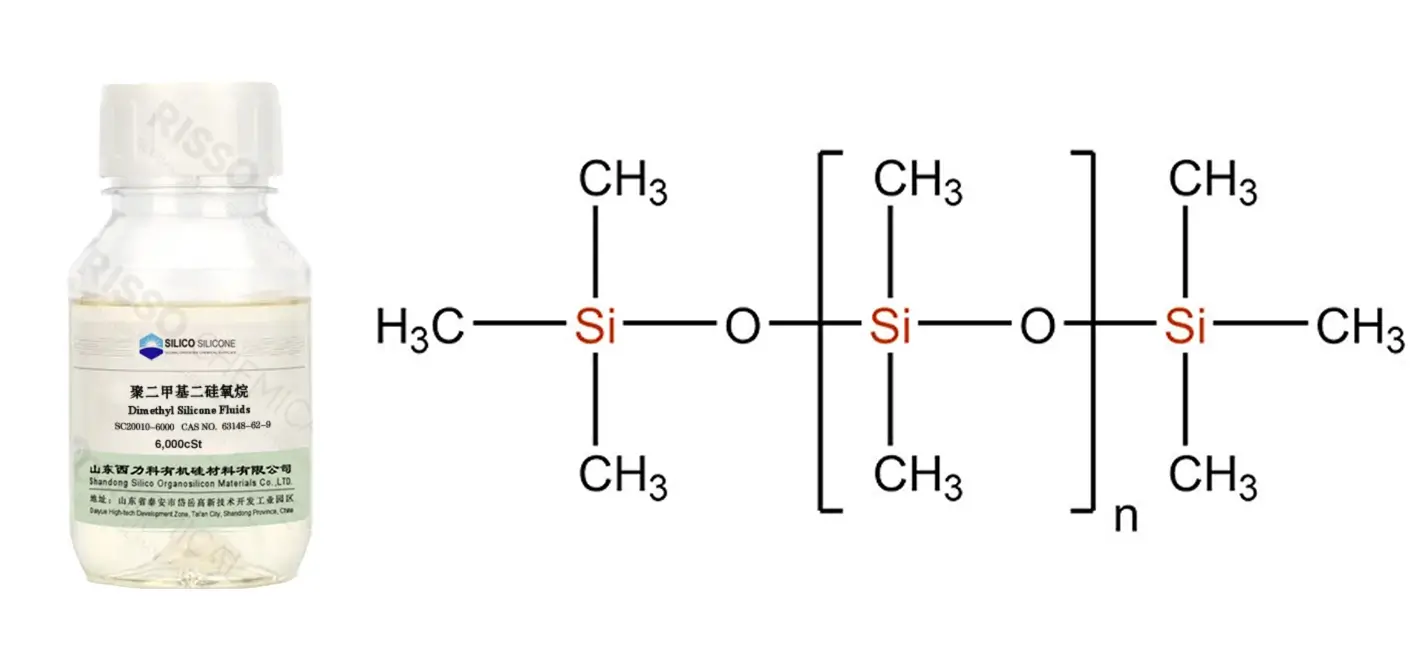
Silicone oil is commonly based on polydimethylsiloxane (PDMS), a silicone polymer valued for its low surface tension, chemical stability, hydrophobicity, lubricity, and controlled viscosity. These properties make it useful in food processing for applications such as foam control, release, lubrication, and selected processing operations.
However, “food grade,” “food contact,” and “FDA compliant” are not interchangeable terms. Regulatory status depends on the exact substance, concentration, impurities, migration or exposure, food type, temperature, contact time, and intended use.
For manufacturers, importers, and food-processing companies, this means compliance should be evaluated from the finished application backward, rather than from a generic statement on a silicone oil datasheet.
Table of Contents
- 1. What Is Food Contact Silicone Oil?
- 2. Food Grade Silicone Oil vs. Food Contact Silicone Oil
- 3. Why PDMS Is Used in Food Applications
- 4. Key Requirements for Food Contact Silicone Oil
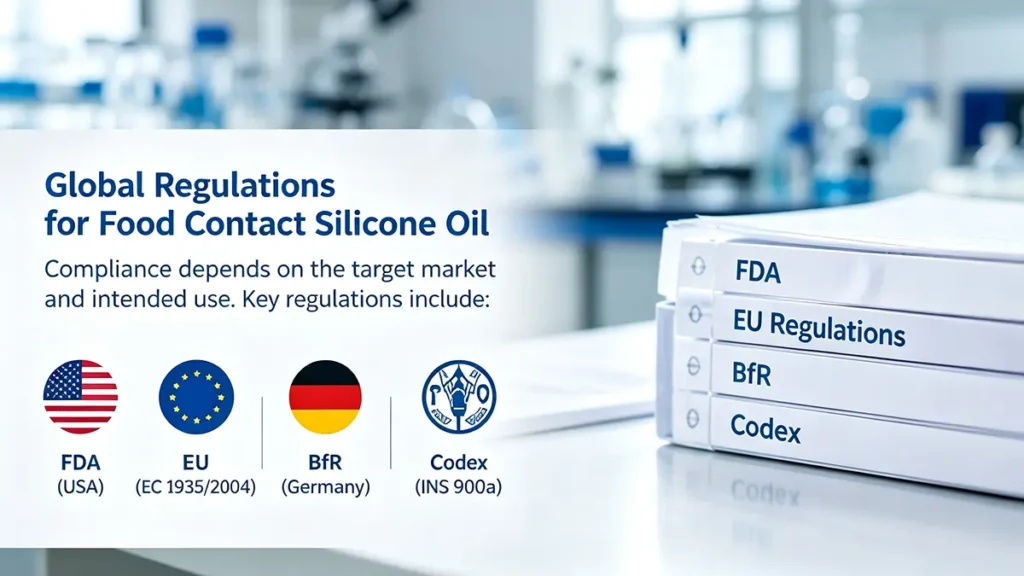
- 5. FDA Requirements in the United States
- 6. EU Requirements for Food Contact Applications
- 7. BfR Requirements for Silicone Materials
- 8. Codex and PDMS as Food Additive INS 900a
- 9. What Testing Is Required?
- 10. Migration Testing of Silicone Oil
- 11. Factors Affecting Silicone Oil Migration
- 12. Quality Control and Purity Requirements
- 13. Documents Buyers Should Request
- 14. Common Compliance Mistakes
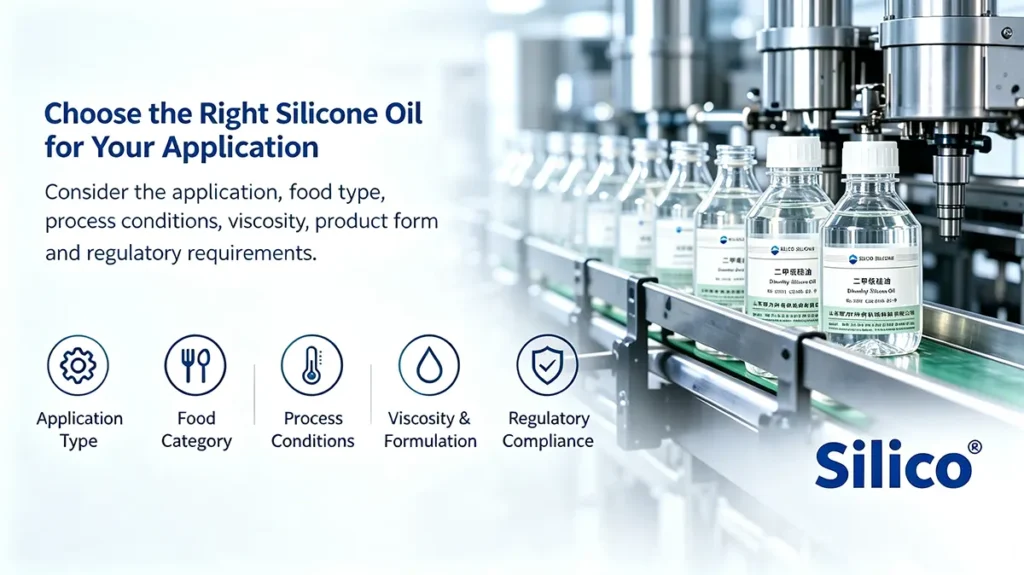
- 15. How to Select Food Contact Silicone Oil
- Conclusion
1. What Is Food Contact Silicone Oil?
Food contact silicone oil generally refers to a silicone-based material that is suitable for a defined application involving food or food-processing equipment.
The most common silicone fluid is polydimethylsiloxane (PDMS), with a repeating structure:
–[Si(CH₃)₂–O]ₙ–
Depending on molecular weight and formulation, silicone fluids can be supplied in a wide range of viscosities, from low-viscosity fluids to very high-viscosity silicone materials.
For food-related applications, silicone oil may be used as:- A processing aid
- A defoaming or antifoaming agent
- A release agent
- A lubricant for equipment
- A surface-treatment material
- A component of food-contact articles or formulations
The regulatory pathway is different for each application.
For example, PDMS used directly as a food additive is not evaluated in exactly the same way as PDMS used as a lubricant on food-processing equipment.
This distinction is important when preparing technical documentation and compliance statements.
2. Food Grade Silicone Oil vs. Food Contact Silicone Oil
Food grade silicone oil
“Food grade” generally describes a product manufactured and controlled for an intended food-related application.
It may indicate:- Controlled raw materials
- Defined purity specifications
- Controlled viscosity
- Low levels of specified impurities
- Batch testing
- Appropriate regulatory documentation
But food grade does not automatically mean that the product is approved for every food-contact application.
Food contact silicone oil
Food-contact suitability is more specific. It asks whether the substance is authorized or otherwise acceptable for the particular intended use and conditions of contact.
Relevant conditions can include:- Direct or indirect contact
- Food type
- Temperature
- Contact time
- Frequency of use
- Concentration
- Surface-to-food ratio
- Processing conditions
The FDA, for example, states that the regulatory status of a food-contact material depends on the individual substances that may reasonably be expected to migrate and whether those substances are covered by an applicable regulation, GRAS status, prior sanction, exemption, or effective Food Contact Substance Notification.
Therefore, a more technically accurate approach is:
Product specification + intended use + regulatory basis + testing data = compliance assessment
3. Why PDMS Is Used in Food Applications
| Property | Typical significance |
|---|---|
| Low surface tension | Helps control foam and improve spreading |
| Hydrophobicity | Low affinity for water-based systems |
| Chemical stability | Suitable for many processing environments |
| Thermal stability | Useful under controlled processing temperatures |
| Lubricity | Reduces friction between surfaces |
| Low water solubility | Supports separation from aqueous systems |
| Controlled viscosity | Allows selection for different application methods |
| Low volatility at normal processing conditions | Useful for many industrial applications |
PDMS is particularly important in foam control.
When used as an antifoaming agent, silicone oil can reach the air-liquid interface, spread through the foam film, destabilize the film, and promote bubble collapse.
The required viscosity and product form depend on the process. A low-viscosity silicone fluid may disperse quickly, while a higher-viscosity material can behave differently in terms of spreading, persistence, and metering.
For food applications, however, performance is only one part of product selection. The regulatory status of the exact grade and use must also be established.
4. Key Requirements for Food Contact Silicone Oil
4.1 Chemical identity
- Chemical name
- CAS number
- Polymer type
- Base composition
- Molecular structure where relevant
- Additives or formulation components
- Residual substances or impurities subject to control
For PDMS, the commonly referenced CAS number is 9016-00-6.
The FDA food-substance inventory lists dimethylpolysiloxane under several relevant regulations and explicitly advises users to consult the cited regulation to determine whether the substance is authorized for the intended use.
4.2 Purity and impurity control
A food-contact product should have defined specifications for relevant quality parameters.
Depending on the application, these may include:- Appearance
- Viscosity
- Specific gravity
- Refractive index
- Volatile content
- Water content
- Acid value where applicable
- Residual catalyst or process chemicals
- Heavy metals or other specified contaminants
- Low-molecular-weight siloxanes where relevant
Not every parameter is required for every product. The specification should be based on the actual regulatory and technical risk of the application.
4.3 Intended-use definition
This is one of the most important requirements.
A product should not simply be described as:A stronger technical statement defines the application, such as:“Suitable for food contact.”
- Food-processing equipment lubricant
- Mold-release agent
- Defoaming agent
- Processing aid
- Food-contact surface treatment
- Food category
- Maximum concentration
- Temperature
- Contact conditions
- Whether direct or indirect contact is expected
5. FDA Requirements in the United States
In the United States, food-contact substances are regulated according to their intended use.
FDA’s inventory lists dimethylpolysiloxane under several provisions, including 21 CFR 173.340, 175.105, 175.300, 176.170, 176.180, 176.200, 176.210, 177.1200, 177.2260, 177.2800, 178.3570 and 178.3910, among others. The applicable provision depends on the specific use.
This is why simply stating “PDMS is FDA approved” is not sufficiently precise.
The correct question is:
Is this particular silicone oil authorized for this particular food-contact use under the applicable FDA regulation or other valid regulatory basis?
FDA also distinguishes between the regulatory status of individual substances and the finished food-contact article. Its guidance explains that substances reasonably expected to migrate into food need an applicable regulatory basis.
FDA food types and conditions of use
FDA also categorizes foods and conditions of use.
Food categories include:- Non-acid aqueous foods
- Acidic aqueous foods
- Foods containing free oil or fat
- Dairy products
- Fats and oils
- Beverages
- Bakery products
- Dry foods
- High-temperature sterilization
- Boiling-water sterilization
- Hot filling or pasteurization
- Room-temperature storage
- Refrigerated storage
- Frozen storage
- Reheating
- Irradiation
- High-temperature cooking
These categories are important because migration behavior can change substantially with temperature, food composition, and contact time.
6. EU Requirements for Food Contact Applications
The European Union takes a different regulatory approach from the United States.
The general framework for food-contact materials is Regulation (EC) No 1935/2004.
Article 3 establishes that food-contact materials and articles must be manufactured so that, under normal or foreseeable conditions of use, they do not transfer constituents to food in quantities that could:- Endanger human health;
- Cause an unacceptable change in food composition; or
- Cause deterioration of organoleptic characteristics.
This means that food-contact compliance in Europe is fundamentally connected to the actual use conditions.
Another important requirement is Commission Regulation (EC) No 2023/2006, which establishes good manufacturing practice for materials and articles intended to contact food.
The regulation requires appropriate quality assurance and quality-control systems and applies throughout relevant manufacturing, processing, and distribution stages.
An important point about silicone
Silicone materials do not simply fall under every requirement written specifically for plastics.
For example, Regulation (EU) No 10/2011 establishes specific rules for plastic food-contact materials. A silicone material or silicone oil therefore should not automatically be described as “EU 10/2011 compliant” merely because it is used in a food-contact application.
The applicable regulatory framework should
7. BfR Requirements for Silicone Materials
For silicone products and silicone articles used in Germany, BfR Recommendation XV — Silicones is an important technical reference.
The BfR document covers silicone materials and includes specific provisions concerning silicone oils and silicone elastomers.
The current BfR Recommendation XV available from BfR states that silicone oils may be used for appropriate intended purposes when the specified conditions are met. It also defines permitted starting materials and other requirements.
For companies supplying silicone products into Europe, BfR documentation can therefore be useful as part of a broader compliance package.
However, a BfR recommendation should not be treated as a universal substitute for the applicable EU legislation and national requirements.
8. Codex and PDMS as Food Additive INS 900a
PDMS is also recognized internationally as polydimethylsiloxane, INS 900a.
The Codex General Standard for Food Additives (GSFA) lists PDMS under INS 900a and identifies functional classes including:
- Anticaking agent
- Antifoaming agent
- Emulsifier
However, Codex maximum levels are food-category specific.
For example, the current GSFA database includes PDMS at 10 mg/kg for several listed food categories, while notes and permitted uses vary by category.
Therefore:
10 mg/kg is not a universal maximum dosage for food-grade silicone oil.
A manufacturer or food processor must check the specific food category and applicable national legislation.
Codex itself describes the GSFA as a searchable database of provisions adopted by the Codex Alimentarius Commission and recommends consulting the GSFA framework when interpreting additive provisions.
9. What Testing Is Required?
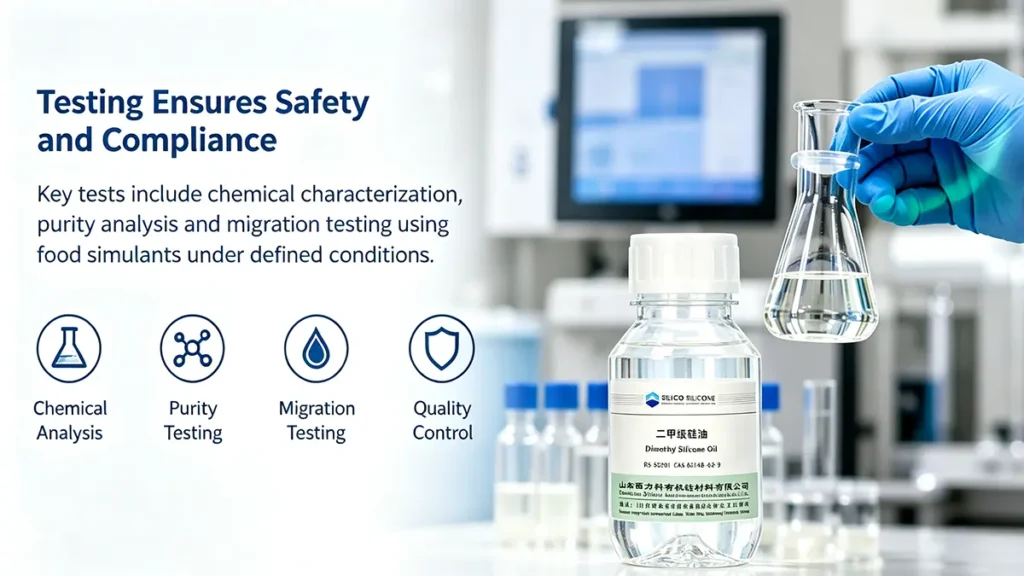
Testing should be designed around the intended application rather than using one generic “food grade test.”
A typical technical evaluation may include:9.1 Chemical characterization
This establishes what the material actually contains.
Common analytical approaches can include:- FTIR
- GC-MS
- GPC/SEC
- ICP-MS or ICP-OES for elemental impurities
- Karl Fischer analysis for water
- Viscosity measurement
- Specific gravity testing
The exact analytical package depends on the product.
9.2 Purity testing
- Low-molecular-weight siloxanes
- Residual solvents
- Catalyst residues
- Metals
- Volatile components
- Other process-related impurities
The analytical limits should be linked to the intended regulatory and toxicological assessment rather than selected arbitrarily.
9.3 Migration testing
For a food-contact application, migration or extractables testing may be required to estimate how much of a substance or its components can transfer into food.
FDA guidance explains that migration information can be obtained using actual food or appropriate food simulants, with testing designed to represent the intended conditions of use.
10. Migration Testing of Silicone Oil
Migration testing can be summarized as:
Silicone material → contact conditions → potential migration → analytical measurement → exposure assessment
Test conditions may consider:- Food simulant
- Temperature
- Contact time
- Surface-to-volume ratio
- Repeated-use conditions
- Intended food type
FDA guidance provides different food simulants and testing conditions for different food types and applications.
For example, aqueous, acidic, alcoholic, and fatty foods may require different simulants.
In some room-temperature storage scenarios, FDA guidance uses 40°C for 240 hours (10 days) as a testing condition. However, this should not be treated as a universal test condition for every silicone product.
The test method must be selected according to the applicable regulatory pathway and actual use conditions.
11. Factors Affecting Silicone Oil Migration
Migration is influenced by more than the chemical identity of PDMS.
Important variables include:Temperature
Higher temperatures can increase diffusion and extraction of mobile components.
Contact time
Longer contact generally provides more opportunity for migration.
Food composition
Fatty foods, acidic foods, alcoholic beverages, and aqueous systems can interact differently with materials.
Molecular weight
Low-molecular-weight siloxanes and oligomers can behave differently from high-molecular-weight PDMS.
Formulation
A pure PDMS fluid and a formulated silicone antifoam containing
Surface-to-volume ratio
The amount of food-contact material relative to the food volume can influence the calculated dietary exposure.
Processing conditions
Mixing, heating, sterilization, pressure, and repeated-use cycles may alter the exposure profile.
For this reason, a compliance report based on one temperature and one food simulant may not cover every possible application.
12. Quality Control and Purity Requirements
Food-contact silicone oil should be manufactured under controlled conditions with traceable batch records.
A practical QC system should normally include:| Quality area | Typical control |
|---|---|
| Raw materials | Approved suppliers and specifications |
| Polymerization | Controlled process parameters |
| Purification | Removal/control of unwanted residues |
| Viscosity | Batch specification and testing |
| Appearance | Visual inspection |
| Volatile content | Defined internal or customer specification |
| Impurities | Analytical control where relevant |
| Packaging | Food-compatible packaging and contamination control |
| Traceability | Batch number and production records |
| Release testing | CoA against specification |
For food-contact applications, consistency between batches is particularly important.
A regulatory assessment performed on one composition cannot automatically be applied to a materially different formulation.
13. Documents Buyers Should Request
When purchasing food contact silicone oil, buyers should request more than an SDS.
A practical documentation package may include:1. Technical Data Sheet (TDS)
- Chemical type
- Viscosity
- Appearance
- Specific gravity
- Typical properties
- Recommended applications
2. Safety Data Sheet (SDS)
- Hazards
- Handling
- Storage
- Transport
- Emergency measures
3. Certificate of Analysis (CoA)
The CoA should identify the production batch and actual test results against defined specifications.
4. Regulatory statement
This should identify the regulatory basis for the intended use rather than simply saying:
“FDA approved.”
A stronger statement references the relevant regulation or authorization and its conditions.
5. Migration or extractables test report
- Test material
- Food simulant
- Temperature
- Contact time
- Surface-to-volume ratio
- Analytical method
- Detection limit
- Results
6. Composition or compliance declaration
For customers with regulatory obligations, additional information may be required concerning formulation, restricted substances, or specific regulatory lists.
The exact documentation depends on the market and application.
14. Common Compliance Mistakes
Mistake 1: Treating “food grade” as universal approval
Food grade does not mean that the same silicone oil can be used in every food-contact application.
Better approach: define the intended use first.
Mistake 2: Saying “FDA approved” without citing the applicable use
FDA’s own database lists multiple regulations for dimethylpolysiloxane and tells users to consult the cited regulation to determine authorization for the intended use.
Better approach: state the applicable 21 CFR section and conditions of use where appropriate.
Mistake 3: Assuming all PDMS grades are equivalent
A 100 cSt silicone fluid, 350 cSt silicone fluid, and 1,000 cSt silicone fluid may share the same base polymer but can differ in molecular-weight distribution and application behavior.
Formulated silicone products can differ even more significantly.
Better approach: evaluate the exact commercial grade.
Mistake 4: Using a migration test from an unrelated application
A migration result for one food type and temperature does not necessarily cover another application.
Better approach: design testing around the worst reasonably foreseeable use.
Mistake 5: Ignoring low-molecular-weight components
A high-purity polymer specification does not automatically demonstrate the absence of all extractable or migratable components.
Better approach: define appropriate analytical controls for oligomers, volatiles, residuals, and other relevant substances.
Mistake 6: Confusing food additive compliance with food-contact material compliance
PDMS used as INS 900a in food is a different regulatory question from PDMS used in a food-processing equipment lubricant.
Better approach: identify whether the product is being used as:- A food additive
- A processing aid
- A release agent
- A lubricant
- A food-contact material component
before determining the compliance pathway.
15. How to Select Food Contact Silicone Oil
Step 1: Define the application
- Is there direct food contact?
- Is it an indirect contact application?
- Is the silicone oil intentionally added to food?
- Is it used on equipment?
- Is it used as a defoamer or release agent?
Step 2: Identify the food system
- Water-based foods
- Acidic foods
- Dairy
- Oils and fats
- Alcoholic beverages
- Dry foods
- High-moisture products
Step 3: Define the process conditions
- Temperature
- Contact time
- Pressure
- Cleaning conditions
- Repeated-use cycles
- Concentration
- Application rate
Step 4: Select the silicone fluid
- PDMS purity
- Viscosity
- Product form
- Dispersion behavior
- Thermal stability
- Required dosage
- Regulatory suitability
For example, Silico® Food Grade Silicone Oil can be evaluated by viscosity and intended application, but the appropriate grade should be selected according to the specific processing conditions and regulatory requirements rather than viscosity alone.
Step 5: Verify regulatory status
- FDA requirements
- EU requirements
- BfR recommendations where relevant
- Codex provisions
- Local food-contact regulations
Step 6: Confirm testing and documentation
- TDS
- SDS
- CoA
- Regulatory declaration
- Migration/extractables data where applicable
- Application-specific supporting documents
Step 7: Conduct application testing
Finally, evaluate the actual product under representative processing conditions.
This is particularly important for silicone defoamers because performance depends on the food matrix, surfactants, proteins, temperature, agitation, and dosing conditions.
Conclusion
Food contact silicone oil compliance is primarily an application-specific regulatory and technical assessment, not simply a question of whether a silicone fluid is called “food grade.”
For PDMS silicone oil, the important factors include:- Chemical identity and purity
- Viscosity and molecular-weight characteristics
- Formulation and additives
- Intended application
- Food type
- Contact temperature
- Contact time
- Migration or extractables
- Applicable FDA, EU, BfR, Codex, or national requirements
- Manufacturing and quality-control systems
- Supporting technical and regulatory documentation
In the United States, FDA lists dimethylpolysiloxane under multiple provisions, but the applicable regulation must be matched to the intended use. In the EU, the general food-contact framework focuses on preventing unsafe migration and unacceptable changes to food, while GMP requirements apply throughout the relevant manufacturing chain. Codex separately recognizes PDMS as INS 900a, with permitted levels that vary according to food category.
The most reliable approach is therefore:
Define the use → identify the regulatory pathway → characterize the material → test under representative conditions → document the result.
That approach gives food processors, silicone manufacturers, and distributors a much clearer basis for selecting and supplying food-contact silicone oil than relying on a generic “food safe” claim.
Frequently Asked Questions
Certain silicone oils, particularly specific PDMS grades, can be authorized or suitable for defined food-contact applications. However, safety and compliance depend on the exact product and intended use. A generic statement that “silicone oil is food safe” is too broad.
FDA’s database lists dimethylpolysiloxane under multiple food-additive and indirect-additive regulations. Whether a specific PDMS product is authorized depends on the applicable regulation and intended conditions of use.
Not necessarily. “Food grade” is a product-quality or market term, while food-contact compliance requires evaluation against the specific intended use and applicable regulations.
It depends on the application and regulatory pathway. Where migration is relevant to demonstrating compliance, migration or extractables testing may be required. FDA guidance specifically discusses migration testing using food or appropriate food simulants.
PDMS is one of the most common base polymers used in silicone oil. Commercial silicone fluids may differ in molecular weight, viscosity, purity, end groups, and formulation.
There is no single food-contact viscosity requirement. The appropriate viscosity depends on the application. Defoaming, lubrication, release, and surface-treatment applications can require different viscosity ranges.
Yes. BfR Recommendation XV specifically addresses silicones and includes provisions concerning silicone oils. Its relevance depends on the target market and application.
No. The regulatory basis and conditions of use must match the actual application. FDA specifically notes that the authorization of a food-contact substance is tied to its applicable regulatory status and intended use.
Silicone Fluid related products
If you want to know other questions about Sillcone Fluid, please contact us and we will provide professional answers.
Popular Recommendations
Get a Catalog & Best Price
- Quick and helpful reply within 24 hours;
- Tailored solutions provided for your project;
- One-stop purchasing service.
Need More Technical Information?
Silico® ORGANOSILICON
- Address: Daiyue Industrial Area, Taian, Shandong, China
- © Copyright 2022 Silico® . All Rights Reserved