
Is 100% Silicone Oil the Same as PDMS? A Technical Guide
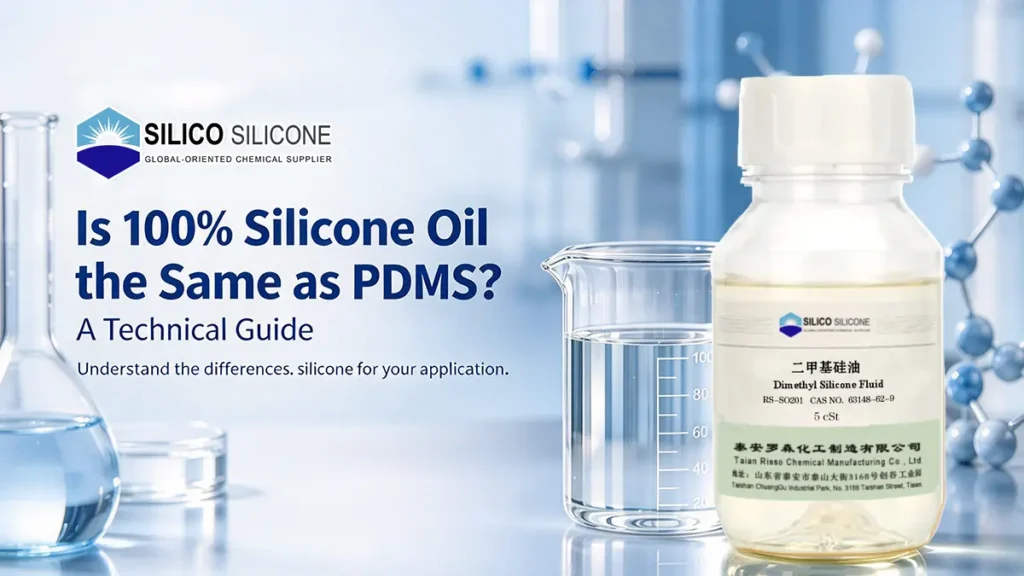
When purchasing silicone oil, buyers often encounter terms such as 100% silicone oil, PDMS, polydimethylsiloxane, dimethicone, and silicone fluid. These terms are closely related, but they do not always describe exactly the same thing.
The most important distinction is simple:
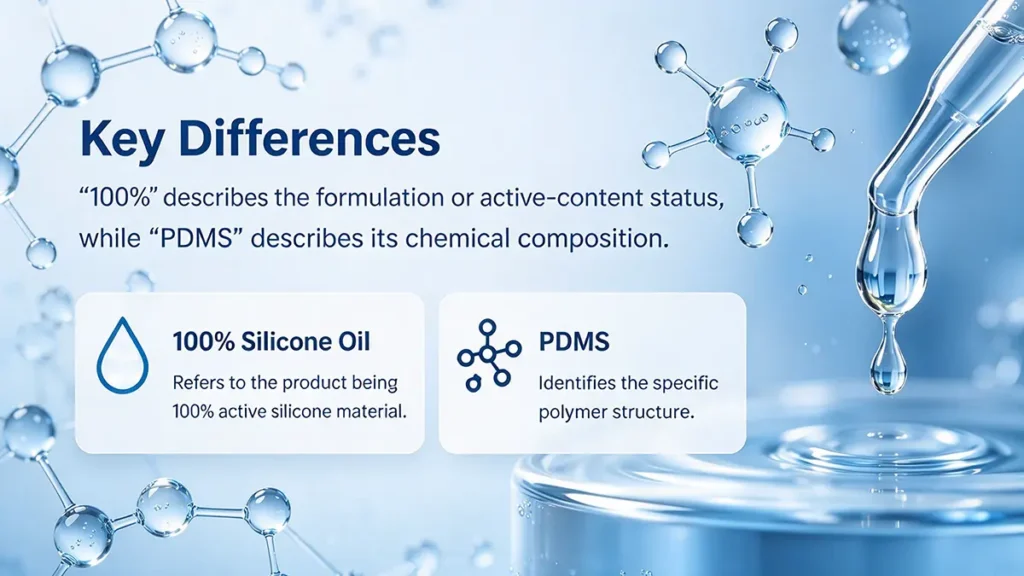
“100%” describes the formulation or active-content status of a product, while “PDMS” describes its chemical composition.
A 100% active silicone fluid may be PDMS, but “100% silicone oil” by itself does not prove that the material is unmodified polydimethylsiloxane. The product could belong to another silicone-fluid category, depending on its polymer structure and functional groups.
This distinction matters when selecting a material for industrial lubrication, mold release, antifoaming, cosmetics, electrical insulation, textile treatment, coatings, food-processing applications, or other technical uses.
For companies evaluating technical silicone suppliers, including Silico®, the correct approach is to look beyond the commercial product name and confirm the polymer type, viscosity, active content, purity profile, and application grade in the technical documentation.
Table of Contents
- 1. What Is Silicone Oil?
- 2. What Is PDMS?
- 3. Is 100% Silicone Oil the Same as PDMS?
- 4. What Does “100% Active” Mean?
- 5. PDMS vs. Dimethicone vs. Silicone Oil
- 6. Why PDMS Viscosity Is a Critical Specification
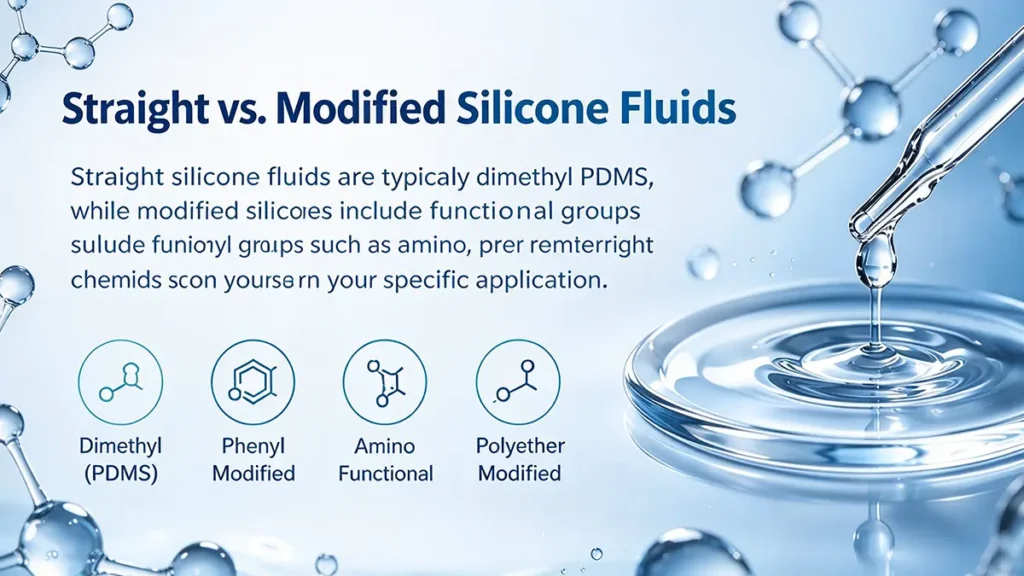
- 7. Straight Silicone Oil vs. Modified Silicone Fluid
- 8. Key Technical Properties of PDMS Silicone Oil
- 9. Major Applications of 100% PDMS Silicone Oil
- 10. What Should Buyers Specify When Purchasing PDMS?
- Conclusion
- Frequently Asked Questions
1. What Is Silicone Oil?
Silicone oil is a broad commercial term generally used for liquid silicone polymers or silicone fluids.
Unlike mineral oils and many synthetic hydrocarbon oils, silicone fluids are based on a silicon-oxygen backbone, typically represented as:
–Si–O–Si–O–Si–
Organic groups are attached to the silicon atoms. The type of organic substituent influences the properties and application behavior of the silicone fluid.
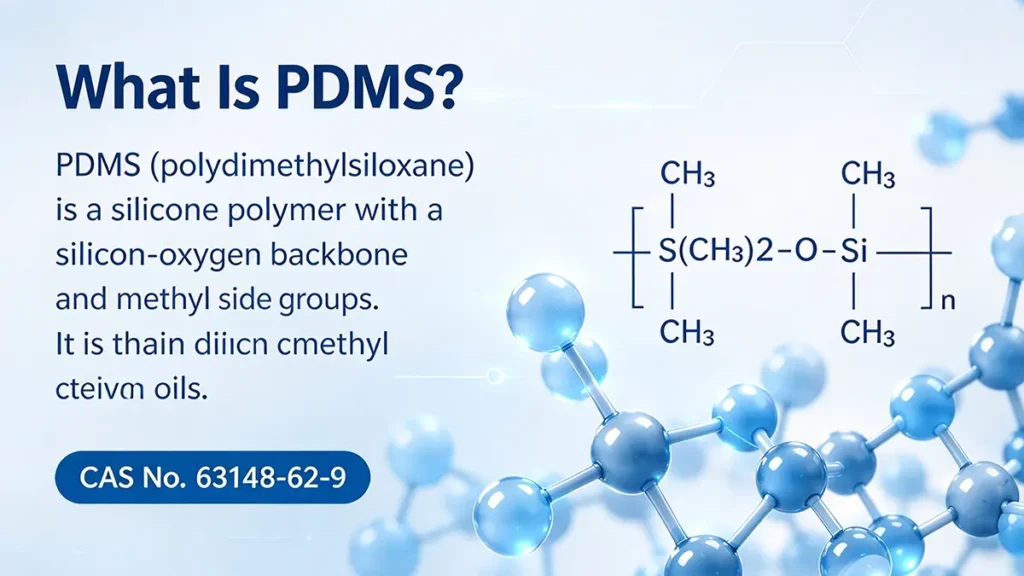
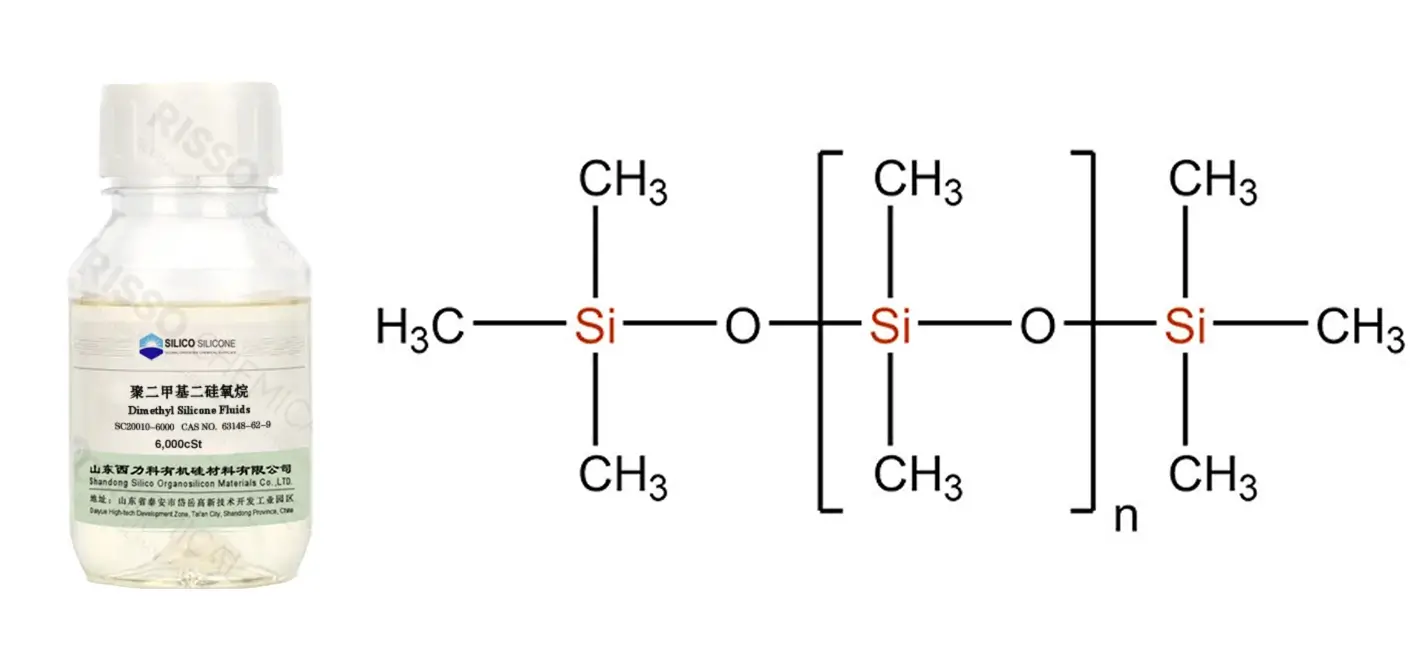
The most common silicone oil used in industry is dimethyl silicone fluid, which is based on polydimethylsiloxane (PDMS). In PDMS, the repeating unit can be represented as:
–[Si(CH₃)₂–O]ₙ–
However, silicone fluids can also contain other structural modifications.
Common categories include:
| Silicone Fluid Type | Main Structural Characteristic | Typical Technical Applications |
|---|---|---|
| Dimethyl silicone fluid | PDMS with methyl substituents | Lubricants, release agents, antifoams, polishes |
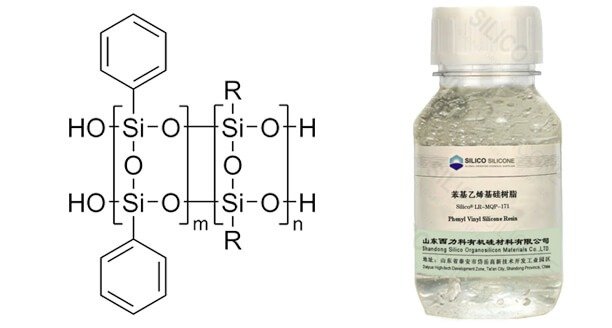
| Methylphenyl silicone fluid | Includes phenyl groups | High-temperature, optical and specialty applications |
| Methylhydrogen silicone fluid | Contains Si–H groups | Water repellents, crosslinking and surface treatment |
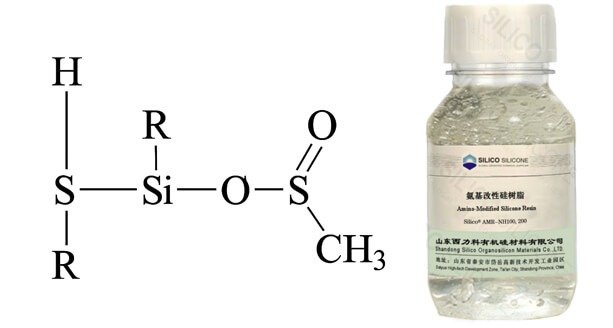
| Amino-functional silicone | Contains amino functionality | Textile softeners, personal care and surface modification |
| Polyether-modified silicone | Contains polyether segments | Surfactants, coatings, foam control and specialty formulations |
Shin-Etsu, for example, separates silicone fluids into straight silicone fluids and modified silicone fluids, with dimethyl, methylphenyl, and methylhydrogen fluids among the straight-fluid categories.
Therefore, silicone oil is a category, not a single chemical identity.
2. What Is PDMS?
PDMS stands for polydimethylsiloxane.
It is one of the most widely used silicone polymers and is the main chemistry behind many standard dimethyl silicone oils.
A simplified structural representation is:
(CH₃)₃SiO[Si(CH₃)₂O]ₙSi(CH₃)₃
The exact molecular weight is not fixed because n, the degree of polymerization, varies.
This is why commercial PDMS is normally sold according to viscosity grade rather than a single molecular-weight specification.
The relationship can be summarized as:
Longer polymer chains → higher molecular weight → higher viscosity
This is one reason two products can both be described as PDMS but behave very differently during mixing, pumping, spraying, coating, lubrication, or formulation.
Commercial PDMS grades cover a very wide viscosity range. Silico’s product range, for example, includes low-viscosity materials from approximately 0.65–1 cSt, standard grades such as 50–1,000 cSt, and high-viscosity products extending to 100,000 cSt and beyond.
The important point is that:
PDMS identifies the polymer chemistry; viscosity identifies a major part of the commercial grade.
3. Is 100% Silicone Oil the Same as PDMS?
The answer is: not automatically.
The expression “100% silicone oil” and the term “PDMS” refer to different aspects of a product.
“100%” generally refers to the product being supplied as a neat or 100% active silicone material, rather than a diluted solution, emulsion, or solvent-containing formulation.
“PDMS,” by contrast, identifies a specific polymer structure.
A useful comparison is:
| Term | What It Primarily Describes |
|---|---|
| Silicone oil | Broad commercial category |
| Silicone fluid | Liquid silicone material |
| 100% active | Active silicone content / neat product status |
| PDMS | Specific polymer chemistry |
| Dimethicone | Standardized name used for fully methylated siloxane polymers |
| 100 cSt / 350 cSt / 1,000 cSt | Viscosity grade |
There are many commercial examples where the terms do align.
Dow’s XIAMETER™ PMX-200 Silicone Fluid 100 cSt is specified as 100% active polydimethylsiloxane polymer, with Dimethicone as its INCI name. The 1,000 cSt grade is described in the same way.
In such a case:
100% active silicone oil = PDMS = Dimethicone
for the relevant product definition.
But this relationship should not be generalized to every product sold under the term “100% silicone oil.”
For example, 100% active silicone fluids can also be functionalized silicone polymers rather than plain dimethyl PDMS. The chemistry therefore needs to be confirmed from the TDS or other technical documentation.
The practical rule
When purchasing material, do not stop at:
“Is it 100% silicone oil?”
The more useful question is:
“Is it 100% active, linear PDMS with the required viscosity and specification?”
That question produces a much more precise technical answer.
4. What Does “100% Active” Mean?
The phrase 100% active is frequently misunderstood.
In commercial silicone-fluid specifications, it generally means that the product itself is the active silicone material rather than a formulation diluted with water, solvent, or another carrier.
For example, Dow specifies several PMX-200 silicone-fluid grades as 100% active PDMS polymers, including 5 cSt, 100 cSt, 1,000 cSt and higher-viscosity materials.
However:
100% active does not necessarily mean 100.00% analytical purity of one single molecular species.
PDMS is a polymeric material with molecular chains of varying lengths. A commercial polymer therefore does not consist of molecules that all have exactly the same molecular weight.
The Cosmetic Ingredient Review explains that linear methicones can contain polymers with varying chain lengths and molecular weights, including oligomers and cyclic compounds, and describes Dimethicone as a mixture of fully methylated linear siloxane polymers end-blocked with trimethylsiloxy units.
As a result, buyers should distinguish between:
- 100% active content
- polymer identity
- chemical purity
- volatile content
- low-molecular-weight siloxanes
- cyclic siloxane content
- application-specific regulatory requirements
These are separate technical considerations.
100% Active Does Not Mean “One Pure Molecule”
This point becomes particularly important for high-specification applications.
A buyer may require a product with:- low volatile content,
- controlled D4/D5/D6 levels,
- defined viscosity tolerance,
- low ionic contamination,
- controlled trace metals,
- cosmetic or pharmaceutical compliance,
- food-contact compliance,
- or medical-grade documentation.
5. PDMS vs. Dimethicone vs. Silicone Oil
PDMS
Polydimethylsiloxane (PDMS) is the chemical name identifying the silicone polymer.
A commonly encountered CAS number is:
CAS No. 63148-62-9
Many commercial PDMS products use this CAS number in international technical documentation. For example, Silico identifies its PDMS products with CAS No. 63148-62-9.
However, silicone nomenclature and CAS registration can vary across databases and historical documentation. Buyers should therefore rely on the supplier’s complete regulatory and technical documentation rather than trying to identify a material from CAS number alone.
Dimethicone
Dimethicone is a commonly used standardized name for fully methylated linear siloxane polymers.
FDA’s Substance Registration System lists Dimethicone with synonyms and mappings including dimethyl polysiloxane, dimethylpolysiloxane, dimethylsilicone fluid, dimethylsilicone oil, and polydimethylsiloxane.
The Cosmetic Ingredient Review similarly defines Dimethicone as a mixture of fully methylated linear siloxane polymers terminated with trimethylsiloxy units.
Silicone Oil
“Silicone oil” is the broadest commercial term.
In many industrial markets, it is used as a general name for PDMS or dimethyl silicone fluid. But the term can also be used for other silicone-fluid chemistries.
The relationship can therefore be summarized as:
Silicone oil
↓
Silicone fluid category
↓
Dimethyl silicone fluid / PDMS
↓
Specific viscosity grade
Not every silicone oil follows this exact path, which is why chemistry must be checked before substitution.
6. Why PDMS Viscosity Is a Critical Specification
For standard PDMS silicone oil, kinematic viscosity is one of the most important product specifications.
It is generally reported in:
cSt (centistokes)
or equivalently:
mm²/s
for kinematic viscosity.
For example:- 5 cSt PDMS
- 10 cSt PDMS
- 50 cSt PDMS
- 100 cSt PDMS
- 350 cSt PDMS
- 1,000 cSt PDMS
- 10,000 cSt PDMS
- 100,000 cSt PDMS
These products all belong to the PDMS family, but they cannot be treated as interchangeable materials.
Dow lists 5 cSt PMX-200 as a 100% active PDMS fluid and reports a typical kinematic viscosity of 5 cSt, specific gravity of 0.913 at 25°C, and refractive index of 1.396.
A 1,000 cSt PDMS grade, by contrast, has a typical viscosity of approximately 1,000 mm²/s at 25°C and a specific gravity around 0.97 at 25°C in Dow’s specification.How viscosity affects application performance
- faster spreading,
- easier pumping,
- easier atomization or spraying,
- lower resistance to flow,
- lighter sensory feel in personal care formulations.
- thicker lubricating films,
- greater damping,
- stronger persistence on surfaces,
- higher resistance to flow,
- different foam-control and release behavior.
Consequently, specifying only “PDMS” is often insufficient for a commercial quotation.
A technically complete requirement should normally state something such as:
PDMS, 100% active, viscosity 350 cSt at 25°C
rather than simply:
100% silicone oil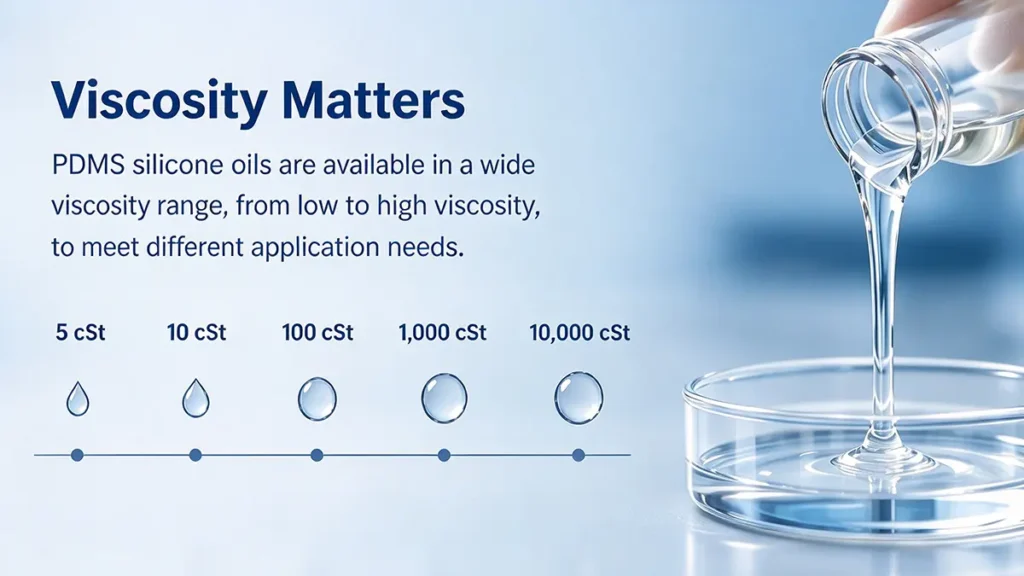
7. Straight Silicone Oil vs. Modified Silicone Fluid
Straight PDMS Silicone Oil
Standard dimethyl silicone fluid is based on PDMS without additional functional organic groups being intentionally introduced into the polymer backbone.
Its characteristic properties include:- low surface tension,
- hydrophobicity,
- good spreading,
- lubricity,
- electrical insulation,
- good thermal stability,
- chemical inertness,
- low reactivity.
Modified Silicone Fluids
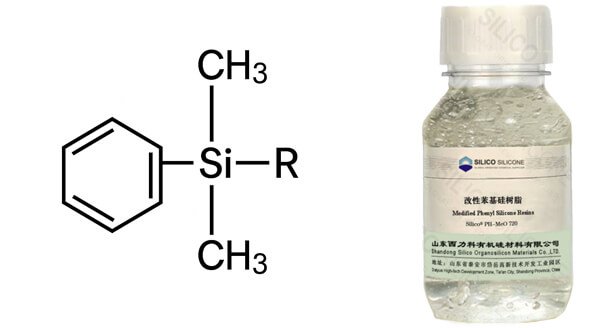
Modified silicone fluids introduce other chemical functionality into the silicone structure.
Examples include:- amino-functional silicones,
- polyether-modified silicones,
- epoxy-functional silicones,
- carboxyl-functional silicones,
- alkyl-modified silicones,
- phenyl-modified silicone fluids.
- improved substrate adhesion,
- better compatibility,
- controlled emulsification,
- enhanced fabric softness,
- different surface activity,
- improved resin compatibility,
- altered temperature behavior.
Therefore, two fluids may both be called silicone oil, and both may contain 100% active silicone material, while their performance in a formulation is completely different.
This is one of the most important reasons that “100% silicone oil” should never be treated as a complete chemical specification.
8. Key Technical Properties of PDMS Silicone Oil
8.1 Silicon-Oxygen Backbone
The Si–O–Si backbone has relatively high bond energy and substantial rotational flexibility.
This combination contributes to the characteristic thermal behavior, flexibility, and chemical stability of silicone polymers.
8.2 Low Surface Tension
PDMS generally has much lower surface tension than conventional hydrocarbon oils.
For example, Dow reports a surface-tension value of approximately 19.7 mN/m for its 5 cSt PMX-200 grade and around 20.9 mN/m for its 100 cSt grade under the stated test conditions.
This contributes to:- rapid spreading,
- surface coverage,
- release behavior,
- lubrication,
- wetting control,
- and foam-control performance.
8.3 Hydrophobicity
The methyl groups surrounding the siloxane backbone give standard PDMS a strongly hydrophobic character.
This makes PDMS useful in:- water-repellent treatments,
- surface protection,
- polishes,
- release coatings,
- textile treatments,
- personal care formulations.
8.4 Thermal Stability
PDMS maintains useful physical properties across a relatively broad temperature range compared with many conventional organic fluids.
The exact service range, however, depends on viscosity, exposure conditions, oxygen availability, system design, and the presence of other components. It should therefore not be assumed that every PDMS grade has the same maximum operating temperature.
8.5 Electrical Insulation
PDMS silicone fluids are also used in electrical applications because of their dielectric characteristics and relatively low reactivity. Dow lists electrical insulating fluid among the applications of multiple PMX-200 grades.
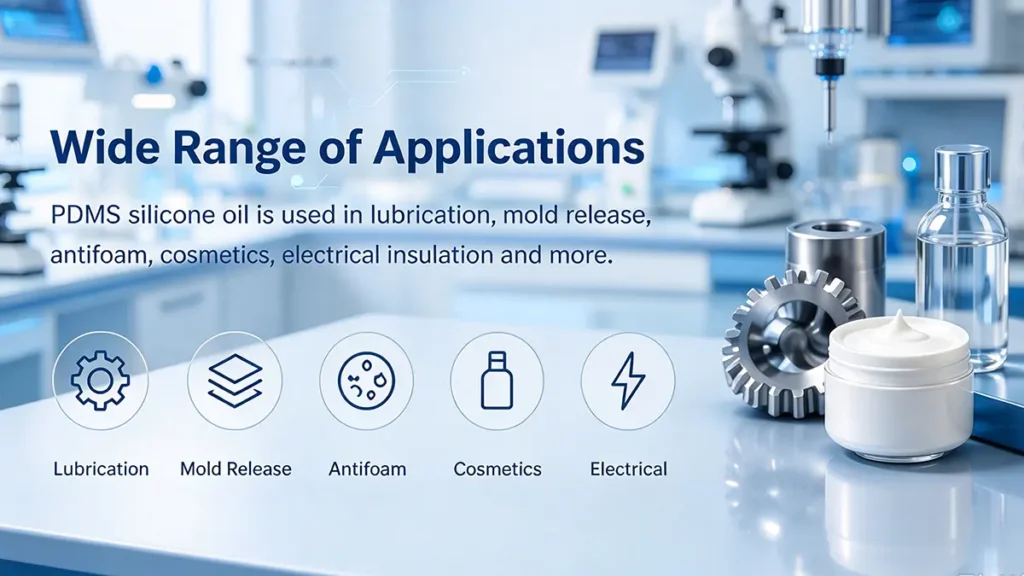
9. Major Applications of 100% PDMS Silicone Oil
Industrial Lubrication
PDMS can be used as a lubricating fluid where low surface energy, chemical stability, and controlled viscosity are required.
Different grades are selected according to:- contact conditions,
- temperature,
- required film thickness,
- equipment design,
- operating speed,
- compatibility with plastics or elastomers.
Mold Release
PDMS is widely used in mold-release systems because of its low surface energy and tendency to reduce adhesion between surfaces.
The appropriate viscosity depends on the substrate, application method, coating thickness, and process conditions.
Antifoam and Defoaming
PDMS is an important silicone-based foam-control material.
Its low surface tension allows the fluid to interact with foam films effectively, although actual defoaming performance depends on viscosity, dispersion state, formulation compatibility, dosage, and the nature of the process fluid.
Polishes and Surface Treatments
PDMS is used in automotive, furniture, metal, leather, and specialty polish formulations.
Typical performance objectives include:- gloss enhancement,
- improved slip,
- water repellency,
- easier spreading,
- reduced surface friction.
Cosmetics and Personal Care
Selected PDMS grades are widely used as Dimethicone in personal care formulations.
They can contribute:- spreadability,
- slip,
- conditioning,
- smooth sensory properties,
- reduced tack,
- protective film formation.
Electrical and Technical Fluids
- damping fluids,
- insulating fluids,
- mechanical fluids,
- specialty coatings,
- plastics and elastomer processing.
10. What Should Buyers Specify When Purchasing PDMS?
For an industrial or commercial purchase, “100% silicone oil” is generally too broad to serve as a complete specification.
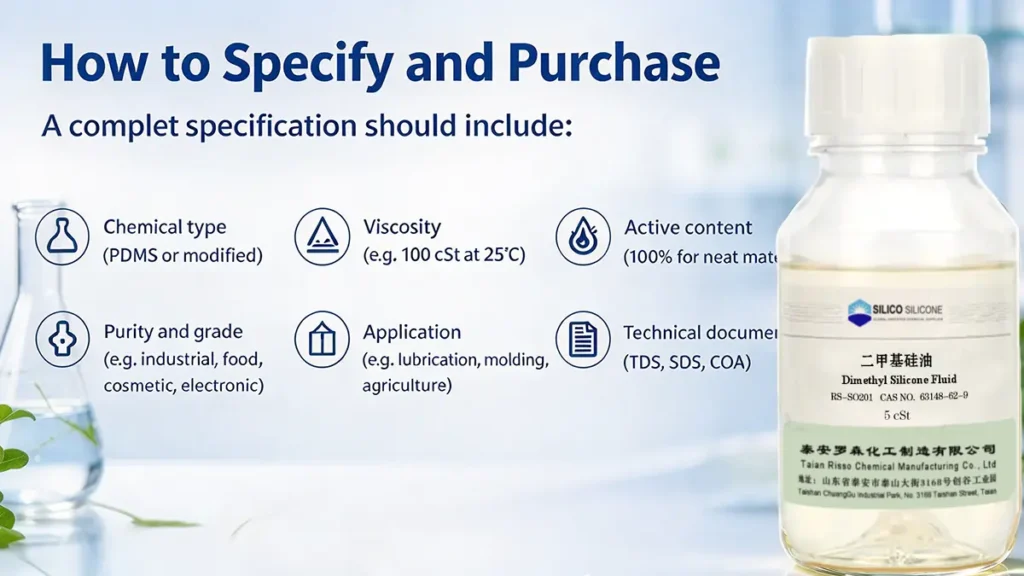
A better purchasing specification should include at least the following:
| Specification | Example Requirement |
|---|---|
| Chemical name | Polydimethylsiloxane (PDMS) |
| Product type | Linear dimethyl silicone fluid |
| CAS No. | 63148-62-9 |
| Active content | 100% |
| Viscosity | 100 / 350 / 1,000 cSt |
| Test temperature | 25°C |
| Appearance | Clear, colorless liquid |
| Specific gravity | Supplier specification |
| Refractive index | Supplier specification |
| Volatile content | Application dependent |
| Cyclic siloxanes | Specify where required |
| Grade | Industrial / cosmetic / food-contact / medical, as applicable |
| Packaging | Drum / IBC / agreed packaging |
| Documentation | TDS / SDS / COA |
The actual specification should be adjusted to the application.
For high-specification materials, buyers may also need to define:- viscosity tolerance,
- low-boiling fraction,
- D4/D5/D6 content,
- trace metals,
- moisture,
- acid value,
- refractive index,
- color,
- regulatory status,
- microbiological requirements where applicable.
For example, Dow identifies low cyclic content as a formulation benefit for certain PDMS grades, showing that the purity profile can be an important differentiating specification even among 100% active silicone fluids.
For a supplier such as Silico®, the same principle applies: the buyer should evaluate the specific PDMS grade, viscosity, application grade, and supporting documentation rather than relying only on the generic term “silicone oil.” Silico’s current PDMS range includes low-, standard-, and high-viscosity grades as well as application-specific cosmetic, food-grade, and medical-oriented products.
A Better RFQ Example
Please quote 100% silicone oil.
A technically stronger inquiry would be:
Please quote 100% active linear PDMS silicone fluid, viscosity 350 cSt at 25°C. Please provide TDS, SDS, COA, specific gravity, refractive index, volatile content, cyclic siloxane information, packaging, and applicable certifications.This wording minimizes ambiguity and makes supplier comparison much easier.
Conclusion
The question “Is 100% silicone oil the same as PDMS?” cannot be answered simply with yes or no.
The technically correct answer is:
Some 100% silicone oils are 100% active PDMS, but the term “100% silicone oil” alone does not establish that the product is PDMS.
PDMS is a defined polymer chemistry—polydimethylsiloxane—while silicone oil is a broader commercial category. “100% active” generally indicates that the material is supplied as a neat active silicone rather than a diluted formulation, but it does not by itself define polymer structure, viscosity, molecular-weight distribution, or analytical purity.
For technical procurement, the most reliable specification is therefore not:
100% Silicone Oil
but something closer to:
100% active Polydimethylsiloxane (PDMS), specified viscosity at 25°C, with defined purity and application-grade requirements.
This distinction becomes especially important when comparing suppliers, qualifying alternative raw materials, or selecting silicone fluids for cosmetics, industrial lubricants, antifoams, mold-release systems, electrical applications, food processing, or medical and pharmaceutical uses.
A professional supplier evaluation should always compare the TDS, SDS, COA, viscosity specification, chemical identity, impurity profile, and applicable regulatory documentation rather than relying on the product name alone.
For buyers seeking a range of PDMS silicone fluids and application-specific grades, Silico® provides technical product information covering different viscosity ranges and applications. The final material selection, however, should always be based on the actual technical requirements of the intended formulation or process.Frequently Asked Questions
No.
“100%” normally describes the product’s active-content or formulation status. PDMS identifies a specific silicone polymer. A 100% active silicone fluid may be PDMS or another silicone chemistry.
In commercial terminology, PDMS is commonly sold as a silicone oil or silicone fluid. However, “silicone oil” is a broader expression and can include silicone materials other than unmodified PDMS.
Not necessarily in the strict analytical sense.
PDMS is a polymeric material with a distribution of chain lengths and molecular weights. Therefore, “100% active” should not automatically be interpreted as a single molecular species with 100% analytical purity.
They are closely related and often refer to the same type of fully methylated linear silicone polymer in commercial and personal-care contexts. FDA lists Dimethicone with synonyms including polydimethylsiloxane and dimethylsilicone fluid.
No.
100 cSt indicates the approximate kinematic viscosity grade under a defined test condition. It says nothing by itself about whether the product is 100% active or what its impurity profile is.
Not automatically.
Although both may be 100% active PDMS, their rheology, spreading, film thickness, pumping behavior, damping characteristics, and formulation performance can be significantly different.
A substitution should be evaluated using the actual application requirements.
No.
Two silicone fluids can have similar viscosities but different polymer structures or functional groups. Similar viscosity does not establish chemical equivalence.
At minimum:
chemical identity + viscosity + active content + purity profile + application grade + technical documentation
For regulated or highly sensitive applications, additional compliance and impurity specifications should also be defined.
Silicone Fluid related products
If you want to know other questions about Sillcone Fluid, please contact us and we will provide professional answers.
Popular Recommendations
Get a Catalog & Best Price
- Quick and helpful reply within 24 hours;
- Tailored solutions provided for your project;
- One-stop purchasing service.
Need More Technical Information?
Silico® ORGANOSILICON
- Address: Daiyue Industrial Area, Taian, Shandong, China
- © Copyright 2022 Silico® . All Rights Reserved