2026-02-25

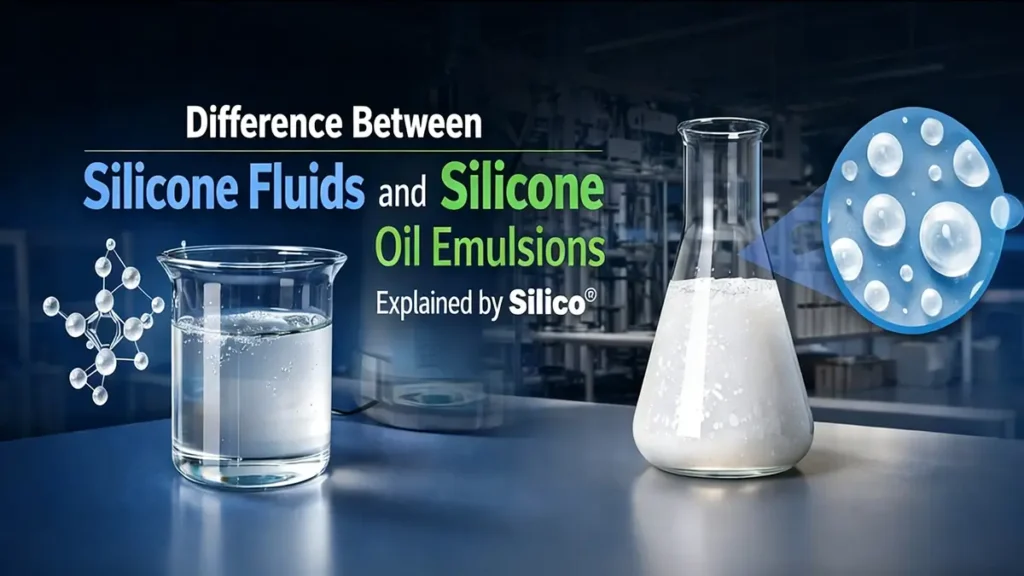
Many technical buyers and formulators are confused when evaluating the difference between silicone fluids and silicone oil emulsions. Although both originate from Polydimethylsiloxane (PDMS), their phase structure, working mechanism, and processing behavior differ fundamentally.
Search queries such as silicone fluid vs emulsion compatibility in water-based coatings or industrial silicone release agent emulsion for rubber molding reflect a strong demand for a clear, visual, engineering-oriented comparison.
As an industrial silicone solution provider, Silico® helps engineers and procurement teams distinguish between silicone fluids and silicone oil emulsions to ensure correct material selection, optimized performance, and cost efficiency.
| Aspect | Silicone Fluids | Silicone Oil Emulsions |
|---|---|---|
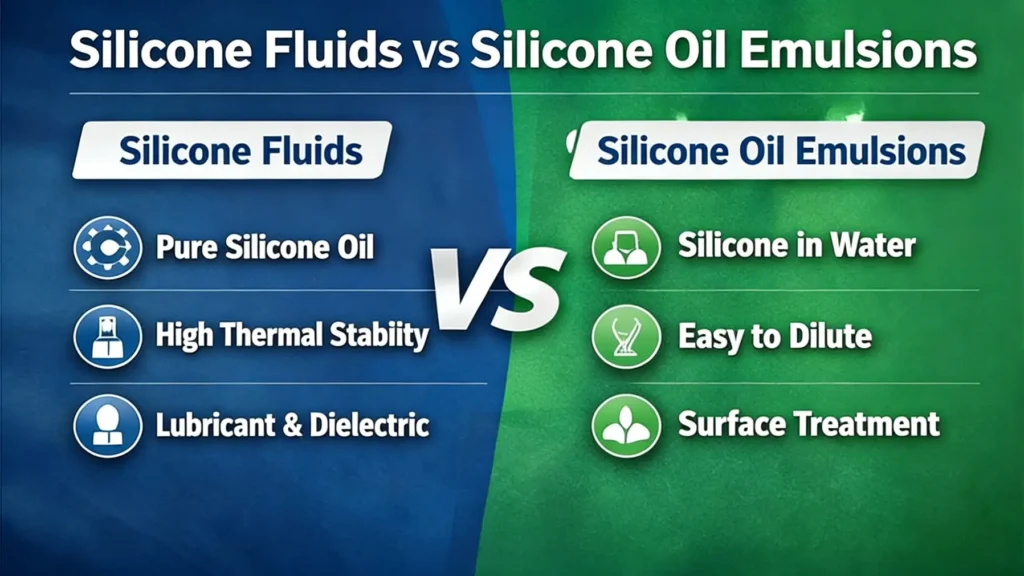
| Physical Form | Clear, homogeneous liquid | Milky or translucent aqueous dispersion |
| Phase Structure | Single-phase polymer | Two-phase (silicone + water) |
| Water Content | None | Typically 40–90% |
| Emulsifier | Not required | Essential for stability |
| Working Mechanism | Direct silicone film | Droplet deposition after water evaporation |
| Processing System | Oil-based / non-aqueous | Water-based formulations |
| Typical Viscosity Control | Polymer chain length | Droplet size + oil viscosity |
| VOC Profile | Higher | Low / water-based |
| Industry | Preferred Form | Reason |
| Textile Finishing | Silicone Emulsion | Softness, sewability, uniform handle |
| Personal Care | Silicone Emulsion | Non-greasy feel, water compatibility |
| Rubber & Plastics Release | Silicone Emulsion | Clean demolding, even coverage |
| Industrial Lubrication | Silicone Fluid | Direct lubricity, thermal stability |
| Electrical & Electronics | Silicone Fluid | Dielectric reliability |
| Papermaking Defoaming | Silicone Emulsion | Fast dispersion, effective foam control |
| Construction Waterproofing | Silicone Emulsion | Water-based application, repellency |
| Item | Silicone Fluids | Silicone Oil Emulsions |
| Main Advantages | Max stability, direct lubrication | Easy handling, uniform coverage, low VOC |
| Main Limitations | Poor water compatibility | Stability depends on emulsifier |
| Typical Issues | Application difficulty in water | Separation, coalescence if poorly designed |
| Common SEO Queries | silicone oil vs emulsion compatibility | silicone emulsion stability troubleshooting |
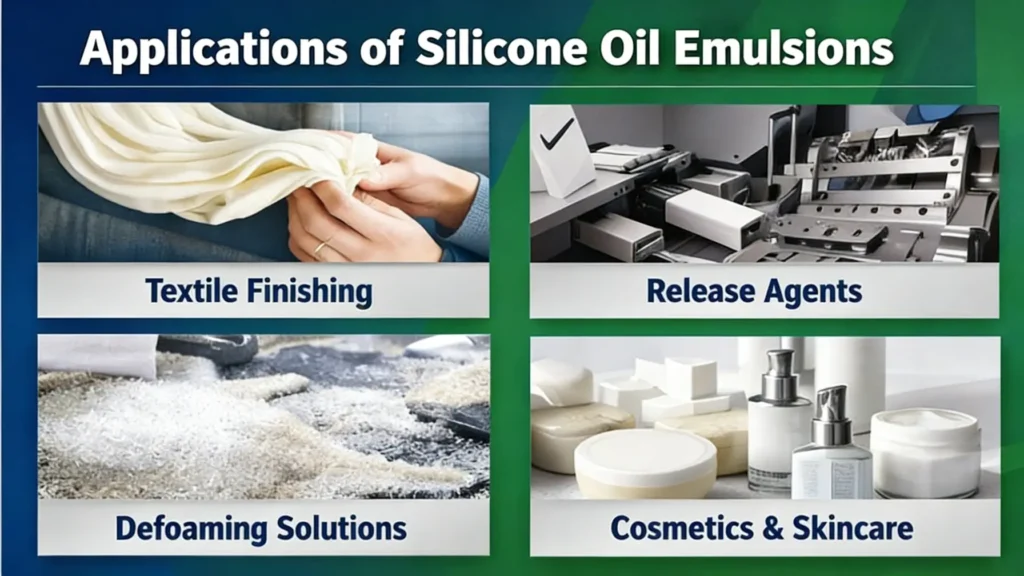
The fundamental difference between silicone fluids and silicone oil emulsions lies in their phase structure and working mechanism. Silicone fluids excel in neat polymer environments requiring thermal, mechanical, and dielectric reliability, while silicone oil emulsions enable efficient silicone delivery in aqueous systems such as textiles, coatings, cosmetics, defoaming, and construction.
Supported by application-driven formulation expertise, Silico® provides both silicone fluids and silicone oil emulsions, helping manufacturers balance performance, processing efficiency, and cost control through 2026 and beyond.