2026-02-25

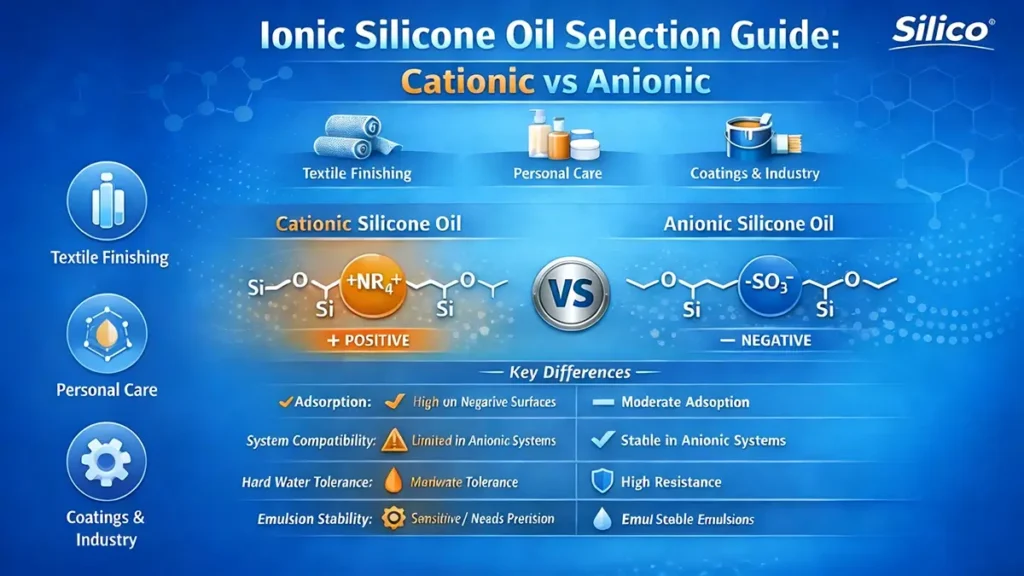
Ionic silicone fluids (also known as silicone oils) play an increasingly important role in modern water-based and functional formulations where surface activity, lubrication, adsorption efficiency, and system compatibility must be carefully balanced. By introducing ionizable functional groups into conventional silicone structures, ionic silicone fluids significantly expand the application range of traditional silicone materials.
With long-term experience in silicone material technologies, Silico® focuses on application-driven silicone solutions designed to meet the stability, compatibility, and performance requirements of textile finishing, personal care, coatings, and industrial processing systems.Ionic silicone fluids are a class of functional silicone materials derived from traditional polydimethylsiloxane (PDMS) through targeted chemical modification. By introducing ionizable functional groups into the polymer backbone or side chains, these fluids acquire the ability to carry electrical charges in aqueous or interfacial environments.
This ionic functionality allows the silicone fluid to combine the intrinsic low surface energy and lubrication properties of PDMS with surfactant-like interfacial activity, enhancing its performance in complex formulations.
Compared with conventional non-ionic silicone fluids, ionic silicone fluids offer:
Superior compatibility and long-term performance in multi-component formulations
Due to these advantages, ionic silicone fluids are widely applied in functional silicone fluid emulsions, surface treatment agents, and high-value specialty formulations.

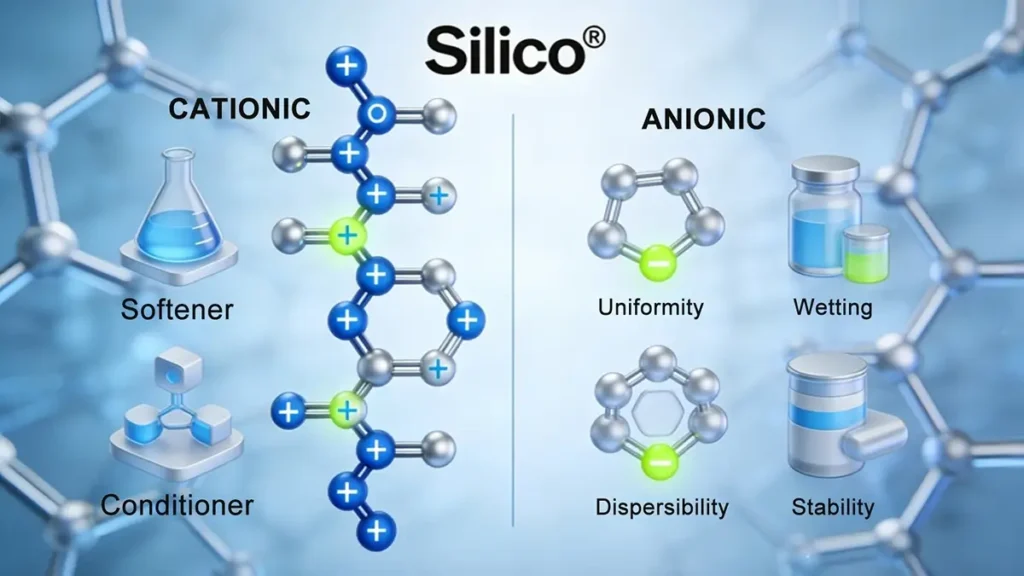
Cationic silicone fluids contain positively charged functional groups, most commonly quaternary ammonium structures. Due to electrostatic attraction, they exhibit strong affinity for negatively charged substrates such as textile fibers and hair surfaces.
Typical performance characteristics include:
Anionic silicone fluids incorporate negatively charged groups such as sulfonic or carboxylic acid derivatives. These materials are well suited for anion-dominated aqueous formulations where system stability and compatibility are critical.
Key advantages include:
Amphoteric silicone fluids contain both positive and negative charges, offering broader pH tolerance and improved formulation flexibility. They are often selected for high-end personal care products and technically demanding industrial formulations.
Ionic modification enables silicone fluids to deliver performance benefits beyond traditional lubrication and surface slip, including:
These advantages are particularly important in high-performance applications where non-ionic silicone fluids alone are insufficient.
| Parameter | Cationic Silicone Fluid | Anionic Silicone Fluid |
|---|---|---|
| Ionic charge | Positive (e.g., quaternary ammonium) | Negative (e.g., sulfonate, carboxylate) |
| Adsorption on substrates | Very strong on negatively charged surfaces | Moderate adsorption |
| Compatibility with anionic systems | Limited, requires careful formulation | Excellent compatibility |
| Emulsion stability | Sensitive to ionic balance | Generally more stable |
| Hard water tolerance | Moderate | Good |
| Electrolyte resistance | Lower | Higher |
| Particle size control | Requires optimized emulsification | Easier to maintain uniform dispersion |
| Primary application focus | Softening, antistatic, conditioning | Wetting, dispersion, formulation stability |
| Typical limitations | Risk of incompatibility with anionic additives | Lower surface adhesion strength |
Technical note: Ionic balance and surfactant selection play a decisive role in emulsion stability and overall performance. Higher ionic strength does not necessarily lead to better functional results.
Cationic silicone fluids are often preferred for their strong fiber adsorption, while anionic silicone fluids are selected where formulation compatibility with dyeing and finishing auxiliaries is critical.
At this application stage, Silico® silicone technologies are frequently evaluated for their balanced sensory performance, formulation compatibility, and consistency in large-scale manufacturing environments.
Anionic silicone fluids are commonly favored for their stability in resin–pigment systems.
Support for environmentally responsible, water-based processing systems

A system-level formulation approach consistently delivers more reliable results than focusing on a single performance parameter.
Comprehensive laboratory testing and compatibility evaluation are essential prior to commercial application.
Future development of ionic silicone fluids is expected to focus on:
These trends support the growing demand for high-performance and sustainable silicone technologies across multiple industries.

Ionic silicone fluids (also known as silicone oils) extend the functional capabilities of traditional silicone materials by combining surface activity, durability, and formulation compatibility. A clear understanding of molecular structure, ionic behavior, and application requirements enables more precise selection and more consistent performance outcomes.
Through continuous application research and material optimization, Silico® remains committed to supporting technically sound, application-focused silicone solutions that align with evolving industry standards and sustainability goals.