2026-04-08

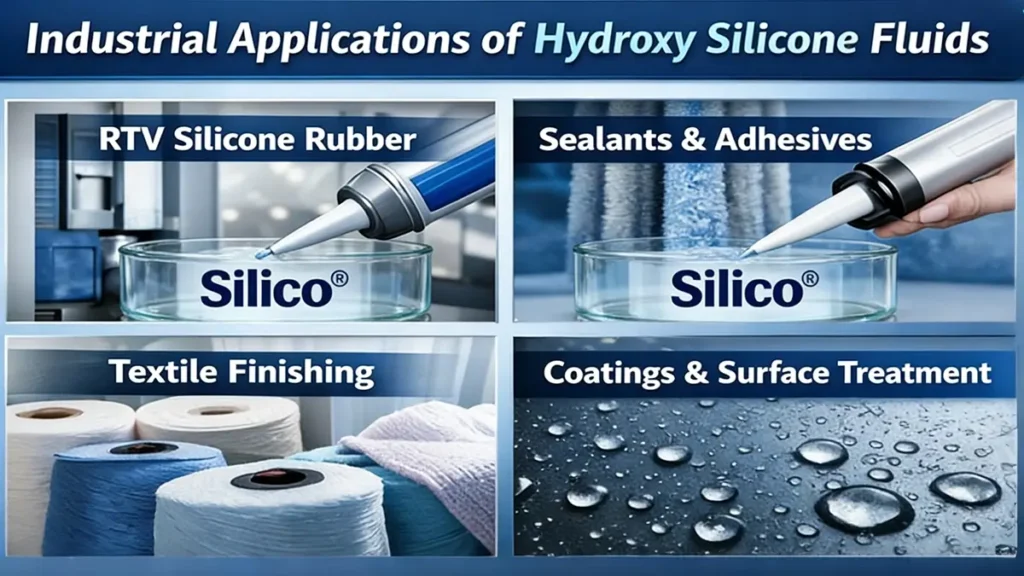
In industrial silicone manufacturing, hydroxy silicone fluids—also known as hydroxyl terminated silicone oil or OH-terminated PDMS—serve as critical base materials for a wide range of applications, including RTV silicone rubber, sealants, adhesives, coatings, and textile finishing systems.
With increasing demand for high-performance elastomers and environmentally resistant materials, manufacturers are actively searching for reliable hydroxy silicone fluid suppliers and optimized selection strategies. Choosing the correct material is essential, as it directly affects curing behavior, mechanical performance, and long-term durability.
Silico® provides a wide range of high-quality hydroxy silicone fluids designed to meet the demanding requirements of RTV silicone rubber, sealants, coatings, and textile applications worldwide.
Hydroxy silicone fluids are linear polydimethylsiloxane (PDMS) polymers terminated with silanol (–Si–OH) functional groups at both ends.
HO–(Si(CH₃)₂–O)n–H
These hydroxyl groups provide reactivity through condensation mechanisms, making these materials essential for:
Compared with non-reactive dimethyl silicone oil, hydroxy silicone fluids enable crosslinking and network formation, which are critical for structural and elastomeric applications.
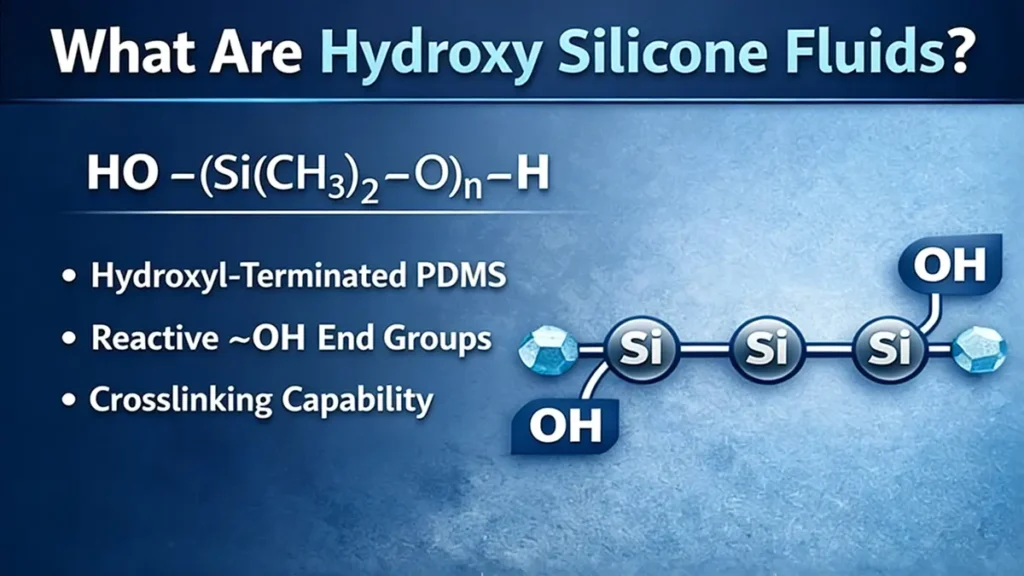
The unique combination of a flexible siloxane backbone and reactive hydroxyl end groups gives hydroxy silicone fluids their distinctive performance.
These characteristics make hydroxy silicone fluids indispensable in industrial silicone elastomers and advanced material formulations.
Hydroxy silicone fluids are widely used as the base polymer in RTV silicone rubber, especially in condensation curing systems. They react with silane crosslinkers to form durable elastomeric networks used in:
In industrial sealants and adhesives, hydroxyl terminated silicone oil delivers:
For textile finishing applications, hydroxy silicone fluids are used to:
They are widely applied in:
Hydroxy silicone fluids are also used in:
Manufacturers can choose from several types depending on application requirements:
Including:
At this stage, manufacturers often evaluate product consistency and technical support—factors where established suppliers such as Silico® are typically considered alongside other global silicone fluid producers.
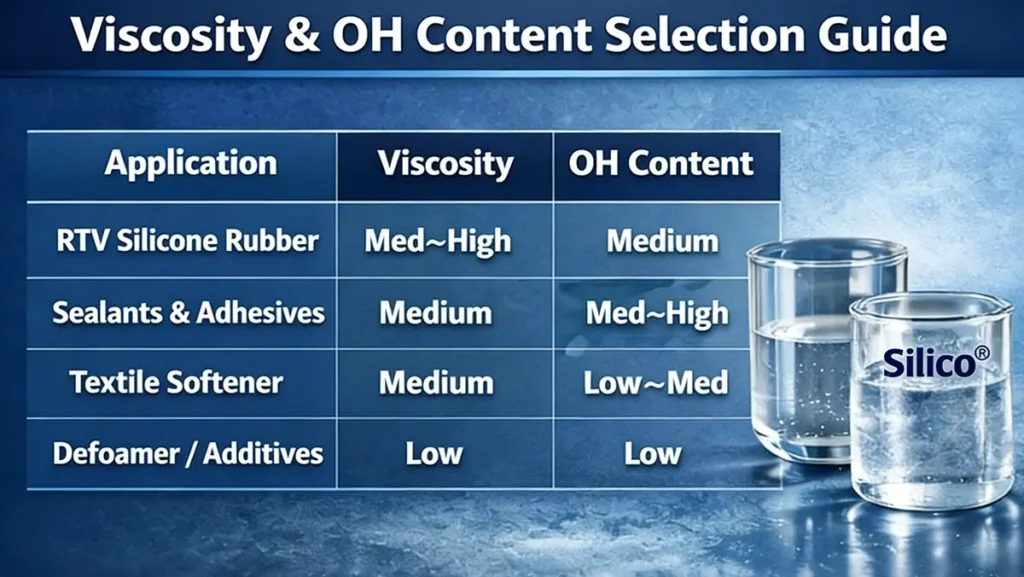
Selecting the right hydroxy silicone fluid requires a comprehensive evaluation of formulation and process requirements.
Higher OH content is typically preferred for fast-curing RTV sealants and adhesive formulations.
Optimizing viscosity and hydroxyl content is essential for achieving consistent performance in industrial formulations.
In practice, manufacturers often fine-tune these parameters to achieve the desired balance between processability, curing rate, and mechanical performance.
Si–OH + Si–OR → Si–O–Si + ROH
This reaction forms the backbone of moisture-curing RTV silicone systems, widely used in industrial sealants and elastomers.
Typical systems include:
Key factors include:
| Type | Reactivity | Typical Applications |
|---|---|---|
| Hydroxy Silicone Fluids | High | RTV, sealants, coatings |
| Dimethyl Silicone Oil | None | Lubrication, release |
| Vinyl Silicone Fluid | Medium | Addition-cure systems |
| Amino Silicone Fluid | Functional | Textile finishing |
Hydroxy silicone fluids remain the preferred option for applications requiring chemical reactivity and crosslinked network formation.
Hydroxy silicone fluids play a vital role in modern industrial silicone systems, enabling high-performance solutions across RTV silicone rubber, sealants, coatings, and textile applications.
For manufacturers, selecting the appropriate hydroxyl terminated silicone oil—based on viscosity, OH content, and formulation compatibility—is essential for achieving:
For manufacturers seeking consistent quality and technical support, Silico® hydroxy silicone fluids are widely recognized for their stable performance and suitability across diverse industrial applications.
Hydroxy silicone fluids typically have a 12–18 month shelf life under sealed, dry, and cool storage conditions.
Proper storage of hydroxyl terminated silicone oil is essential to prevent moisture exposure, viscosity changes, and premature reactions in RTV silicone applications.
No. Hydroxy silicone fluids are used in condensation-cure RTV silicone rubber systems.
Addition-cure systems require vinyl and Si–H functional silicone fluids. Incorrect selection can lead to poor curing performance.
Hydroxy silicone fluids function as structure control agents, improving:
They are widely used to optimize silicone rubber manufacturing efficiency and consistency.
Yes. Due to low surface tension and reactive OH groups, hydroxy silicone fluids provide:
They are commonly used in coatings, textile finishing, and surface treatment applications.
Curing speed depends on:
Optimizing these parameters ensures controlled curing and stable final performance.