• Home » News » What Is the Difference Between Dimethicone and PDMS?

What Is the Difference Between Dimethicone and Polydimethylsiloxane (PDMS)?

What Is the Difference Between Dimethicone and Polydimethylsiloxane (PDMS)

Dimethicone and Polydimethylsiloxane (PDMS) are linear polydimethylsiloxane polymers with minor differences in naming, viscosity, and end groups. This guide compares their performance in cosmetics, microfluidics, and industrial uses, covering safety, regulatory, and environmental considerations to help formulators, materials engineers, and procurement specialists make informed selections.

1. Quick Summary (TL;DR)

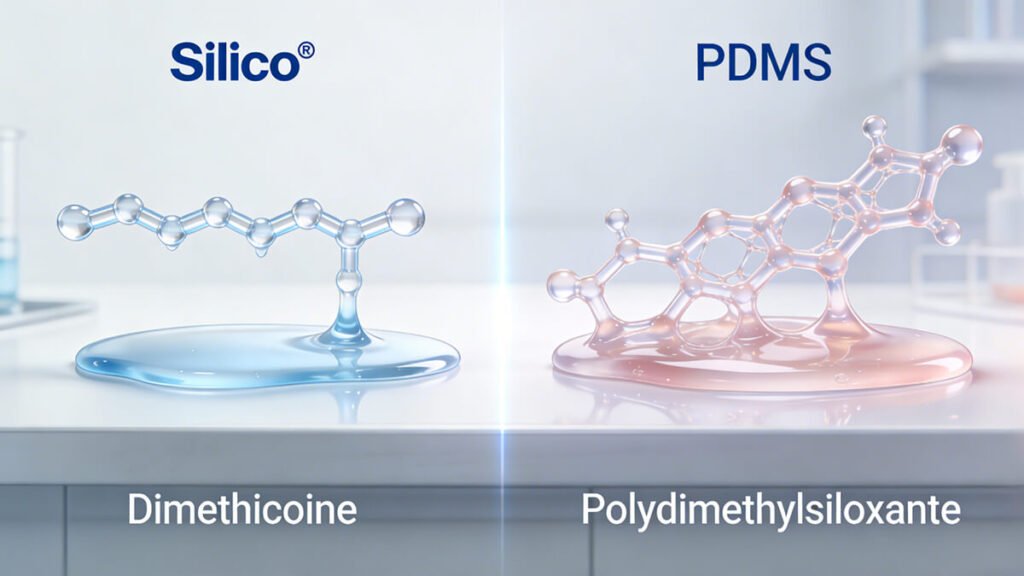
Dimethicone is the INCI name widely used in cosmetics, while PDMS (Polydimethylsiloxane) is the scientific/materials-science term for the same class of linear dimethylsiloxane polymers.
In most practical situations, Dimethicone = PDMS, but commercial products may differ in:

  • viscosity / molecular weight
  • end-group type (e.g., trimethylsilyl-terminated or hydroxyl-terminated)
  • purity and cyclic siloxane residue (D4/D5)

Silico® PDMS fluids are available across multiple viscosity grades with cosmetic- and industrial-grade purities.

2. Definitions: What Exactly Are Dimethicone and PDMS?

PDMS – Polydimethylsiloxane (Scientific / Industrial Term)

A linear silicone polymer consisting of repeating –Si(CH₃)₂–O– units.
Covers a broad spectrum—from low-viscosity silicone fluids to high-molecular-weight elastomers, and even crosslinked RTV/HCR silicone rubbers.

Dimethicone – INCI Term (Cosmetics & Personal Care)

Used in ingredient lists to refer specifically to linear PDMS fluids used in skincare, haircare, makeup and OTC skin protectants.
In cosmetic industry usage:
Dimethicone ≈ PDMS (non-reactive, trimethylsilyl-terminated grades).

Both names describe the same underlying chemistry, but their market context differs.

3. Chemical Structure, Molecular Weight & End Groups

Shared core structure

Both PDMS and Dimethicone share the identical backbone:
–Si(CH₃)₂–O–
This confers:
  • extremely low surface tension
  • hydrophobicity
  • high thermal stability
  • chemical inertness
  • lubricity & smooth sensory feel

Where differences appear

  1. Molecular weight / viscosity
    • Can range from <10 cSt to >300,000 cSt.
    • Affects flow, film-forming, volatility, sensory feel, lubrication and barrier properties.

  2. End groups (termination)
    • Trimethylsilyl-terminated (CH₃)₃Si– → common cosmetic Dimethicone (non-reactive, stable).
    • Hydroxyl-terminated (–OH) → reactive; used for crosslinking RTV silicones.
    • Functional groups (amino, polyether, epoxy, etc.) → enhance compatibility and reactivity for targeted applications.
  3. Purity & cyclic siloxane residue
    • Cosmetic regulations often specify maximum allowable D4/D5/D6 content.

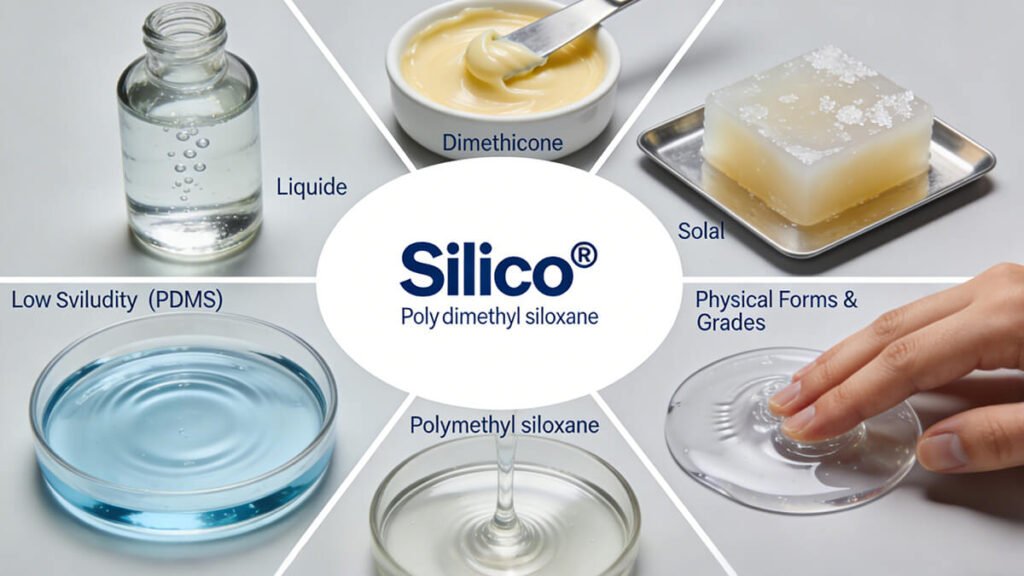
4. Physical Forms & Grades

  • Slip agents
  • Anti-foam agents
  • Light sensory enhancers
  • Skin-conditioning agents
  • Conditioning & shine enhancers in haircare
  • Film-forming & water-repellent functions
  • Industrial lubricants & dielectric fluids

Crosslinked PDMS (elastomers / gels / rubbers)

  • Microfluidics molds
  • Medical tubing
  • Seals, gaskets, and potting materials
Commercial PDMS/Dimethicone selection is primarily based on viscosity + end groups.
Dimethicone and Polydimethylsiloxane (PDMS) Physical Forms

5. Functional Performance & Application Comparison

Cosmetics & Personal Care (INCI: Dimethicone)

Dimethicone is prized for:
  • silky, non-greasy sensory feel
  • smoothing & filling effects (blurring fine lines)
  • water resistance & barrier formation
  • reducing tackiness in emulsions
  • spreading and slip in makeup
  • hair conditioning, frizz control, shine enhancement
    Widely used in moisturizers, sunscreens, foundations, primers, shampoos, conditioners, and styling products.

Medical, Microfluidics & Research (PDMS)

PDMS is dominant due to:
  • optical clarity
  • gas permeability
  • tunable elasticity
  • biocompatibility
    Used in:
  • microfluidic chips (soft lithography)
  • organ-on-chip systems
  • medical films, dressings, and implants

Industrial (PDMS fluids & modified silicones)

Common roles:
  • defoamers (food-grade & industrial)
  • lubricants and anti-friction agents
  • release agents
  • insulating fluids
  • heat-stable hydraulic media
Silico® industrial-grade PDMS fluids offer high thermal stability and low volatility for demanding applications.

6. Regulatory & Safety Considerations

Cosmetics — CIR & EWG

CIR (Cosmetic Ingredient Review) confirms:
  • Dimethicone and PDMS are safe in common cosmetic concentrations.
    Concerns generally relate to impurities, not PDMS itself.

FDA

Dimethicone is an approved skin protectant in OTC monographs.

EFSA (EU Food Safety Authority)

PDMS (E900) is permitted as an anti-foaming agent under specific purity and residue limits.

Key point

Safety evaluation focuses on:
  • residual cyclic siloxanes (D4, D5, D6)
  • catalyst residues
  • application route (topical > oral > inhalation)

7. Environmental Concerns & Cyclic Siloxanes

The environmental debate centers mainly around:

Cyclic siloxanes (D4, D5, D6)

  • potential bioaccumulation
  • volatility and persistence

Linear PDMS (Dimethicone)

  • very low volatility
  • low bioavailability
  • tends to degrade slowly in soil via siloxane bond cleavage mechanisms
Regulators in EU and Canada closely monitor D4/D5 limits, especially in rinse-off cosmetics.

8. How to Choose Dimethicone / PDMS (Practical Guide)

Step 1 — Define the function

  • Lightweight feel → 10–50 cSt
  • Film-forming / long-lasting barrier → 350–20,000 cSt
  • Hair shine / frizz control → 50–1,000 cSt
  • Lubrication / defoaming → grade-dependent
  • Crosslinking (sealants, elastomers) → hydroxyl-terminated PDMS

Step 2 — Choose the correct end-group

  • Trimethylsilyl-terminated → inert, ideal for cosmetics
  • Hydroxyl-terminated → reactive silicone base polymer

Step 3 — Confirm purity & cyclic siloxane levels

  • Especially for cosmetics, food-contact, and medical applications

Step 4 — Request documentation

  • COA
  • MSDS
  • GC–MS analysis for cyclic siloxanes
  • Compatibility & stability data

Step 5 — Vet suppliers

  • Reliable suppliers like Silico® provide stable quality, consistent viscosity profiles, and low-residue cosmetic-grade PDMS.
Dimethicone and PDMS Related FAQs

Q1. Are Dimethicone and PDMS the same?

Yes. In most contexts, Dimethicone is the cosmetic-industry name for linear PDMS. Differences primarily involve viscosity and end-group modification.

Q2. Does Dimethicone clog pores?

Dimethicone is generally non-comedogenic, hypoallergenic and well-tolerated. As with any ingredient, sensitive users may patch-test.

Q3. Should I worry about environmental accumulation?

The primary concern involves cyclic siloxanes (D4/D5/D6).
Linear PDMS/Dimethicone exhibits significantly lower environmental persistence and bioaccumulation.

Q4. Is PDMS safe for skin?

CIR, FDA and dermatological literature classify Dimethicone/PDMS as safe when used as intended in cosmetic formulations.

Popular Recommendations

Get a Catalog & Best Price​

  • Quick and helpful reply within 24 hours;
  • Tailored solutions provided for your project;
  • One-stop purchasing service.
Please enable JavaScript in your browser to complete this form.
  • © Copyright 2022 Silico® . All Rights Reserved.
Scroll to Top