2026-09-08

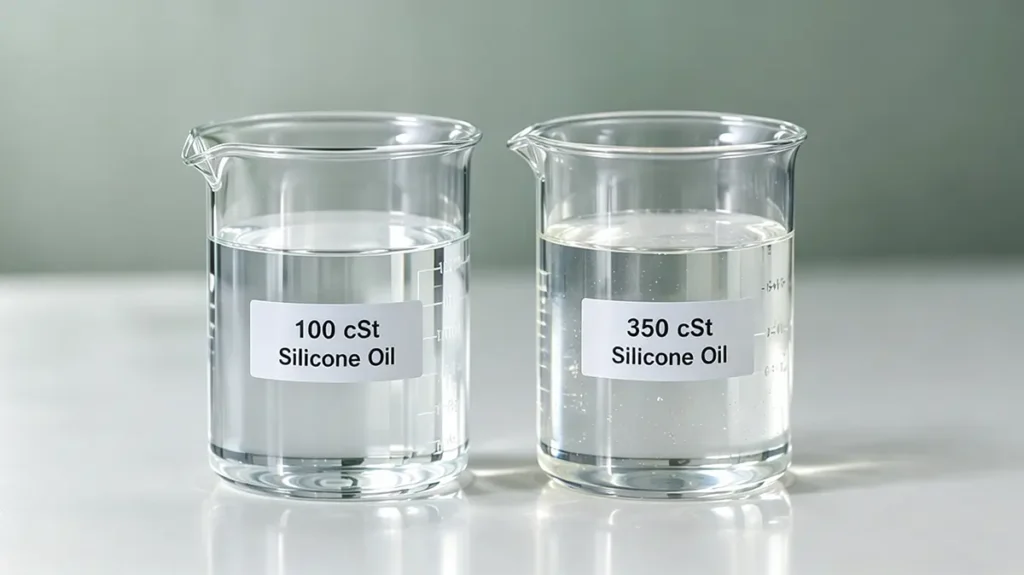
100 cSt and 350 cSt silicone oil are two common viscosity grades of PDMS (polydimethylsiloxane) silicone fluid. The main difference is viscosity, but that difference affects flow, film retention, lubrication, damping, pumping, and application behavior.
At 25°C, 350 cSt has 3.5 times the nominal kinematic viscosity of 100 cSt. This does not mean it flows exactly 3.5 times more slowly, because actual flow also depends on pressure, pipe geometry, pump design, temperature, and shear conditions.
In general, 100 cSt provides easier flow and spreading, while 350 cSt provides greater resistance to flow and better film persistence. The right grade depends on the application rather than viscosity alone.
For industrial users evaluating PDMS viscosity grades, Silico® provides standard silicone fluids including 100 cSt and 350 cSt grades for applications such as lubrication, mold release, damping, surface treatment, and electrical applications.
100 cSt and 350 cSt silicone oils normally refer to PDMS silicone fluids with different kinematic viscosities.
The unit cSt, or centistokes, is used to express kinematic viscosity:
1 cSt = 1 mm²/s
Therefore:
Commercial PDMS viscosity is commonly specified at 25°C, although the actual test temperature and method should always be confirmed in the technical data sheet.
Both grades are clear, chemically stable silicone fluids, but their different viscosities produce noticeably different processing and application behavior. Dow, for example, lists both 100 cSt and 350 cSt PDMS products, with applications ranging from heat-transfer fluids and mechanical-fluid systems to release, lubrication, damping, and specialty formulations.

100 cSt is the lower-viscosity grade of the two.
It generally provides:
These characteristics make 100 cSt useful where flowability and processing efficiency are important.
350 cSt has substantially higher viscosity and therefore greater resistance to flow.
It generally provides:
Silico®’s 350 cSt PDMS, for example, is specified at 350 cSt at 25°C and is positioned for applications including release agents, damping and vibration control, lubrication, heat transfer, electrical insulation, and surface treatment.
| Property | 100 cSt | 350 cSt |
|---|---|---|
| Kinematic viscosity at 25°C | 100 cSt | 350 cSt |
| Relative viscosity | 1× | 3.5× |
| Flowability | Higher | Lower |
| Pumping resistance | Lower | Higher |
| Surface spreading | Faster | Slower |
| Film retention | Moderate | Higher |
| Lubrication persistence | Good | Higher |
| Damping contribution | Lower | Higher |
| Mixing and metering | Easier | More demanding |
| Thin-film application | More suitable | Suitable |
| Persistent-film application | Suitable | More suitable |
The key point is that 350 cSt is not simply a “better” version of 100 cSt.
It is a different viscosity grade intended to provide different rheological behavior.

Viscosity directly affects fluid movement through pumps, pipes, valves, nozzles, and metering systems.
Under comparable conditions, 100 cSt PDMS is easier to circulate than 350 cSt PDMS.
This can matter in:
When changing from 100 cSt to 350 cSt, the pump pressure, dosing rate, nozzle performance, or mixing time may need to be adjusted.
100 cSt silicone oil generally spreads more easily and is therefore useful when a relatively thin and uniform film is required.
350 cSt moves more slowly and tends to provide greater film persistence.
This distinction is useful in:
For example, a spray-applied release agent may favor 100 cSt when rapid coverage is important, while a process requiring greater film retention may benefit from 350 cSt.
Actual release performance, however, also depends on concentration, substrate, mold temperature, carrier system, and application rate.
Both grades can be used as silicone lubricants, but their behavior differs.
100 cSt is generally more suitable when:
350 cSt can be advantageous when:
The correct silicone oil viscosity for lubrication therefore depends on equipment speed, load, temperature, clearance, and lubrication method.
Higher viscosity generally increases resistance to fluid movement, which is why higher-viscosity PDMS grades are commonly considered for damping applications.
Between these two grades:
100 cSt → lower fluid resistance
350 cSt → higher fluid resistance
350 cSt may therefore be preferable for applications requiring greater damping, such as precision instruments, mechanical dampers, and vibration-control systems.
However, the correct damping viscosity cannot be selected from viscosity alone. Damper geometry, operating temperature, piston speed, clearance, and required damping characteristics must also be considered.
Silicone-fluid technical literature identifies PDMS grades as damping fluids, while commercial 350 cSt products are also marketed for high damping performance.
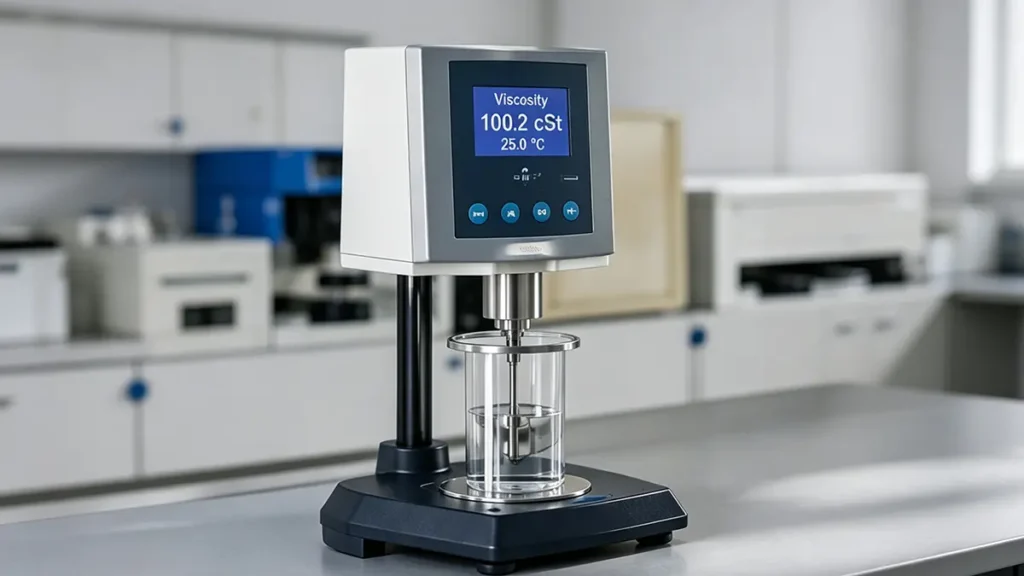
A simple selection rule is:
A practical comparison is:
| Application Requirement | Starting Grade |
|---|---|
| Fast spreading | 100 cSt |
| Spray application | 100 cSt |
| Easy pumping | 100 cSt |
| Fine metering | 100 cSt |
| High circulation rate | 100 cSt |
| Thin-film coating | 100 cSt |
| Persistent lubrication | 350 cSt |
| Damping | 350 cSt |
| Vibration control | 350 cSt |
| Greater film retention | 350 cSt |
These are starting points rather than fixed specifications. Actual performance should be confirmed under the intended operating conditions.
Temperature is critical when comparing silicone fluid viscosity grades.
As temperature increases, PDMS viscosity decreases.
As temperature decreases, PDMS viscosity increases.
Therefore, a silicone oil specified as 100 cSt at 25°C will not have a viscosity of exactly 100 cSt at its operating temperature.
The same applies to 350 cSt.
For equipment design, the more useful question is:
What viscosity will the silicone fluid have at the actual operating temperature?
This is particularly important for:
Commercial PDMS data also show that viscosity and other physical properties are normally reported together with a reference temperature.
Both viscosity grades can be considered for heat-transfer applications, but the lower viscosity of 100 cSt can provide an advantage where circulation is important.
A circulating system should consider:
Higher viscosity does not automatically mean better heat-transfer performance.
For example, Dow lists a 100 cSt PDMS product specifically for heat-transfer applications and reports a thermal conductivity of 0.11 W/m·K.
The appropriate grade should therefore be selected according to the complete thermal-fluid system rather than viscosity alone.
Compatible PDMS fluids can generally be blended to obtain an intermediate viscosity.
However, a 50:50 mixture of 100 cSt and 350 cSt does not necessarily produce 225 cSt.
Viscosity does not change linearly with blend ratio because it is related to polymer molecular weight and molecular-weight distribution.
For production use, the blend should be:
If a tight viscosity specification is required, a commercially manufactured grade may be preferable to in-house blending.
Yes. At the same reference temperature, 350 cSt has 3.5 times the nominal kinematic viscosity of 100 cSt.
100 cSt flows and spreads more easily, while 350 cSt provides greater resistance to flow and generally better film retention.
Neither is universally better. 100 cSt is generally preferred for flow and processing, while 350 cSt can be more suitable for damping, persistent lubrication, and film retention.
Typical applications include lubrication, mold release, surface treatment, coatings, heat-transfer systems, and other applications requiring relatively easy flow.
Common applications include lubrication, damping, mold release, surface treatment, electrical applications, and formulations requiring higher viscosity.
Generally, the higher viscosity provides greater resistance to fluid movement, making 350 cSt a reasonable starting point for applications requiring more damping than 100 cSt.
Only if the application can tolerate the lower viscosity. A change may affect film retention, damping, lubrication, and processing behavior.
Not automatically. Higher viscosity can increase pumping resistance and affect spraying, mixing, metering, and circulation.
Yes. PDMS viscosity decreases as temperature increases and increases as temperature decreases.
Yes, compatible grades can generally be blended, but the final viscosity should be measured rather than calculated as a simple average.

The difference between 100 cSt and 350 cSt silicone oil is primarily a difference in viscosity, but that difference has practical consequences for processing and application performance.
100 cSt: easier flow, faster spreading, lower pumping resistance, and easier metering.
350 cSt: higher flow resistance, greater film retention, more persistent lubrication, and stronger damping contribution.
For applications focused on flow, spraying, circulation, or thin-film coverage, 100 cSt is often the logical starting point.
For applications where film persistence, damping, or lubricant retention is more important, 350 cSt may be more appropriate.
The final selection should be based on the actual operating temperature, equipment, application method, substrate, and performance requirement rather than viscosity alone.
For industrial users comparing 100 cSt vs 350 cSt PDMS, Silico® provides multiple standard silicone-fluid viscosity grades that can be evaluated according to specific processing and end-use requirements.