2026-03-16

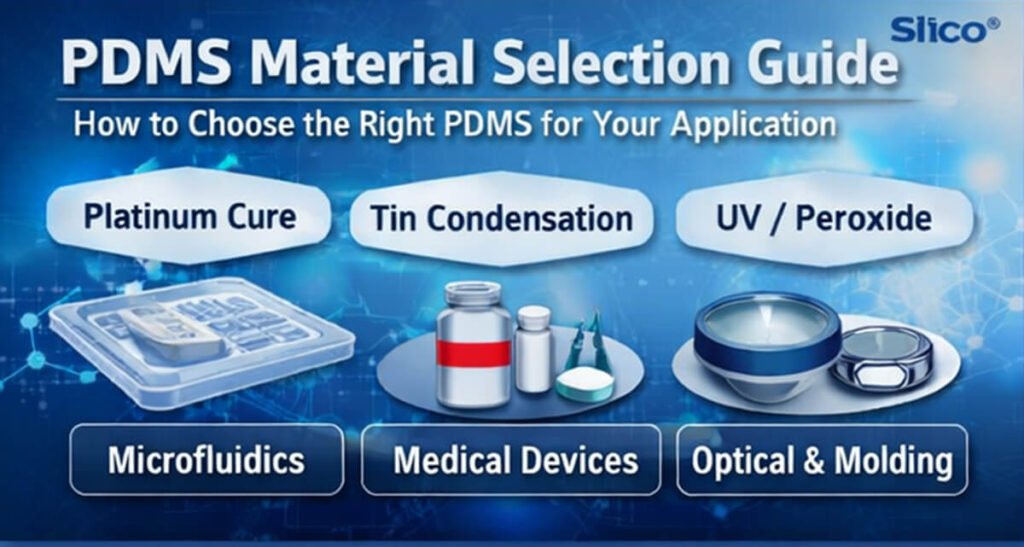
Polydimethylsiloxane (PDMS) is a highly versatile silicone material widely used in microfluidics, medical devices, optics, sealing, and mold-making applications. Selecting the appropriate PDMS requires careful evaluation of curing chemistry (platinum addition or tin condensation), key material properties such as viscosity, hardness, optical clarity, and thermal stability, as well as application-specific performance requirements. This guide provides a structured, engineering-focused approach to PDMS material selection, helping designers and manufacturers optimize reliability, processing efficiency, and long-term performance.
Advanced PDMS solutions from Silico® further support consistent quality and precise material control for demanding industrial and scientific applications.
Polydimethylsiloxane (PDMS) is a silicone-based polymer characterized by a flexible Si–O–Si backbone and methyl side groups. This molecular structure gives PDMS a unique balance of elasticity, stability, and chemical inertness, making it one of the most versatile materials in modern engineering and scientific applications.
Key advantages of PDMS include:
Because of these properties, PDMS is widely used in microfluidics, medical devices, optics, electronics encapsulation, sealing systems, and mold-making.
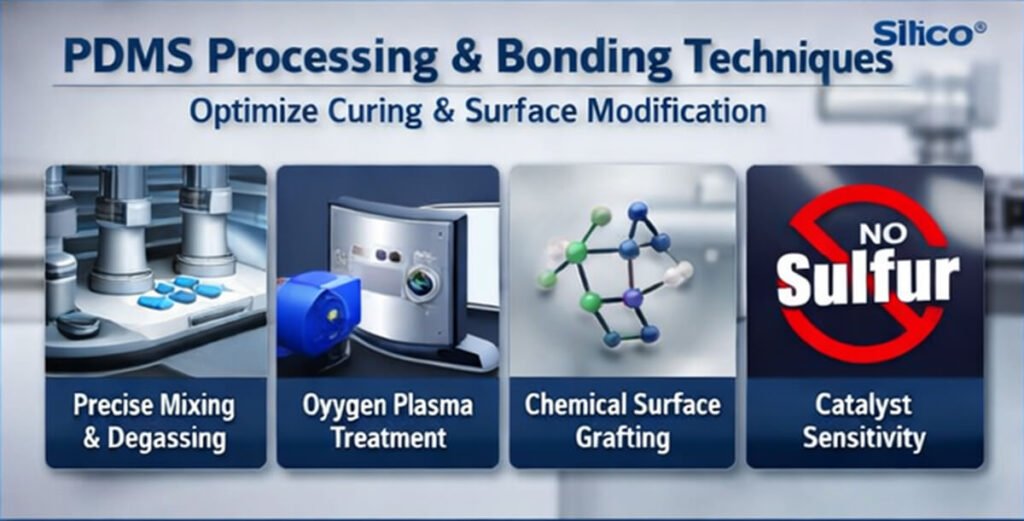
The curing or crosslinking mechanism is one of the most critical factors when selecting a PDMS material. It directly affects processing conditions, dimensional stability, by-products, odor, and long-term performance.
Reaction Mechanism
Vinyl-terminated PDMS reacts with Si–H groups via a platinum catalyst in a hydrosilylation reaction.
No volatile by-products are generated.
Typical Applications Microfluidic chips, optical lenses, medical components, precision encapsulation
High-purity platinum-cured systems such as those offered in the Silico® advanced PDMS portfolio are specifically engineered for low extractables and consistent batch-to-batch performance in critical applications.Reaction Mechanism
Crosslinking occurs through condensation reactions, releasing small molecules such as alcohol or water during curing.
Lower material cost
Reduced suitability for sealed, optical, or ultra-clean environments
Typical Applications RTV mold-making, rapid prototyping, general industrial parts
These systems are used for specialized or fast-curing formulations, including high-temperature rubber processing, UV-curable PDMS, and additive manufacturing applications. Careful control of residual initiators and thermal history is required.
Fast curing or special processing → UV or peroxide systems
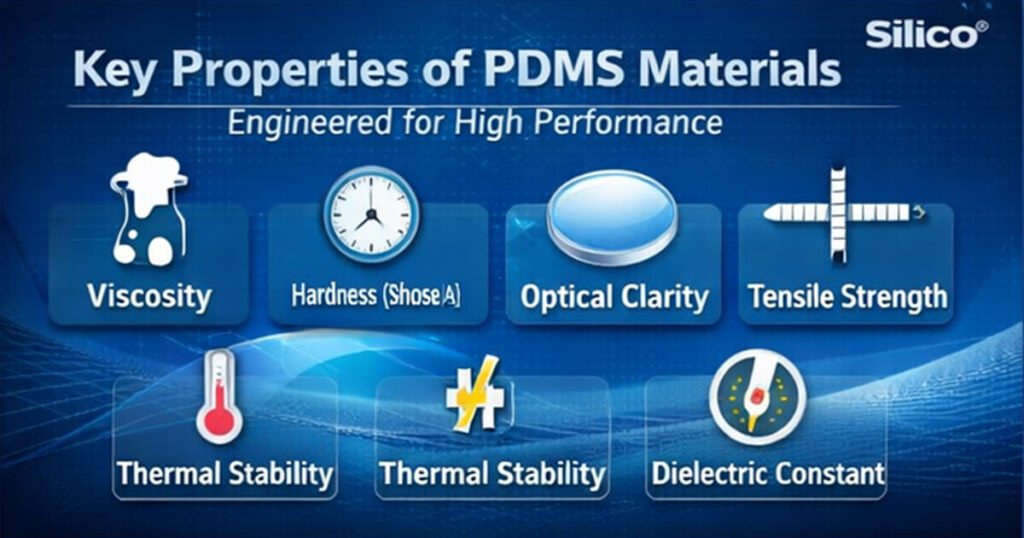
Electrical insulation strength
High-quality suppliers such as Silico® provide detailed TDS and batch consistency data to support accurate engineering validation.
By-product control: Condensation-cure systems require ventilation and caution in sealed molds
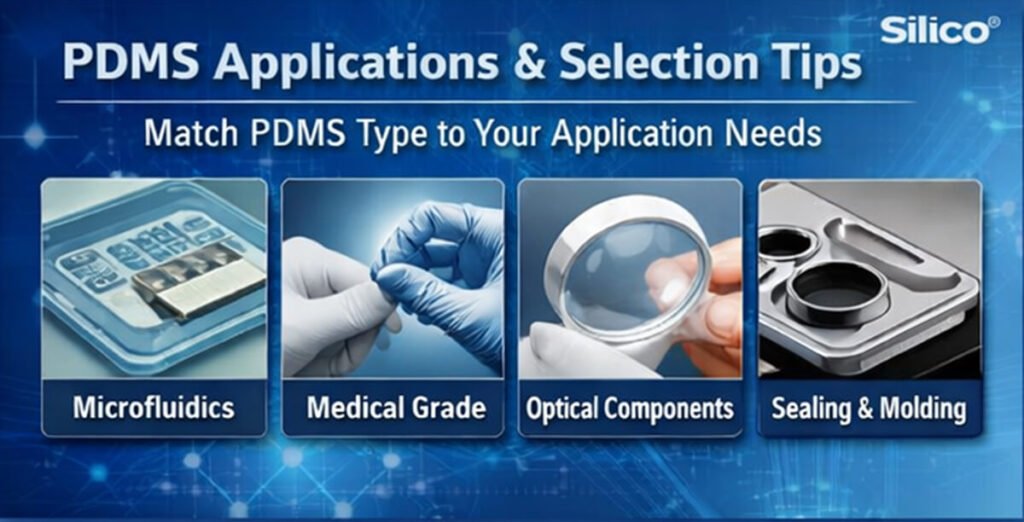
| Application Requirement | Recommended PDMS Type |
|---|---|
| Optical / Micro-structured parts | Platinum-cured, low-viscosity PDMS |
| Microfluidics / Biochips | Platinum-cured, plasma-bondable PDMS |
| Medical devices | Medical-grade platinum-cured PDMS |
| Sealing and durable parts | Addition or condensation cure (hardness-matched) |
| Low-cost molds and prototypes | Tin-cured RTV PDMS |
Selecting the right PDMS is not about choosing a “standard grade,” but about matching chemistry, processing behavior, and long-term performance to your application requirements. By combining proper material selection with controlled processing and validation, PDMS systems—such as those developed by Silico®—can deliver exceptional reliability across scientific and industrial applications.